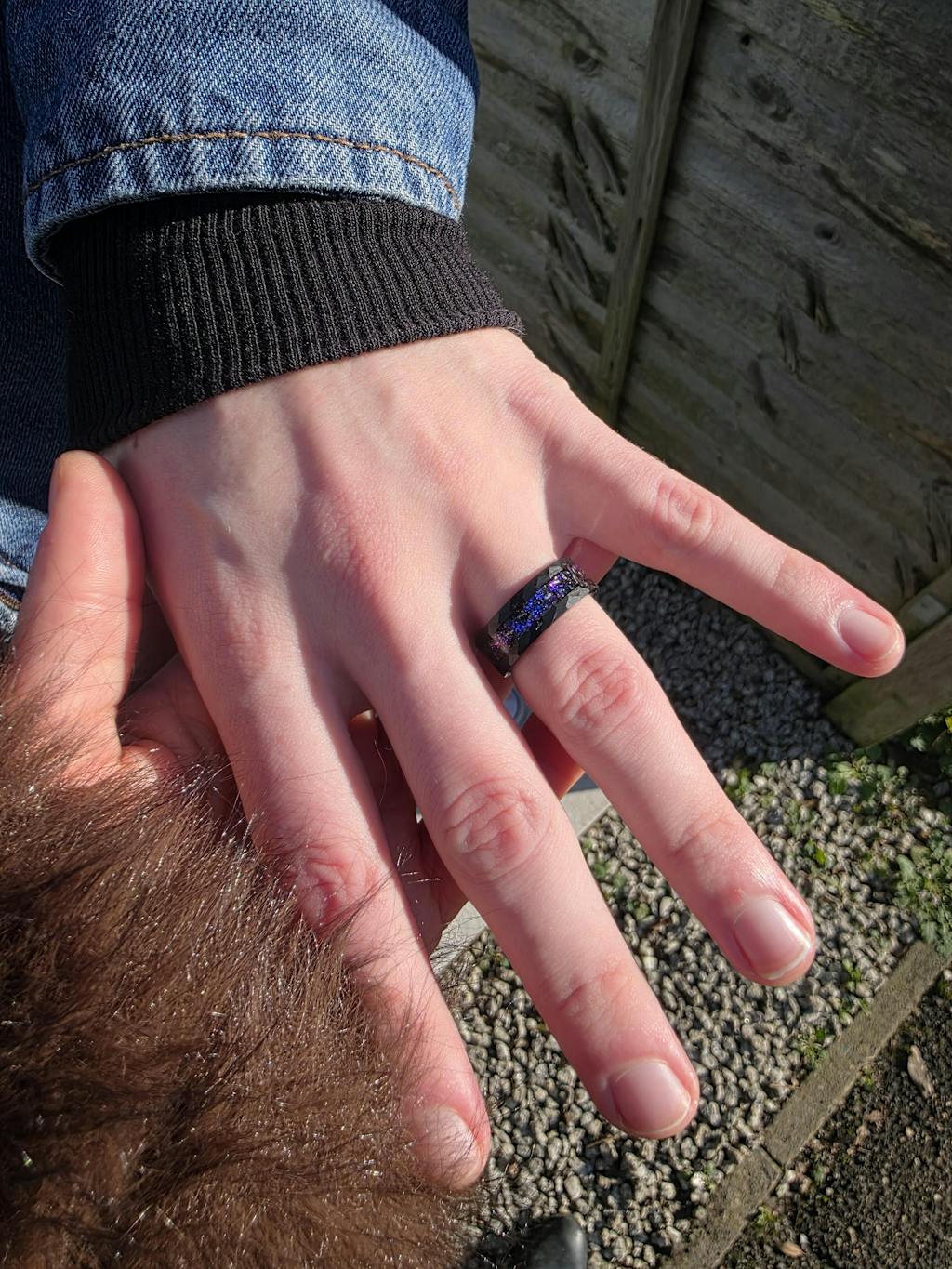
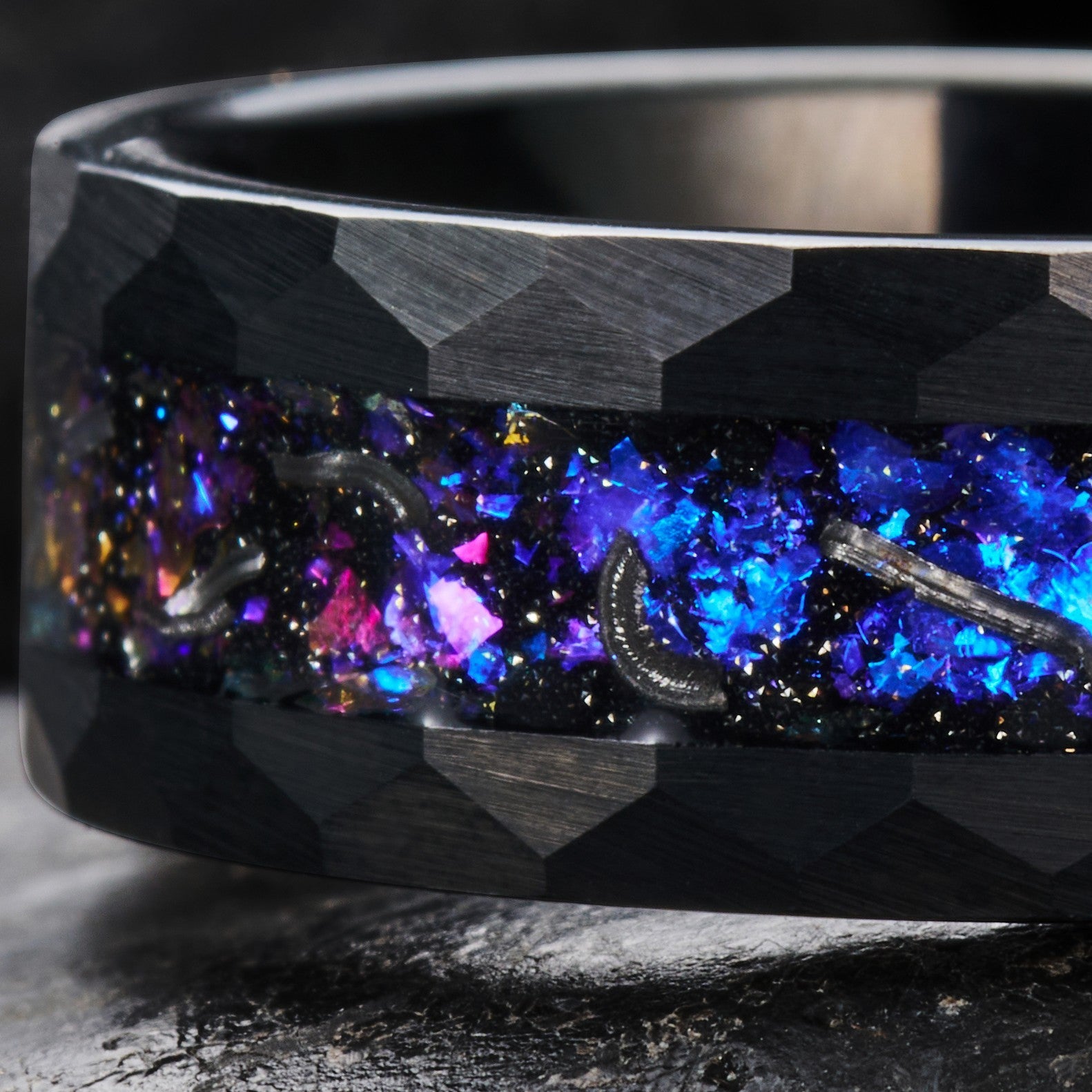
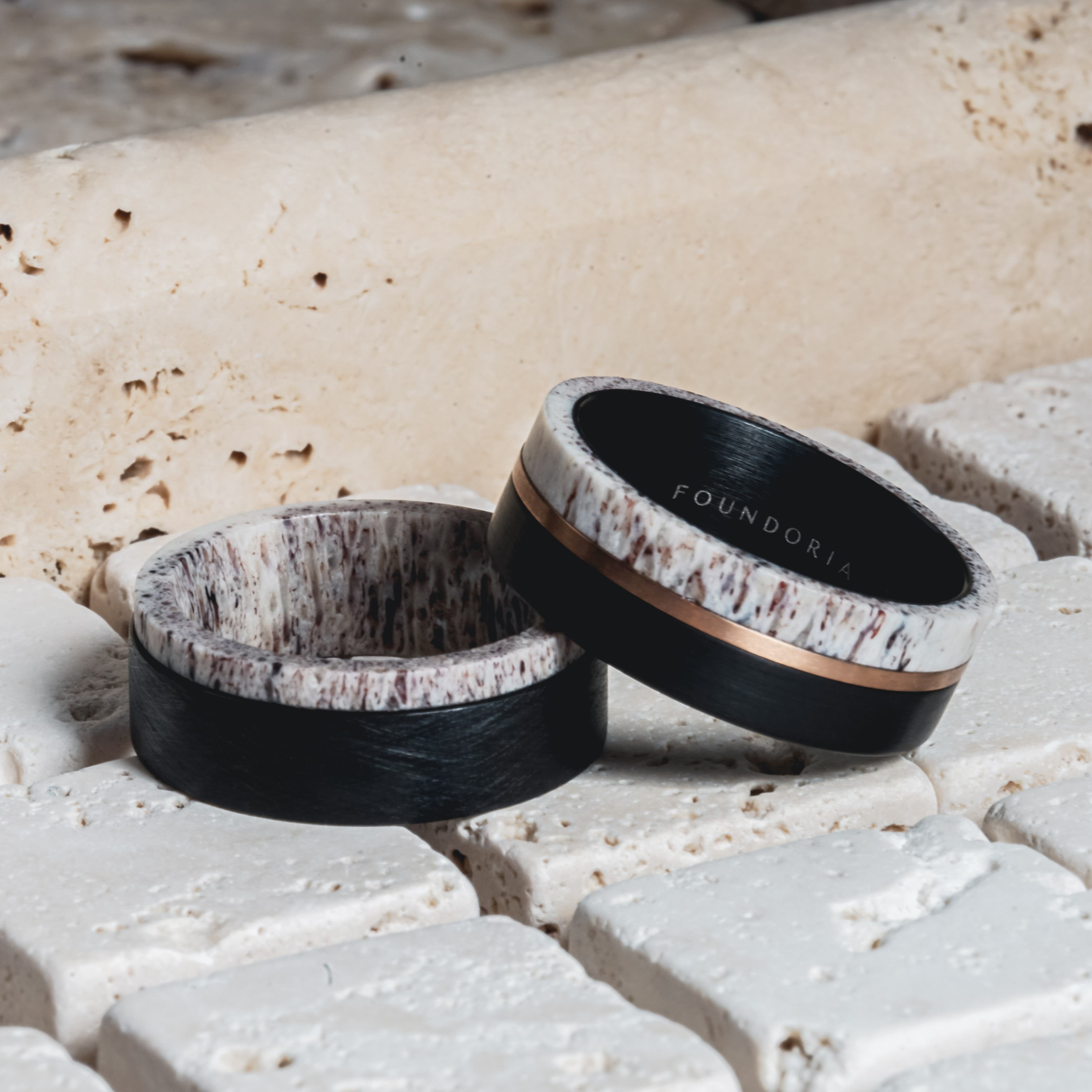
Hypoallergenic Rings Explained
Tested, certified, and safe for sensitive skin
Nickel allergy affects around 17% of women and 3% of men, making it one of the most common contact allergies worldwide. If you've ever experienced redness, itching, or irritation from jewellery — a ring that leaves a mark, a watch strap that makes your wrist flare — what you're reacting to is almost always nickel, regardless of what the metal was marketed as.
Every Foundoria ring is independently tested for safe skin contact by an IAS-accredited laboratory. Our titanium rings are biocompatible at the level used in surgical implants. Our tungsten carbide rings are manufactured with a low-nickel binder and verified to EN 1811:2023 — with nickel release measured below the laboratory detection limit. Our STRATUM carbon fibre range is completely metal-free for wearers with severe or multi-metal sensitivities.
What "Hypoallergenic" Actually Means
"Hypoallergenic" means a material is unlikely to cause an allergic reaction — not that it's guaranteed to cause none. The term isn't tightly regulated in jewellery, which means any manufacturer can print it on a product without independent verification. What actually matters is the metal composition, documented testing, and whether those tests reference established safety standards.
For rings specifically, the benchmark is REACH — the EU and UK regulation that sets strict limits on how much nickel a product in prolonged skin contact can release. The threshold is 0.5 micrograms of nickel per square centimetre per week. Below that, the material is legally considered safe for the vast majority of wearers, including those with mild nickel sensitivity.
The Nickel Problem: Nickel is the most common metal allergen, responsible for around 80% of metal-allergy reactions. It's used in many jewellery alloys to improve hardness, colour, or binding. Even trace amounts can trigger reactions in sensitised individuals — which is why REACH sets release thresholds rather than composition limits, and why independent testing matters more than marketing claims.
Common Signs of Metal Allergy
Metal allergy symptoms typically appear where jewellery contacts skin — around your finger, in the case of rings. Watch for:
Redness
Red, inflamed skin where the ring sits
Itching
Persistent itchiness that worsens with wear
Blisters
Fluid-filled bumps or weeping skin
Swelling
Finger becomes puffy or tight
Dry Patches
Cracked, flaky, or peeling skin
Burning Sensation
Feeling of heat or tenderness
Symptoms usually appear within 12 to 48 hours of initial contact, though some people develop sensitivity gradually after years of wearing problematic metals. This is called contact dermatitis — a type IV hypersensitivity reaction.
Safe vs Risky: Metal Allergy Guide
✓ Generally Safe for Sensitive Skin
- Titanium — Biocompatible, used in surgical implants. The gold standard for severe nickel allergies.
- Carbon Fibre — Completely metal-free. Definitive answer for multi-metal sensitivities.
- REACH-Tested Tungsten Carbide — Low-nickel binder, verified below the 0.5 μg/cm²/week threshold.
- Platinum (950+) — 95-98% pure, minimal allergens.
- 24K Gold — Pure gold with no alloys, but very soft and rarely used for rings.
- REACH-Tested Gold Alloys — 18K or rose gold verified for safe nickel release.
⚠ Often Problematic
- Unbranded Tungsten Rings — Cheap tungsten often uses high-nickel binders. Quality varies widely.
- White Gold (untested) — Commonly alloyed with nickel to achieve the white finish.
- 14K/18K Gold (untested) — May contain nickel, copper, or zinc depending on the mix.
- Rose Gold (untested) — Copper content can cause reactions even without true nickel allergy.
- Sterling Silver — 7.5% copper; can also contain trace nickel in some alloys.
- Brass or Bronze — High copper content. Often causes green skin staining.
- Costume Jewellery — Frequently uses high-nickel alloys with no disclosure.
Gold alloys and rose gold that have been independently tested to REACH standards are safe for most wearers — see below.
Why Our Tungsten Carbide Is Safe for Most Wearers
Tungsten carbide is a composite material: tungsten particles bonded together using a metallic binder. The binder is where the nickel question sits. Cheap, unbranded tungsten rings often use high-nickel binders to cut manufacturing costs — and for anyone with even a mild nickel sensitivity, these can absolutely trigger reactions.
Higher-grade tungsten carbide uses a low-nickel binder formulated specifically because the jewellery market now expects hypoallergenic performance. Every Foundoria tungsten ring is tested against REACH Annex XVII Item 27 using the current EN 1811:2023 method — and the nickel release results come back below the laboratory's detection limit of 0.05 μg/cm²/week. That's at least ten times lower than the REACH legal threshold of 0.5 μg/cm²/week for prolonged skin contact.
That makes our tungsten rings safe for the vast majority of wearers, including those with mild nickel sensitivity. It does not make them "nickel-free" — a claim you'll sometimes see made about tungsten that is rarely accurate, because the binder chemistry typically contains some nickel. The honest claim is low-nickel, independently tested, and measured below the detection limit.
Where Tungsten Isn't the Right Answer: For severe or medically-diagnosed nickel allergies, we'd always recommend a material that takes nickel out of the equation entirely. Titanium is biocompatible and used in surgical implants without issue. Carbon fibre is completely metal-free. Both sit above tungsten in our hierarchy for severely sensitised wearers.
The Four Qualities That Matter
✓ Low-Nickel Binder
Formulated for low nickel release, tested to sit well below the REACH threshold for prolonged skin contact.
✓ Inert & Stable
Tungsten carbide doesn't react with skin oils, sweat, or moisture. No tarnishing, oxidation, or chemical degradation.
✓ Non-Porous Surface
The dense, smooth finish prevents bacteria build-up and reduces skin irritation from trapped moisture.
✓ Independently Verified
Every batch is tested by independent laboratories. Certification documentation is available on request.
What About Natural Inlays?
Our rings feature natural materials — Scottish red deer antler, whisky and bourbon barrel oak, and genuine meteorite. These sit on the ring's exterior, and the comfort-fit interior means your skin primarily contacts the tungsten or titanium base rather than the inlay itself.
Natural inlays are sealed during manufacture to protect the material, but even unsealed, antler and wood rarely cause allergic reactions. Meteorite contains iron and nickel as part of its composition, but it's positioned on the outer surface and sealed — direct prolonged skin contact with the meteorite itself doesn't occur in normal wear.
What About Gold and Rose Gold Accents?
Some Foundoria rings feature rose gold or 18K gold inlays and accents. Untested gold alloys can contain nickel, copper, or zinc at unpredictable levels — which is why gold jewellery causes reactions for some wearers. Every Foundoria ring featuring gold elements is independently tested to REACH standards, verifying that nickel release from any gold components falls within the legal safe limit.
Combined with our comfort-fit design — where your skin primarily contacts the tungsten or titanium base rather than the accent material — our gold-accented rings are safe for the vast majority of wearers.
The Difference Testing Makes: Untested gold jewellery is a gamble — you don't know what's in the alloy or how much nickel it releases. REACH-tested gold has been independently verified. This is why we test every material we use, not only the tungsten.
Independently Tested and Verified
At Foundoria, safety isn't just a marketing line — it's independently verified. Every ring we produce is tested by an independent, IAS-accredited laboratory operating under the ILAC/IAF Mutual Recognition Arrangement — the international framework that ensures test results are recognised across regulators in the EU, UK, US, and beyond. Testing is conducted against EN 1811:2023 and EN 12472:2020 — the current EU and UK standards for nickel release in items intended for prolonged skin contact.
The results across our tungsten range:
- Nickel release: Not Detected (below the 0.05 μg/cm²/week detection limit) — the REACH legal threshold is 0.5 μg/cm²/week, so our rings measure at least ten times lower than the legal safe limit
- Lead content: Not Detected (below 10 mg/kg detection limit) — REACH limit is 500 mg/kg
- Cadmium content: Not Detected (below 10 mg/kg detection limit) — REACH limit is 100 mg/kg
What "Not Detected" Actually Means: Our tungsten releases such a low amount of nickel that the testing equipment cannot measure it. We're not passing REACH by a small margin — we're passing by an order of magnitude. Certification documentation is available on request for customers, stockists, and compliance teams.
REACH Regulation Compliance
The REACH regulation (EC 1907/2006) is the European framework for managing chemical safety, adopted into UK law as UK REACH. For jewellery, it sets strict limits on three things relevant to allergy sufferers:
- Nickel release (Annex XVII Item 27): no more than 0.5 μg/cm²/week for items in prolonged skin contact
- Lead content (Annex XVII Item 63): no more than 500 mg/kg
- Cadmium content (Annex XVII Item 23): no more than 100 mg/kg
Our suppliers submit samples for third-party testing on a scheduled basis. Test certificates specify the individual samples tested, the methods used, and the results — all the information a compliance auditor or enquiring customer would need to verify the claim.
✓ IAS-Accredited Laboratory
Testing conducted by an IAS-accredited laboratory under the International Accreditation Service framework — the same mutual-recognition standard used by regulators across the EU, UK, and US.
✓ Current Test Standards
EN 1811:2023 and EN 12472:2020 — the current EU/UK standards for nickel release testing. Not an older method, not an internal protocol.
✓ Below Detection Limit
Nickel release isn't merely within legal limits — it's below the laboratory's ability to measure it at all.
✓ Documentation on Request
We maintain current test certificates for every supplier batch. Available to customers, stockists, and compliance teams on request.
Why This Matters
Many online jewellery retailers — particularly those operating from outside the UK and EU — don't comply with REACH. They may claim their products are "hypoallergenic" or "nickel-free" without independent verification, and without the legal obligations that come with UK or EU distribution.
When you choose Foundoria, you're protected by:
- Verified composition: Laboratory-tested nickel release across all materials
- Legal accountability: We're legally responsible for safety compliance in the UK and EU
- Established standards: Products meet published REACH safety thresholds
- Documentation: Certificates of conformity maintained per batch, available on request
Comparing Wedding Ring Materials
| Material | Safe for Sensitive Skin? | Nickel Release | Notes |
|---|---|---|---|
| Titanium | ✓ Yes | None | Biocompatible, used in surgical implants. Safest choice for severe allergies. |
| Carbon Fibre | ✓ Yes | N/A (metal-free) | Completely metal-free base. Ideal for multi-metal sensitivities. |
| Foundoria Tungsten Carbide | ✓ Yes (vast majority) | Below detection limit (< 0.05 μg/cm²/week) | Low-nickel binder, tested to EN 1811:2023 by an IAS-accredited lab. For severe nickel allergy, titanium or carbon fibre preferred. |
| Platinum (950+) | ✓ Yes | Minimal | 95-98% pure. Expensive but very low allergen risk. |
| 24K Gold | ✓ Yes | None | Pure gold. Very soft and rarely used for everyday rings. |
| Foundoria 18K / Rose Gold Accents | ✓ Yes | Below REACH threshold | Independently tested to meet REACH standards. |
| Untested 18K Gold | ⚠ Varies | Unknown | 25% alloy content — composition varies by manufacturer. |
| Untested Rose Gold | ⚠ Varies | Unknown | Contains copper and often trace nickel. Test before prolonged wear. |
| 14K Gold | ⚠ Variable | Often elevated | 42% alloy content — higher chance of problematic nickel levels. |
| White Gold | ✗ Often problematic | Often above threshold | Commonly alloyed with nickel to achieve the white finish. |
| Sterling Silver | ⚠ Variable | Low to moderate | 7.5% copper and occasional trace nickel in some alloys. |
| Cheap Unbranded Tungsten | ✗ Often problematic | Frequently high | Often uses high-nickel binders without disclosure. |
The Foundoria Hypoallergenic Commitment
Every ring in our CERVUS, WELDWOOD, CELESTIUM, TUNGRA, and STRATUM collections is independently tested for safe skin contact before it's listed for sale. We don't rely on supplier assurances — we verify each material through UK laboratories against established standards.
Our commitment to your safety includes:
- IAS-Accredited Testing: All materials verified by an independent laboratory under the ILAC/IAF Mutual Recognition framework
- Current Test Standards: Nickel release tested against EN 1811:2023, REACH Annex XVII Item 27
- Below Detection Limit: Nickel release measured below 0.05 μg/cm²/week — ten times lower than the REACH threshold of 0.5 μg/cm²/week
- Biocompatible Titanium: The same grade used in medical implants, safe even for severe nickel allergies
- Metal-Free STRATUM Option: Carbon fibre removes metal from the equation entirely for severe or multi-metal sensitivities
- Test Certificates Available: Documentation available on request for customers, stockists, and compliance teams
- Lifetime Warranty: Full Lifetime Warranty on every ring, including material defects and reactions
If you experience any adverse reaction to a Foundoria ring, get in touch — we'll work with you to find an alternative material that suits your skin or provide a full refund under our warranty terms.
Honest Hierarchy: If you have a severe or medically-diagnosed nickel allergy, our titanium rings or STRATUM carbon fibre range are the safest choices. For mild sensitivity or no known allergy, any Foundoria material is safe to wear.
Caring for Hypoallergenic Rings
Even hypoallergenic rings benefit from proper care to maintain comfort and finish:
Weekly: Wipe with a soft, dry cloth to remove skin oils, dirt, and moisture build-up.
Monthly: Wash with warm water and mild soap, rinse thoroughly, and dry completely. Trapped soap residue can cause irritation even on hypoallergenic metals.
Avoid: Harsh chemicals, bleach, or abrasive cleaners that could damage the protective sealing on natural inlays.
For complete care instructions specific to each material, see our ring care guide.
When to Take Your Ring Off
Even with hypoallergenic materials, trapped moisture can cause irritation — not from the metal but from bacteria building up in a wet environment. Remove your ring before:
- Swimming (especially in chlorinated pools)
- Extended showering or bathing
- Heavy exercise or sweating
- Applying lotions or creams
- Sleeping, to let skin breathe
Use your complimentary ENDURA silicone companion band (included free with every Foundoria metal ring) during these activities — medical-grade silicone, flexible, and designed for active wear.
Testing for Metal Allergies
If you suspect you have a metal allergy but aren't sure which metals trigger reactions:
Patch Testing: A dermatologist can perform patch testing where small amounts of different metals are applied to your skin for 48 hours. This identifies exactly which metals you react to and at what concentration. It's the most reliable way to know where you stand.
At-Home Trial: Before committing to an expensive ring, wear a small sample of the metal in question — a cheap ring or a sample piece — for several days. Watch for redness, itching, or tenderness.
Family History: Nickel allergy often runs in families. If parents or siblings react to jewellery, you have a higher chance of doing so too.
Already Diagnosed with a Metal Allergy?
If you've had reactions in the past, our titanium and carbon fibre ranges are the safest options. Titanium is biocompatible and carries no practical allergy risk for the vast majority of wearers — it's the same material used in surgical implants. Carbon fibre removes metal content entirely. Either will let you wear a ring daily without the low-level anxiety of waiting for a reaction to develop.
Why Hypoallergenic Matters for Wedding Rings
You'll wear your wedding ring every day, likely for decades. Unlike earrings or necklaces you might remove regularly, a wedding ring stays in nearly constant skin contact. That makes choosing a material that won't react with your skin essential rather than optional.
Allergic reactions don't always appear immediately. Some people develop sensitivity after months or years of wearing a problematic metal — the reason nickel allergies often seem to "appear" in adulthood. Starting with independently tested materials from day one removes that concern entirely, even if you've never had reactions before.
Beyond avoiding discomfort, hypoallergenic rings let you focus on what your ring actually represents — commitment, partnership, the life you're building — rather than on itching, redness, or wondering whether it's time to take it off again.
Beyond Nickel: Other Allergens to Know About
While nickel is the dominant concern, some wearers also react to:
Cobalt: Occasionally used as an alternative binder in cheaper tungsten carbide. Our tungsten binder composition is documented and tested — detail available on request.
Copper: Found in rose gold, sterling silver, and lower-karat gold alloys. Can cause green skin staining and, in some people, true allergic reaction. Our REACH-tested rose gold has verified release levels within safe limits.
Chromium: Present in stainless steel and some white gold alloys. Less common than nickel but worth knowing about if you react to watch casings or spectacle frames.
Our material hierarchy — titanium (biocompatible), carbon fibre (metal-free), REACH-tested tungsten (low-nickel binder) — is designed to accommodate wearers with multiple sensitivities by offering a safe option regardless of which metal triggers your reaction.
Find Your Hypoallergenic Ring
Every Foundoria ring is independently tested, REACH-certified, and backed by our Lifetime Warranty. Tested for sensitive skin, built to last.
Shop Titanium Shop Tungsten Shop Carbon Fibre