
We're often asked if the meteorite in our rings is real. It is. Every Foundoria meteorite ring uses authenticated Gibeon or Muonionalusta meteorite, with provenance documentation available on request. But the wider market has been flooded with imitations: printed steel, resin composites, and "meteorite-style" rings priced for the unaware. This guide explains how to identify genuine meteorite from cheap imitations, whether you're researching before a purchase or wanting to verify a ring you already own.
The Widmanstätten Pattern: The Definitive Visual Test
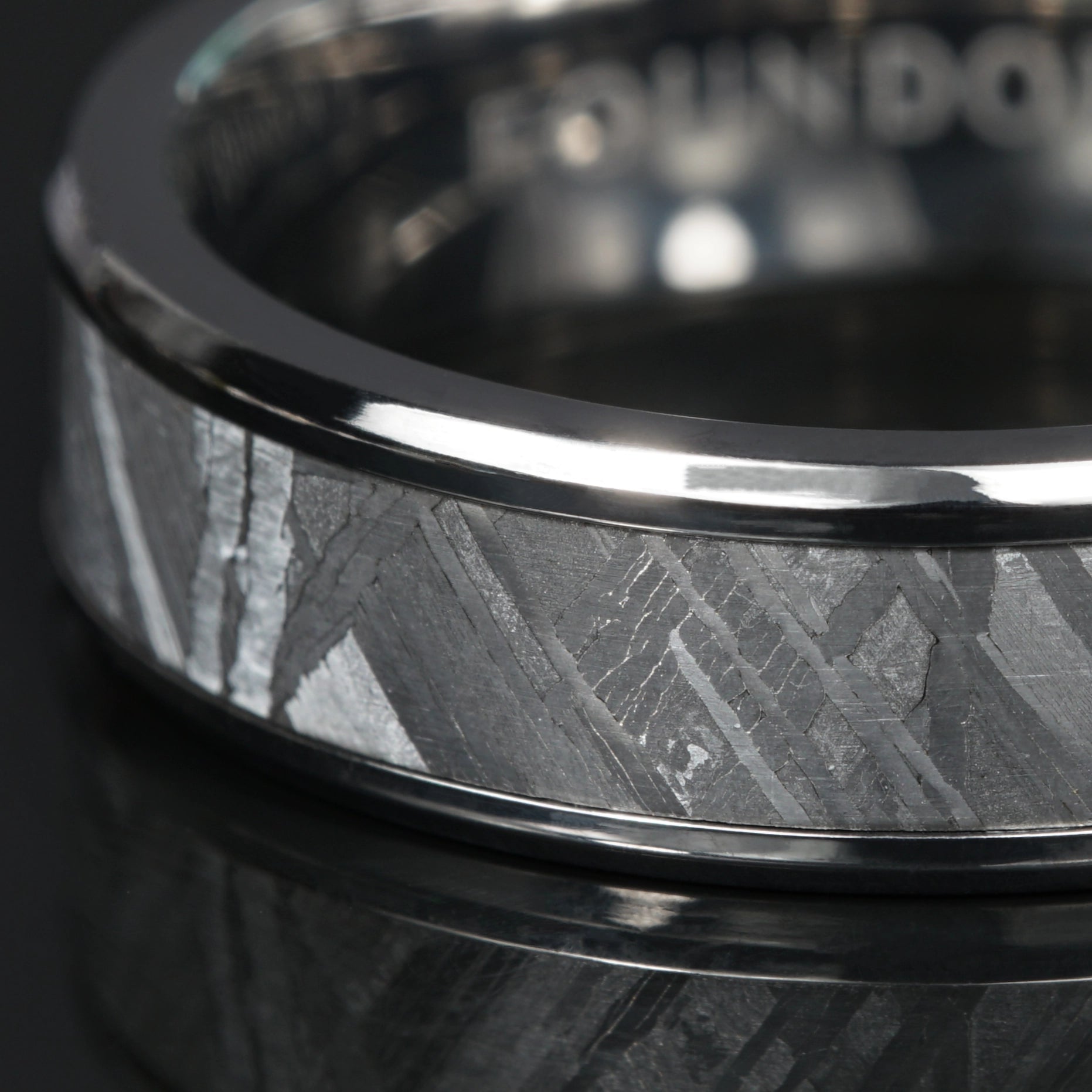
The Widmanstätten pattern is the single most reliable indicator of authentic meteorite. It's a geometric crystalline structure visible across the surface of cut and acid-etched iron-nickel meteorite, and it cannot be replicated by any earthly manufacturing process.
What it looks like
Authentic Widmanstätten patterns show:
- Two intersecting crystal directions. The pattern consists of long bands of one alloy (kamacite) intergrown with bands of another (taenite), running in at least two different orientations. The angles between them are consistent within the meteorite structure but not perfectly geometric.
- Irregular spacing and width. Crystal bands vary in thickness, length, and density across the surface. They are not uniform like a printed pattern or repeating grid.
- Three-dimensional depth. Real meteorite, when caught at the right angle in light, shows subtle topographic variation. The crystals create faint shadows. Printed or etched fakes appear completely flat.
- Tonal variation. Gibeon meteorite shows warmer grey tones. Muonionalusta shows a cooler blue-silver sheen after acid etching. Both have natural variation across each piece.
Why it can't be faked
The Widmanstätten pattern forms only when molten iron-nickel cools at approximately one degree per million years in the vacuum of space. This is impossible to replicate. The cooling rate cannot be achieved in any laboratory, factory, or natural process on Earth. Any object claiming the Widmanstätten name that lacks the genuine structure is either a different material entirely (printed steel, resin composite) or an imitation pattern that won't withstand close inspection.
What to do
Look at your ring under strong, direct light, preferably with a jeweller's loupe or magnifying glass. The pattern should reveal increasing detail as you look closer, with crystals visible at multiple scales. A fake will look flat and uniform under magnification. Real meteorite reveals more complexity as you zoom in.
The Magnet Test: A Simple Physical Verification
Iron-nickel meteorite is naturally magnetic due to its high iron content (typically 90% or more iron). This makes a simple magnet test one of the most accessible authentication methods, requiring nothing more than a household fridge magnet or a stronger neodymium magnet.
How to test
- Take a small magnet (a standard fridge magnet works for most meteorite rings).
- Hold the meteorite inlay close to the magnet. Don't press the magnet directly against the ring as this can scratch the surface.
- Genuine meteorite will show clear magnetic attraction, pulling toward the magnet.
- Composite or resin imitations will show no attraction. Stainless steel imitations may show some attraction but typically weaker, less consistent, and will lack the crystalline pattern under magnification.
What this tells you: Magnetic attraction alone doesn't prove authenticity (some steel imitations are also magnetic), but the absence of magnetic attraction reliably indicates the meteorite is fake. Use the magnet test in combination with visual inspection of the Widmanstätten pattern.
Weight and Density
Iron-nickel meteorite has a specific gravity of around 7.6 to 8.0, making it noticeably heavier than aluminium, brass, or composite materials of the same volume. It's similar in density to steel but distinguishable by other markers.
For a ring buyer, weight isn't usually a direct test because the meteorite is set into a titanium or tungsten base. But if you're examining a loose piece of meteorite (such as a sample or off-cut), it should feel substantially heavy for its size. A piece that feels surprisingly light for its dimensions is unlikely to be genuine.
Natural Variation Between Pieces
Every genuine meteorite ring is unique. No two pieces share the same Widmanstätten pattern, crystal density, or surface character. If you're comparing your ring against the product photography, your ring will look subtly different. This is a feature of authenticity, not a defect.
If you ever meet another owner of the same ring model, the two pieces should display visibly different patterns. If two "meteorite" rings show identical or near-identical inlays, they're almost certainly printed, etched, or moulded imitations rather than genuine meteorite.

Natural characteristics that confirm authenticity
- Dark spots from troilite (iron sulphide) inclusions
- Subtle rust or warm tones where iron content is higher
- Pattern density variation across the inlay surface
- Occasional micro-pitting from atmospheric entry
- Different patterns on each piece of the same product
These are not defects. They are evidence of authenticity. A meteorite ring without natural variation would not be a real meteorite ring.
Provenance Documentation
A reputable meteorite ring seller should be able to tell you:
- Which meteorite the inlay comes from. The two most commonly used in jewellery are Gibeon (recovered from Namibia) and Muonionalusta (recovered from northern Sweden). Other named meteorites exist but are rarer. A seller who can't or won't name the meteorite is a red flag.
- Where the meteorite was sourced. Legitimate meteorite is sold by specialist suppliers who deal in authenticated material. A reputable jeweller will have a clear supply chain even if they don't disclose the exact supplier name commercially.
- What protective treatment is applied. Iron-nickel meteorite oxidises if untreated. Most rings use either brush-on wax or industrial electrophoretic coating (e-coat) to seal the surface. The seller should be able to explain what they use.
What to ask before you buy
- Which meteorite is the inlay?
- Is provenance documentation available?
- How is the meteorite sealed against oxidation?
- What's the warranty on the meteorite specifically (not just the metal base)?
- What's the return policy if you have doubts after receiving the ring?
If a seller cannot answer these questions clearly, the meteorite likely isn't genuine or the seller doesn't know enough about their own product to be trusted with a £500+ purchase.
Common Signs of a Fake Meteorite Ring
Imitation meteorite rings have flooded the lower end of the market. They typically use one of these techniques:
Printed or laser-etched steel
A flat geometric pattern printed or laser-etched onto stainless steel to mimic the Widmanstätten appearance. These look convincing in photographs but fall apart under close inspection. The pattern is uniform, perfectly geometric, and lacks the three-dimensional crystal structure of real meteorite. Often sold under names like "meteorite-style," "space-pattern," or "cosmic-design" to avoid making false authenticity claims.
Resin or composite inlays
A resin material with metallic flecks or a printed insert designed to suggest meteorite. These fail the magnet test and feel lighter than expected. Surface texture is uniform across the inlay rather than showing natural variation.
"Meteorite-inspired" naming
Some sellers describe products as "meteorite-inspired" or "inspired by meteorite" without making a direct authenticity claim. This is legal but misleading. Always read product descriptions carefully and look for explicit claims of "genuine meteorite," "authentic Gibeon," or "real Muonionalusta" rather than aspirational language.
Price as a red flag: Authentic meteorite is expensive. The raw material costs significantly more than steel or composite alternatives, before any jewellery work. A "meteorite" ring priced under £150-200 is statistically unlikely to contain genuine meteorite. There are exceptions (small inlays, simple settings, direct-to-consumer pricing), but extreme low prices are typically a strong indicator of imitation material.
What You Should Expect from Foundoria
Every meteorite ring in our CELESTIUM collection uses authentic Gibeon or Muonionalusta meteorite. We're happy to provide:
- Provenance documentation specifying the meteorite type for any CELESTIUM ring on request
- Detailed technical information about how the meteorite is sourced, set, and protected
- A full 30-day return policy if you're not satisfied for any reason, including authenticity concerns
The flagship Astraeus ring showcases the widest meteorite inlay in our range, with enough surface area that the Widmanstätten pattern is clearly visible without magnification. For collectors and serious meteorite enthusiasts, it's the easiest piece in our range to authenticate visually.
For deeper background on the science of meteorite formation and the differences between Gibeon and Muonionalusta, see our meteorite science guide.
Authentication Questions Answered
The most reliable indicator is the Widmanstätten pattern: a geometric crystalline structure visible across the meteorite surface, with crystal bands running in two intersecting directions. This pattern forms only through millions of years of slow cooling in space and cannot be replicated. Examine the ring under strong light or a jeweller's loupe. Real meteorite reveals more complexity under magnification; fakes look flat and uniform. Genuine iron-nickel meteorite is also magnetic, so a simple magnet test confirms authenticity in seconds.
Yes. Iron-nickel meteorite is composed of approximately 90% iron, which gives it natural magnetic properties. A standard household fridge magnet held near the meteorite inlay will show clear attraction. If a "meteorite" ring shows no magnetic response, it's almost certainly not genuine meteorite. Note that stainless steel imitations may also show some magnetic attraction, so combine the magnet test with visual inspection of the Widmanstätten pattern for confirmation.
Real meteorite is genuine iron-nickel material from a meteorite that fell to Earth. "Meteorite-style" or "meteorite-inspired" rings use materials like printed stainless steel, laser-etched metal, or resin composites designed to mimic the appearance of meteorite. These imitations may look similar in photographs but fail close inspection (no genuine Widmanstätten crystals, no magnetic attraction, no natural variation between pieces). Always look for explicit claims of "genuine," "authentic," or "real meteorite" rather than aspirational language.
Authentic meteorite ring prices typically start around £250-300 for simple narrow inlays and rise to £500-800+ for wider inlays, more complex settings, or rarer meteorite types. The raw material itself is expensive (significantly more costly than steel or composite alternatives), before any jewellery work. Rings priced under £150-200 claiming to contain real meteorite should be approached with caution. Foundoria's CELESTIUM collection ranges from around £349 to £549, reflecting both authentic material sourcing and the craftsmanship involved.
Yes. A reputable seller should be able to specify the meteorite type (Gibeon, Muonionalusta, or another named meteorite) and provide provenance documentation on request. Foundoria provides this for any CELESTIUM ring. Sellers who can't name the meteorite, won't provide documentation, or who use only aspirational language ("meteorite-inspired," "space-style") rather than explicit authenticity claims should be treated cautiously.
Yes. The Widmanstätten pattern and magnet test can be performed at home with a jeweller's loupe and a standard fridge magnet, and together provide strong indicators of authenticity. For absolute certainty, formal third-party verification is available through specialist meteorite dealers and authentication services for around £50-150. If you've bought from Foundoria and have any concerns after receiving your ring, our 30-day return policy means you can return it for a full refund for any reason, including authenticity doubts.
No, the opposite is true. Every genuine meteorite ring is unique because the Widmanstätten pattern, crystal density, colour variation, and surface character differ across every piece of meteorite. If you compare two real meteorite rings of the same model, they should show visibly different patterns. If two "meteorite" rings show identical inlays, they're almost certainly imitations rather than genuine meteorite. Natural variation is one of the strongest signs of authenticity.
Authentic Meteorite Rings from Foundoria
Every CELESTIUM ring contains genuine Gibeon or Muonionalusta meteorite. Provenance documentation available on request. Full 30-day returns if you're not satisfied for any reason.
Shop CELESTIUM Collection View Astraeus