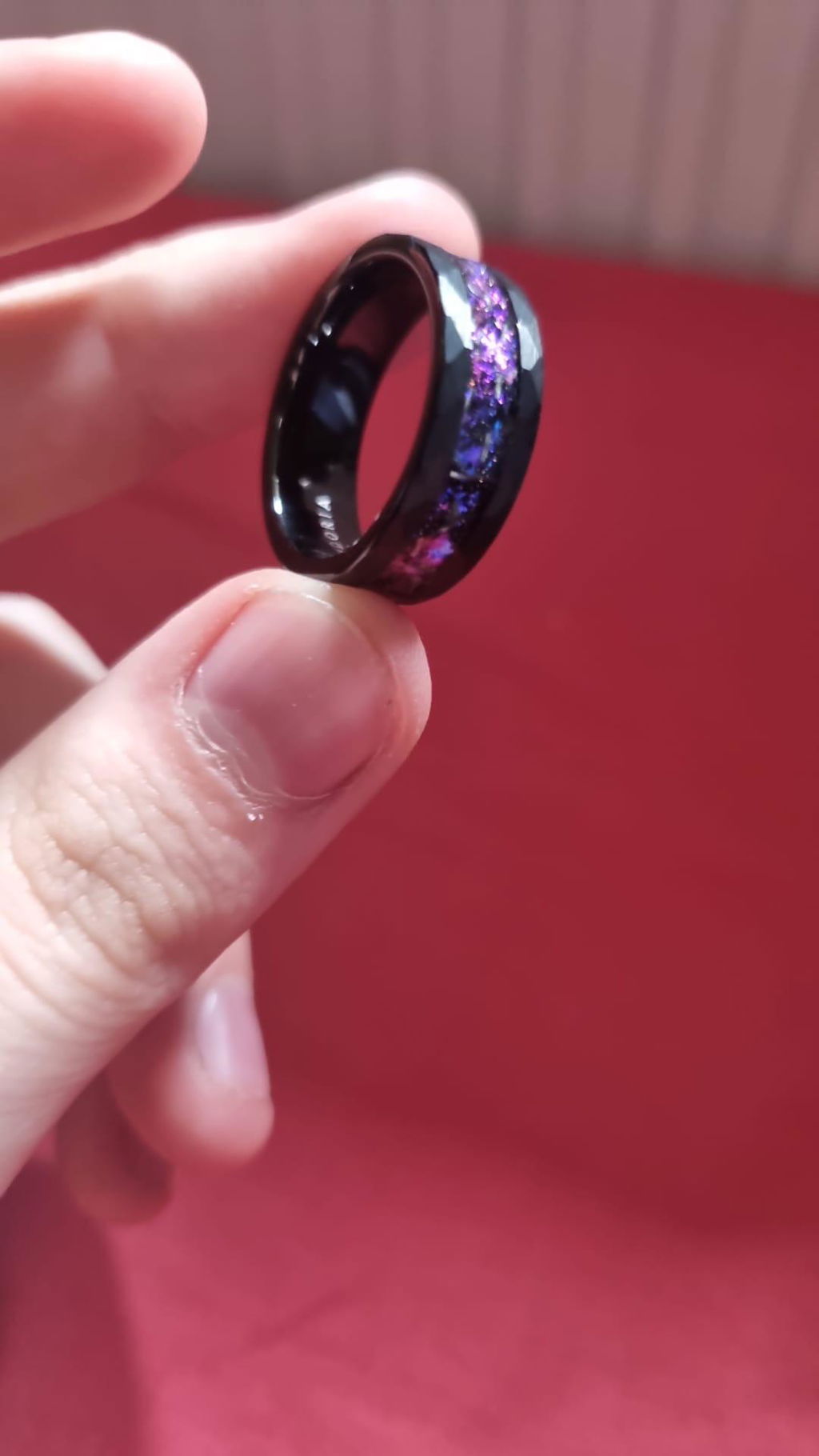
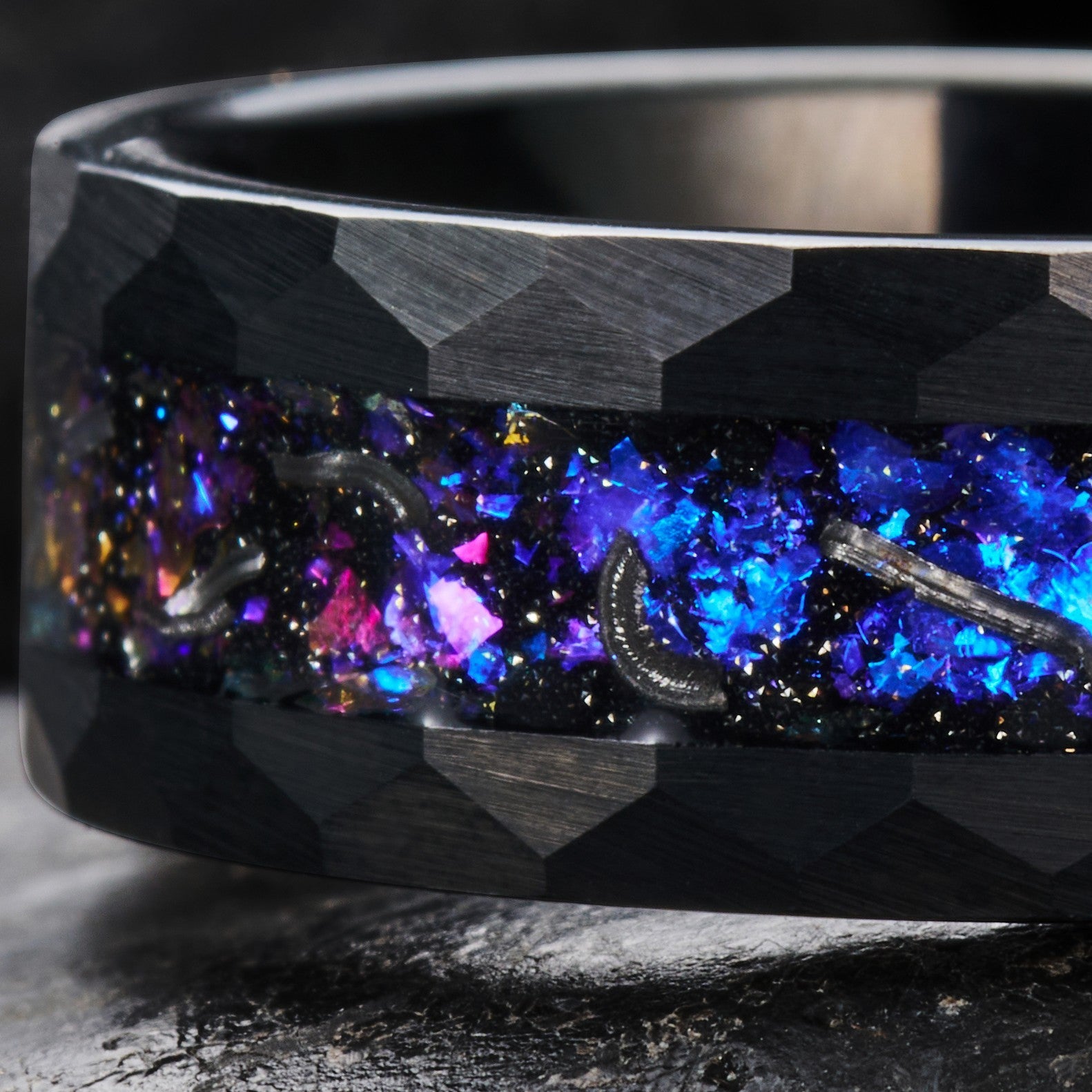

If you're considering a titanium wedding ring in the UK, you want a straight answer: are these rings actually any good? This guide walks through the honest pros and cons. Titanium is lighter than steel, stronger by weight than platinum, completely hypoallergenic, and used in surgical implants because the human body genuinely doesn't react to it. It's also softer than tungsten, lighter than what some wearers want from a wedding ring, and has limits on resizing. The point of this guide is to help you decide whether titanium is the right material for you specifically.
This guide does the explaining. It covers what titanium really offers as a wedding ring material, how it compares to the alternatives most UK buyers consider, what the practical buying decisions look like, and where titanium isn't the right answer. I'll be straight with you throughout: titanium is excellent for certain wearers and certain priorities, and not the right choice for others. The point of this guide is to help you work out which one you are.
What Makes Titanium Different from Other Wedding Ring Metals
Titanium sits in a category of its own among ring materials. It's a pure metal (not an alloy like white gold or sterling silver), which means its properties come from the metal itself rather than from what's been mixed into it. That single fact explains most of what makes it good.
Strength Without the Weight
Titanium has one of the highest strength-to-weight ratios of any metal. It's roughly 45% lighter than steel but matches it for tensile strength. Compared to platinum (the traditional "premium" wedding ring metal), titanium is around 60% lighter while being significantly harder. For a wedding ring, this translates to a band that feels almost weightless on your finger but holds its shape under daily wear without bending, denting, or warping.
This is the property that gets the most marketing attention but is rarely explained well. The practical version: pick up a titanium ring and a platinum ring of the same dimensions and the titanium will feel like a feather by comparison. Some wearers love this. Others miss the reassuring weight of a heavier metal. Both reactions are valid.
Biocompatible by Nature
This is where titanium genuinely separates itself. The human body recognises titanium as inert. It's used in dental implants, hip replacements, surgical pins, and bone screws because surgeons can put it inside a body and the immune system simply doesn't react to it. There's no allergic potential, no slow chemical leaching, no oxidation that affects surrounding tissue.
For wedding ring wearers, that biocompatibility means titanium is the safest option available for anyone with metal allergies, sensitive skin, or a history of reactions to white gold, sterling silver, or costume jewellery. If you've had problems with jewellery in the past, titanium removes the variable entirely. See our hypoallergenic rings guide for the full picture, including the EN 1811:2023 testing we apply to all our materials.
Corrosion Resistance That Lasts
Titanium forms a microscopic protective oxide layer the moment it's exposed to air. That layer is chemically stable, self-repairing if scratched, and resistant to almost everything you'll encounter in daily life. Saltwater, chlorinated pools, cleaning chemicals, sweat, perfume, and hand sanitiser don't affect it. Silver tarnishes within months without polishing. Gold can dull over years. Titanium looks the same in year ten as it did in year one.
The honest take: Titanium's properties read like a marketing wish list because they genuinely are exceptional. But it's not a "best of everything" material. It's softer than tungsten (scratches more readily) and lighter than what some people want a wedding ring to feel like. Knowing the trade-offs matters.
Titanium vs the Alternatives
Most UK buyers comparing wedding ring metals are weighing titanium against tungsten, gold, platinum, or sterling silver. Here's how titanium actually stacks up against each.
Titanium vs Tungsten Carbide
The two most-discussed alternative wedding ring metals, and they're genuinely different. Tungsten is significantly harder (8.5-9.5 on the Mohs scale vs titanium's 6) and almost impossible to scratch. Titanium is dramatically lighter (around 4.5g/cm³ density vs tungsten's 15.6g/cm³) and more forgiving in everyday wear because it bends under extreme force rather than fracturing.
Tungsten wins on scratch resistance and visual permanence. Titanium wins on weight, biocompatibility, and resizability (yes, titanium can be resized within limits; tungsten can't). For a full breakdown including REACH compliance and binder chemistry, see our tungsten carbide guide.
Titanium vs Gold
Gold (yellow, white, or rose) is the traditional wedding ring metal, and the comparison really comes down to weight, allergen risk, and durability. Gold alloys frequently contain copper and nickel (especially white gold), which can trigger reactions in sensitised wearers. Titanium has none. Gold is significantly heavier; titanium is barely there. Gold can be dented and scratched with everyday wear; titanium is much harder.
Where gold still leads: warmth of colour (yellow and rose gold have a richness titanium can't match), traditional symbolism, and the option to resize easily. For UK buyers focused on hypoallergenic performance and modern aesthetic, titanium typically wins. For traditional wedding aesthetic with strong gold-tone colour, gold still has the edge.
Titanium vs Platinum
Platinum is the closest competitor in performance terms. Both are hypoallergenic, both are durable, both have a similar silver-grey colour. The differences come down to weight, price, and density. Platinum is denser (and therefore heavier) and significantly more expensive (typically 4-6× the cost of titanium for the same ring). For wearers who want the prestige of platinum and don't mind the weight or the price, platinum remains a strong choice. For everyone else, titanium delivers comparable performance at a fraction of the cost.
Titanium vs Sterling Silver
This one's less close. Sterling silver tarnishes, scratches, dents, and contains 7.5% copper (with some alloys also containing trace nickel) which can cause skin reactions. It's also softer and more prone to deformation under impact. Titanium is harder, doesn't tarnish, contains no allergens, and weighs less. The only thing silver offers over titanium is lower cost and (in some pieces) more ornate detailing. For a wedding ring designed to last decades, titanium is the better engineering choice.
Finishes, Colour, and Design Options
Titanium's natural colour is a soft silver-grey, similar to platinum but slightly cooler in tone. It takes a range of surface finishes well, and unlike many metals it can also be anodised to create coloured oxide layers without paint or coating.
Polished, Brushed, Satin, and Matte
The three most common finishes for titanium wedding rings are polished (high-shine, reflective, similar to platinum), brushed/satin (textured matte that hides micro-scratches and reads as more contemporary), and full matte (deeper texture, most muted appearance). Each is achieved by surface treatment after the ring is shaped, and each ages differently. Polished finishes show wear more visibly over time; brushed finishes camouflage daily wear better.
Anodised Colours
Titanium can be anodised, which is an electrochemical process that grows a thin oxide layer on the surface. The thickness of that layer determines the colour you see (blues, purples, golds, and greens are all possible). Because it's not paint or coating, anodised colour doesn't chip or peel, but it can wear down where the ring contacts hard surfaces over many years. Worth knowing if you're considering a coloured titanium ring.
Inlays and Mixed Materials
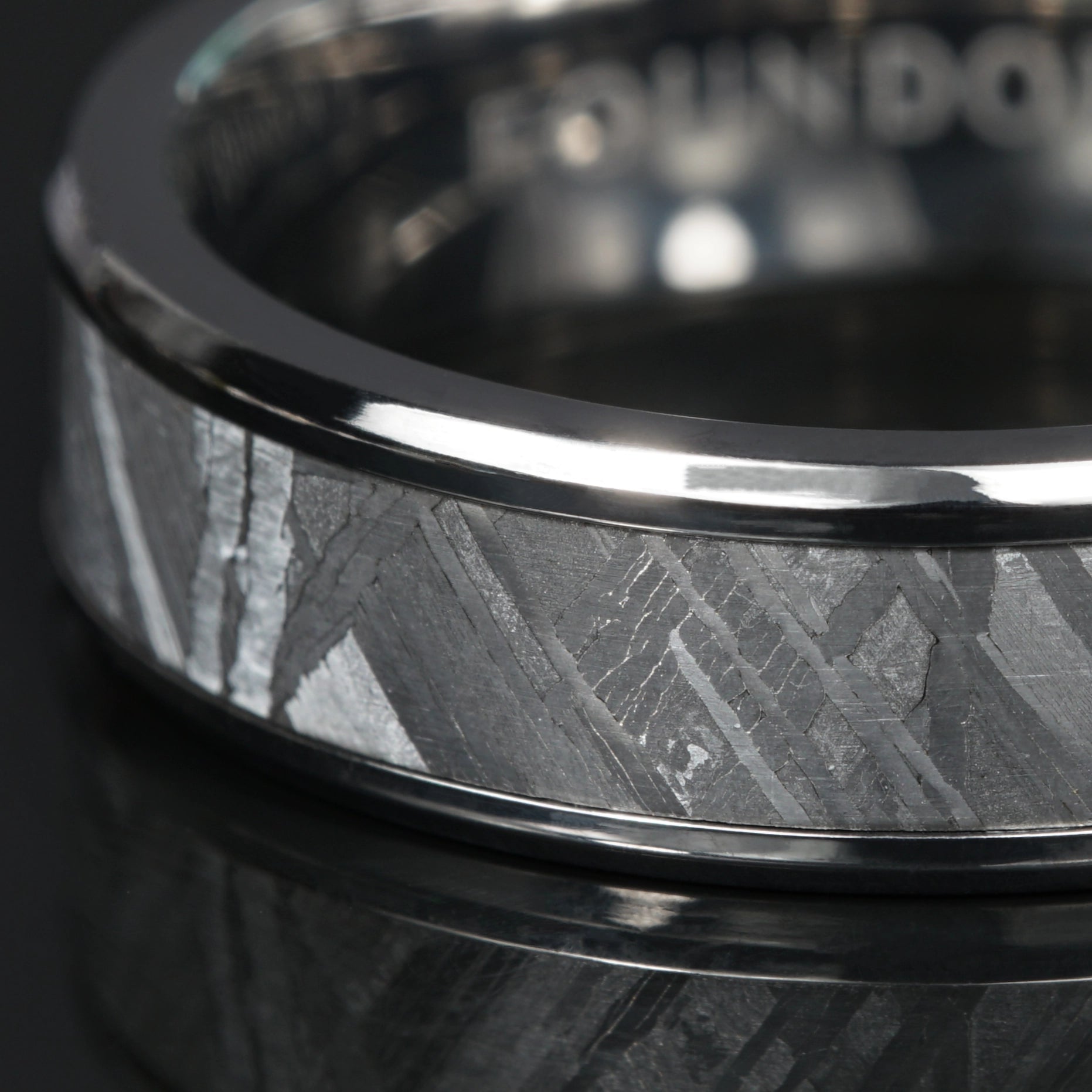
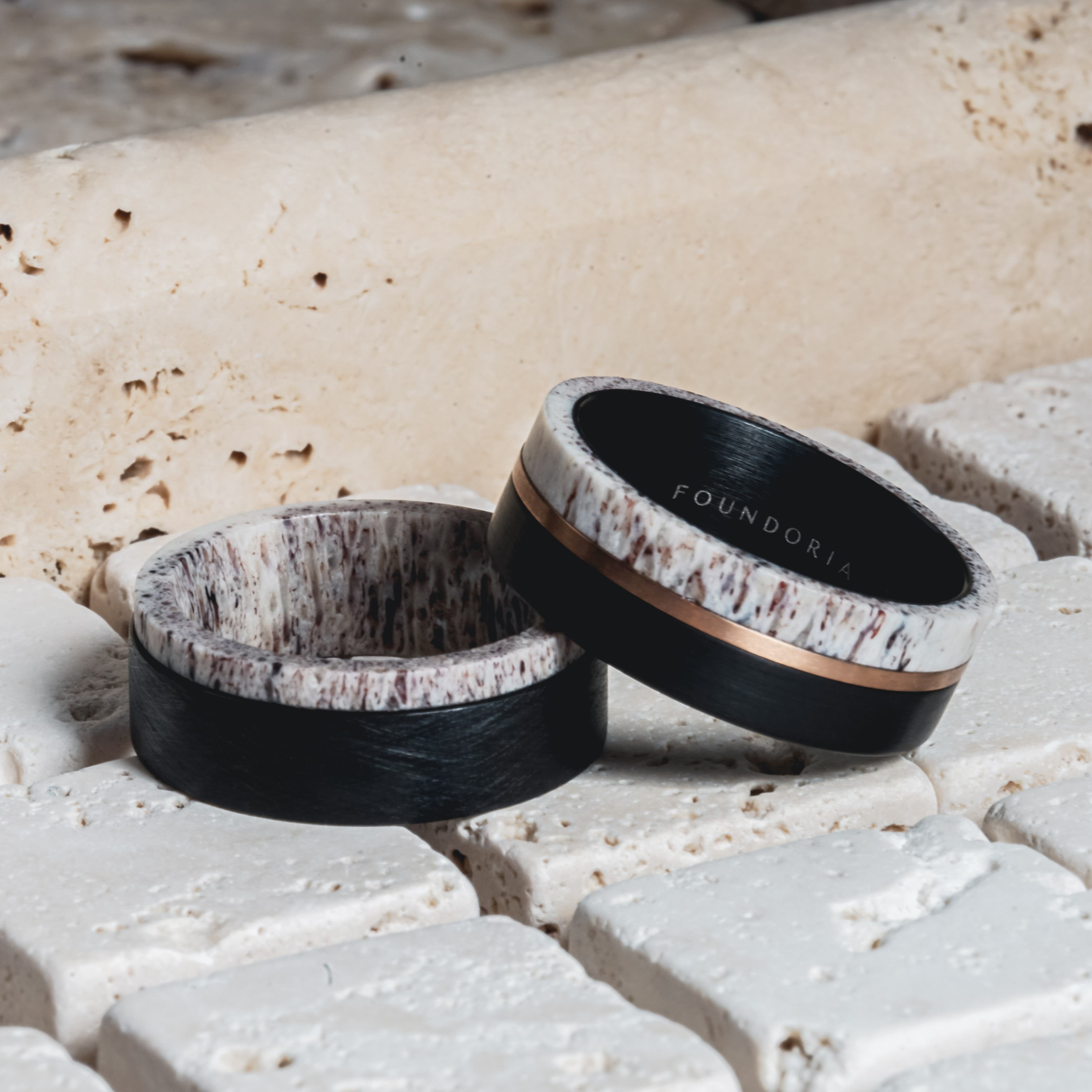
Titanium pairs well with natural materials because its neutral colour lets the inlay do the visual work. Wood inlays, antler inlays, and meteorite inlays all sit beautifully against a titanium base. The combination of titanium's hypoallergenic safety with the character of natural materials is one of the defining choices in alternative wedding rings. Our ASTRAEUS ring is the clearest example in the Foundoria range: a brushed titanium base with a band of genuine Muonionalusta meteorite, more than four billion years old, retrieved from the Arctic Circle.
Titanium and Hypoallergenic Wear
If sensitive skin or metal allergies are part of your decision, titanium is the safest material we sell. Surgical-grade titanium contains no nickel in the alloy, which means there's no nickel to release into your skin. That matters because nickel is the most common metal allergen, responsible for around 80% of metal-allergy reactions in jewellery wearers.
Our titanium components are independently tested against EN 1811:2023 (the current EU and UK nickel release standard) by an IAS-accredited laboratory. Results consistently come back below the laboratory's detection limit. The same testing standard, the same lab, the same documentation as our tungsten and gold-accented rings. Read our hypoallergenic rings guide for the full testing detail and how titanium compares to the other materials in our range.
For severe nickel allergies: Titanium is the material we'd point you toward first. It eliminates the underlying material concern rather than testing around it, which is what REACH-tested tungsten effectively does. Both are safe for the vast majority of wearers, but titanium offers an extra layer of certainty for sensitised wearers.
The Weight Question
This is the one that surprises most first-time titanium wearers. A titanium ring at 8mm width weighs roughly 2-3 grams, compared to 8-10 grams for the same ring in tungsten and 12-15 grams in platinum. You feel the difference instantly.
For some wearers, especially those who've worn heavier metals before, titanium feels almost imperceptible. Some love this (no awareness of the ring during the day, no fatigue, easier wear during active or manual work). Others find it slightly underwhelming and miss the reassuring weight of a heavier metal.
Combined with our comfort-fit interior design, where the inside of the ring is slightly domed rather than flat, titanium rings slide on and off more easily than traditional flat-fit bands of the same size. Worth noting if you're between sizes (we recommend sizing down for comfort-fit rings in any material).
UK Sizing and the Resizing Question
Titanium can be resized, but only within limits and not as easily as gold or platinum. A skilled jeweller can typically adjust a titanium ring by half a size (occasionally a full size) up or down using specialised equipment. Larger changes generally aren't possible because of titanium's hardness.
This is one of the genuine differences between titanium and tungsten. Tungsten can't be resized at all, which makes accurate first-time sizing essential. Titanium offers a small margin, but it's still worth measuring correctly from the start because resizing is a workshop job rather than a quick adjustment.
If you're not sure of your size, our UK ring sizing guide covers four methods (visiting a jeweller, requesting our free posted sizer, measuring an existing ring, and string-and-paper at home) plus a UK-to-US conversion chart. You can also request a free ring sizer sent to your UK address, no obligation.
Care, Longevity, and What to Expect Over Decades
Titanium needs essentially no maintenance to keep its finish. Soap and water, dry with a soft cloth, and that's the routine. No polishing compounds, no specialist cleaners, no annual jewellery service. The natural oxide layer that gives titanium its corrosion resistance reforms instantly when scratched, so the ring effectively maintains its own surface.
Over years of wear, expect:
- Minor surface scratches from daily contact with harder objects (door handles, keys, coins). Visible on polished finishes, much less so on brushed or matte.
- No tarnishing at any point. The colour stays the same.
- No bending or deformation under normal wear. Titanium is significantly harder than gold, silver, or platinum.
- No yellowing or chemical reaction from contact with soaps, lotions, perfumes, or hand sanitisers.
Emergency Ring Removal
A genuine concern for anyone in trades, healthcare, mechanics, or active sports: can a titanium ring be cut off in an emergency? Yes. The myth that titanium rings can't be removed is widespread and wrong. They require specialised equipment that goes beyond the standard jeweller's ring cutter (which is designed for softer metals like gold and silver), but UK A&E departments, fire services, and emergency rooms carry the right tools.
The typical equipment is a hardened-blade ring cutter or specialised ring-cracking pliers that fracture the ring rather than slicing through it. The process takes one to two minutes compared to seconds for gold. If your finger is severely swollen due to injury or compression, a titanium ring will be removed safely. It just takes slightly longer than a softer metal.
For wearers in high-risk environments (paramedics, mechanics, climbers, electricians) who are concerned about this, we recommend using our complimentary ENDURA silicone companion band during work or active periods. ENDURA is designed to break away under stress, so the titanium ring stays safe at home for everyday wear and the silicone takes the daily knocks.
For NHS staff, armed forces, and students: As recognition of the work you do, we offer a verified 20% discount on every Foundoria ring. Verification takes seconds and the code applies automatically at checkout. See our exclusive discounts page for full detail and to verify your eligibility.
For finish-specific care and how to handle natural inlays (wood, antler, meteorite) on combination rings, see our ring care guide. The titanium itself needs nothing special. The inlay, if your ring has one, may need attention depending on what it is.
Quality Grades: What Foundoria Uses
"Titanium" isn't a single grade. There are several commercial grades used in jewellery and other industries, each with slightly different properties. The most common are Grade 1 (purest, softest, rarely used in rings), Grade 2 (commercially pure, good corrosion resistance, common in jewellery), and Grade 5 (Ti-6Al-4V, an aerospace alloy with added aluminium and vanadium, much harder than Grade 2 but more difficult to machine).
Our titanium components use aerospace-grade titanium for the right balance of hardness, durability, and finish quality. The same grade specification is used in surgical implants and structural aircraft components. Documentation available on request.
Buying Titanium in the UK
A few things worth knowing when buying a titanium wedding ring in the UK specifically.
Sizing Conventions
UK ring sizes use letters (J, K, L, M, etc.), while most international ring manufacturers use US numerical sizes. Conversion isn't always 1:1 (UK R = US 8.5, UK T = US 9.5, UK U = US 10). Our product pages use US sizing for consistency with international markets, with conversion guidance available throughout. The sizing guide includes a full conversion table.
UK Hallmarking
Titanium isn't a hallmarked metal in the UK (the hallmarking system covers silver, gold, platinum, and palladium specifically). This means UK titanium rings don't carry the four-mark hallmark you'd see on a gold or platinum band. That's a regulatory reality rather than a quality signal. Reputable titanium ring makers use other forms of documentation (test certificates, supplier provenance) to verify quality.
Delivery and Returns
UK delivery on Foundoria orders is free via Royal Mail Special Delivery for higher-value rings, with full tracking and insurance. International delivery to EU countries (France, Germany, Netherlands, Portugal, Spain) and beyond is also free, with all import duties and taxes covered at our end. No customs charges on arrival. Lifetime warranty on every ring against manufacturing defects.
When Titanium Isn't the Right Choice
Three scenarios where I'd point you toward a different material:
If You Want Maximum Scratch Resistance
Tungsten carbide is significantly harder than titanium and resists scratches better. If keeping the ring in pristine condition for decades is a high priority, tungsten is the more demanding choice for that.
If You Want a Heavier Ring
Titanium's lightness is divisive. If you've worn gold or platinum and miss the weight, titanium might feel insubstantial. Tungsten (heavy and dense) or precious metals will feel more like what you're used to.
If You Want Traditional Warm Colour
Titanium is silver-grey, not gold. If your wedding aesthetic specifically calls for yellow or rose gold tones, anodised titanium can approximate it but doesn't replace genuine gold colour. Foundoria offers tungsten rings with gold inlays for wearers who want both traditional warmth and modern durability.
The Foundoria Approach to Titanium
Every titanium ring in our range is built around the same principles: aerospace-grade titanium, comfort-fit interior, REACH-tested for safe skin contact, and backed by our lifetime warranty. Where we differ from most titanium ring brands is in what we pair the titanium with.
Our ASTRAEUS ring combines a brushed titanium base with a band of genuine Muonionalusta meteorite. The meteorite has been cooling slowly in space for around 4.5 billion years, which is more time than the entire history of Earth, formed from iron and nickel into the distinctive Widmanstätten crystalline pattern you see on the ring. We chose titanium specifically for this pairing because it's hypoallergenic (important when meteorite contains nickel) and because its silver-grey tone lets the meteorite's character lead visually. See the wider CELESTIUM meteorite collection for the full cosmic range.
Across the wider titanium collection, every ring is independently tested for safe skin contact, sized to UK comfort-fit standards, and shipped free across the UK with duties covered for international orders. Lifetime warranty on every piece.
Frequently Asked Questions
Yes, for the right wearer. Titanium is hypoallergenic, biocompatible (same grade used in surgical implants), corrosion-resistant, and remarkably lightweight. It holds its shape and colour for decades with essentially no maintenance. Less suitable if you want maximum scratch resistance (tungsten is harder) or a heavier ring feel (precious metals are denser).
Within limits. A skilled jeweller can typically adjust a titanium ring by half a size or occasionally a full size, but larger resizing is difficult because of titanium's hardness. Resizing requires specialist equipment, not standard jeweller's tools. We recommend accurate first-time sizing using our free UK ring sizing guide rather than relying on resizing later.
Yes. Surgical-grade titanium contains no nickel, no copper, and no other common metal allergens. It's used in surgical implants because the human body doesn't react to it. For wearers with severe or medically diagnosed nickel allergies, titanium is the safest wedding ring material available. Our titanium is independently tested to EN 1811:2023 with nickel release below the laboratory detection limit.
Yes. The myth that titanium rings can't be removed in emergencies is wrong. UK A&E departments, fire services, and emergency rooms carry hardened-blade ring cutters and specialised pliers that fracture or cut titanium safely. The process takes one to two minutes rather than seconds (as with gold or silver), but it's done routinely. For wearers in high-risk professions, we recommend our complimentary ENDURA silicone companion band for active periods.
Tungsten is harder (more scratch-resistant) and heavier. Titanium is lighter, more comfortable for all-day wear, and slightly resizable. Both are hypoallergenic when sourced correctly. Tungsten can't be resized at all. For active wearers who do manual work and want maximum scratch resistance, tungsten wins. For lightweight comfort and the safest hypoallergenic profile, titanium wins.
Foundoria titanium wedding rings start from around £119 with free UK delivery, free posted ring sizer, and lifetime warranty included. Titanium is significantly less expensive than platinum (typically 4-6× cheaper for comparable rings) while offering similar hypoallergenic and durability properties. NHS staff, armed forces personnel, and students save a further 20% via our exclusive discounts page.
Yes. We offer a verified 20% discount for UK NHS staff, armed forces personnel, and students on every Foundoria ring. Verification takes seconds and the discount code applies automatically at checkout. See our exclusive discounts page for full eligibility detail. The discount is our way of recognising the work done by people in these roles.
Minor surface scratches are normal over years of wear. Brushed and satin finishes hide them well; polished finishes show them more. Titanium is significantly harder than gold or silver but softer than tungsten. The natural oxide layer that forms on titanium's surface self-repairs when minor scratches occur, so the ring maintains its protective qualities indefinitely.
Yes. Titanium is fully resistant to water, soap, saltwater, chlorine, and most household chemicals. The protective oxide layer is chemically stable and doesn't react with these substances. We still recommend our complimentary ENDURA silicone companion band for swimming, gym, and active wear to keep the ring itself protected from impact damage.
Grade 2 titanium is commercially pure and used in entry-level jewellery. Grade 5 (Ti-6Al-4V) is an aerospace alloy with added aluminium and vanadium, significantly harder than Grade 2 and used in surgical implants and aircraft structural components. Foundoria uses aerospace-grade titanium for the right balance of hardness, finish quality, and durability.
Find Your Titanium Wedding Ring
Aerospace-grade titanium. REACH-tested for sensitive skin. Free UK delivery and lifetime warranty included.
Shop Titanium Collection View ASTRAEUS