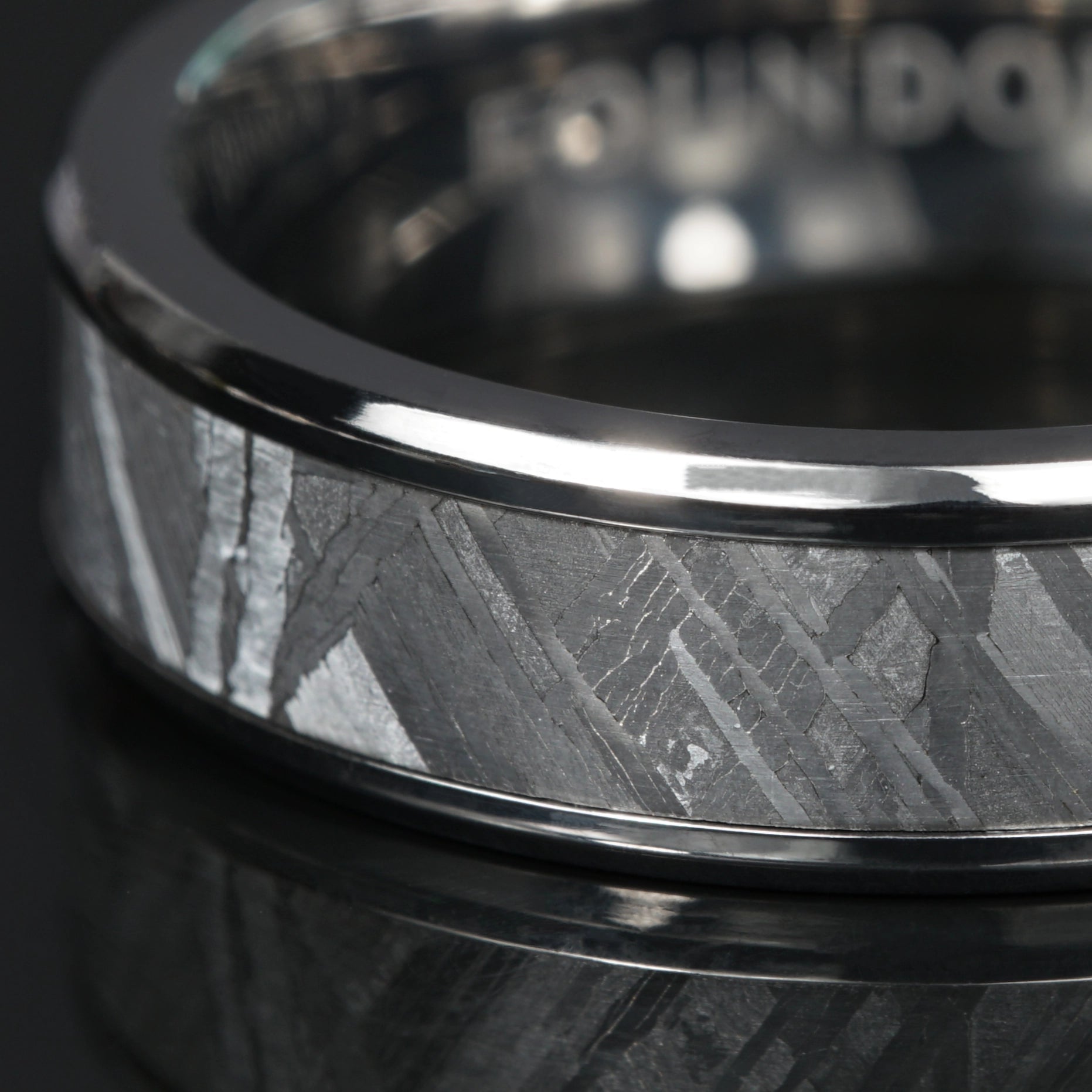

Muonionalusta is an iron-nickel meteorite from northern Sweden, named after the river where the first fragments were found in 1906. The material itself formed roughly 4.5 billion years ago in the early solar system. What makes it distinctive in jewellery is the Widmanstätten pattern: tighter, finer, and more intricate than other meteorites, with a blue-silver sheen after etching. At Foundoria, Muonionalusta is set into titanium rather than tungsten. The two materials suit each other.
- Muonionalusta fell to Earth roughly one million years ago in what is now northern Sweden, making it one of the oldest known meteorite finds on the planet.
- The material itself formed approximately 4.5 billion years ago, in the early solar system, before the Earth had fully coalesced.
- The first known fragment was discovered in 1906 by two children playing near the Muonio River.
- Muonionalusta is classified as a fine octahedrite, the same class as Gibeon meteorite, but with a finer crystalline structure.
- After acid etching, Muonionalusta develops a distinctive blue-silver sheen no other meteorite consistently produces.
- Foundoria pairs Muonionalusta with titanium, a hypoallergenic, biocompatible metal that suits the meteorite's lighter visual tone.
Updated for 2026.
Roughly 4.5 billion years ago, in the cooling core of a small planet that never finished forming, iron and nickel crystallised into geometric lattices over a timescale that nothing on Earth has ever matched. The parent body shattered. The fragments drifted through space for far longer than life has existed on this planet. Eventually, one cluster of them was caught by Earth's gravity and fell across what is now the Arctic Circle in northern Sweden.
The Sami people of the region almost certainly knew the fragments existed before they were documented by anyone else. The first recorded find came in 1906, when two children playing near the Muonio River picked up a rock that turned out to be a piece of the early solar system. The material has carried the river's name ever since.
The strewn field, the area across which the fragments were scattered, lies in the far north of Sweden, close to the Finnish border. It's high Arctic country. Pine forest, granite, the long winter night. The meteorite fell roughly a million years ago, making it one of the oldest known meteorite events recorded on the planet's surface. Most meteorite fragments are weathered to nothing within tens of thousands of years. Muonionalusta survived because the cold preserved it.
Fragments have been found across roughly 25 square kilometres of forest and tundra. The largest, by recorded weight, was around 230 kilograms. Most are far smaller. Many were collected in the early 20th century, before any formal scientific apparatus existed for cataloguing or restricting the trade. Sweden does not place the same export restrictions on Muonionalusta as Namibia does on Gibeon, but the supply is finite. Like all iron meteorites used in jewellery, no new Muonionalusta is being produced. The material in circulation today is the material we have.
The Muonionalusta used in Foundoria's CELESTIUM collection is sourced through established meteorite suppliers with documented provenance. It is genuine, verifiable, and traceable to the Swedish find.
Muonionalusta, like Gibeon, is a fine octahedrite. That means it displays the Widmanstätten pattern: the geometric lattice of interlocking kamacite and taenite crystals that forms only over millions of years of slow cooling in space. It is the single physical authenticator of genuine iron meteorite. No factory process replicates it.
What sets Muonionalusta apart is the crystalline structure. The bands are finer and more densely packed than Gibeon's, creating a tighter, more intricate visual pattern. Cut and polished, it looks busier, with more to read. Where Gibeon tends toward broad, confident bands and warm grey tones, Muonionalusta is more delicate. More restless. More mathematically beautiful, if that's a thing you respond to.
Then there's the sheen. When Muonionalusta is treated with mild acid to reveal the pattern, many pieces develop a cool blue-silver lustre across the surface. It catches light differently to any other meteorite used in jewellery. The effect is subtle in dim light and striking in bright light. A ring scale at 6mm wide, in good lighting, looks like nothing else.
For a fuller comparison of Muonionalusta against Gibeon, including the chemistry of why they look different, see our meteorite material guide.

Most meteorite rings on the market use tungsten carbide as the base metal. It's the obvious choice: hard, scratch resistant, available in dark and brushed finishes that contrast well with meteorite. Foundoria uses tungsten for Gibeon rings precisely because Gibeon's warmer, broader pattern benefits from the visual weight of a dark band around it.
Muonionalusta is different. The pattern is finer, the tone is cooler, the sheen is lighter. Set in tungsten, especially black tungsten, the meteorite competes with the metal for attention. A heavier band would muddy the effect.
Polished titanium does the opposite. It's lighter in tone, lighter in physical weight, and its silver-grey finish reads as a quieter frame around the meteorite. The eye is drawn to the inlay first, not the band. At a wider inlay width (Foundoria's Astraeus uses a 6mm band, with the meteorite occupying most of the visible face), the contrast between the polished titanium edges and the etched meteorite centre is what makes the ring distinctive. Tungsten wouldn't deliver that result.
There's a second reason titanium suits this meteorite, less visual and more practical. Titanium is hypoallergenic. It contains no nickel, doesn't oxidise on skin contact, and is the standard metal used in surgical implants and dental work for exactly this reason. For anyone with metal sensitivities, particularly nickel allergies, titanium is one of the few wedding ring base metals that's reliably safe across a wide range of skin types.
If skin sensitivity matters to you, our hypoallergenic rings guide covers the full picture across our materials. The titanium in Astraeus and Equinox is aerospace-grade and biocompatible.
Muonionalusta is iron, which means it can oxidise if exposed to sustained moisture. Every Foundoria meteorite ring is finished with an electrophoresis coating (e-coat) on the inlay during manufacture. This is an industrial process that bonds a uniform protective layer to the meteorite surface, preventing oxidation in everyday wear without altering the visible pattern.
For everyday life the e-coat does its job. You don't need to think about it. The titanium band itself is essentially maintenance-free and won't tarnish, scratch easily, or react with skin.
A few sensible habits extend the coating's life significantly: remove the ring before swimming, avoid prolonged exposure to chlorine or harsh chemicals, and apply a thin layer of Renaissance Wax to the inlay every 6 to 12 months. Full guidance is in our ring care guide.
Two rings in the CELESTIUM collection use Muonionalusta specifically. Astraeus is built around a wide meteorite inlay in polished titanium. Equinox pairs Muonionalusta with reclaimed bourbon barrel oak in the same titanium band.

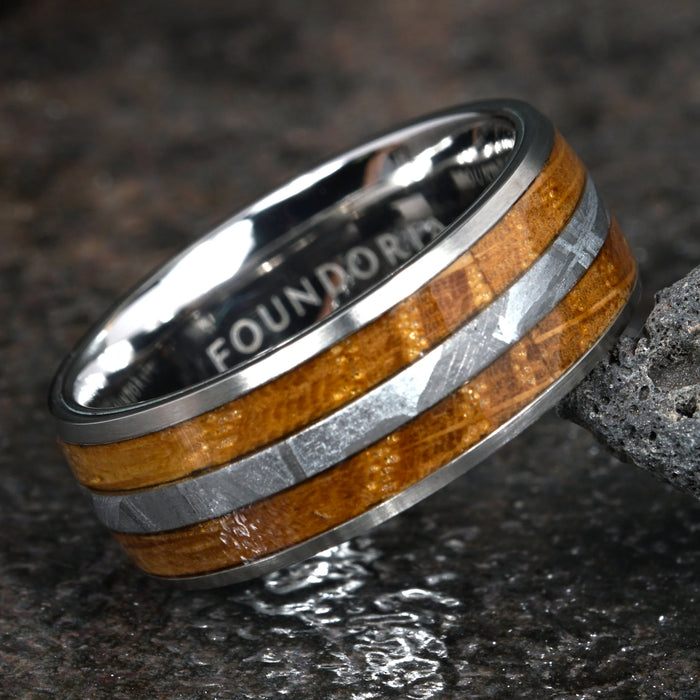
If you want a ring that's genuinely, provably ancient, made of material that no human or factory could ever produce, Muonionalusta is in a category of its own. The blue-silver sheen reads cosmic in a way that's hard to describe accurately and impossible to miss in person. It looks like nothing on Earth because the material isn't from here.
It suits people drawn to the sciences, to space, to materials that carry their own story. It also suits anyone with nickel sensitivities, since the titanium base is biocompatible. The care requirements are minimal: keep it dry, treat it kindly, wax the inlay occasionally.
If you're still weighing materials, the wider CELESTIUM collection includes Gibeon meteorite options in tungsten alongside the Muonionalusta titanium pieces. Or compare the two metals directly in our tungsten vs titanium guide.
Muonionalusta is an iron-nickel meteorite that fell to Earth roughly one million years ago in what is now northern Sweden, near the Muonio River. The material itself formed approximately 4.5 billion years ago in the early solar system. It is classified as a fine octahedrite, a category of iron meteorite that displays the distinctive Widmanstätten crystalline pattern. The first recorded fragment was found in 1906.
Both are genuine iron-nickel meteorites with the Widmanstätten pattern, but they look noticeably different. Gibeon, from Namibia, has broader, bolder crystalline bands and warmer grey tones. Muonionalusta, from Sweden, has a finer, more intricate pattern and often develops a distinctive blue-silver sheen after acid etching. The materials are roughly the same age, both formed around 4.5 billion years ago, but the visual character is distinct enough that most buyers will prefer one over the other at first sight.
The blue-silver sheen comes from how light interacts with Muonionalusta's particular crystalline structure after acid etching. The finer, tighter Widmanstätten bands create surface conditions that reflect light at slightly different angles than Gibeon or other coarser meteorites, producing a cooler, more lustrous tone. The effect is most visible in bright, direct light and varies subtly between pieces, since no two sections of the original meteorite are identical.
Two reasons. The first is visual: Muonionalusta has a fine pattern and a cooler, lighter tone. Polished titanium has a similarly light silver-grey finish that frames the meteorite without competing with it, letting the blue-silver sheen take centre stage. Tungsten, particularly black tungsten, sits too heavily against the lighter meteorite. The second is practical: titanium is hypoallergenic and biocompatible, which makes it safe for everyday wear even for people with metal sensitivities or nickel allergies.
Yes. Titanium is biocompatible and contains no nickel, which is the metal most commonly responsible for skin reactions. It is the same material used in surgical implants and dental work, chosen for its lack of reactivity with the human body. For most people with metal sensitivities, including nickel allergies, titanium is one of the safest wedding ring materials available. Foundoria uses aerospace-grade titanium for Astraeus and Equinox.
All Foundoria meteorite rings are finished with an electrophoresis coating (e-coat) on the inlay during manufacture, which prevents oxidation in everyday wear. For long-term protection, remove the ring before swimming, avoid prolonged exposure to chlorine or harsh chemicals, and apply a thin layer of Renaissance Wax to the meteorite inlay every 6 to 12 months. The titanium band itself needs no specific care. Full guidance is in our ring care guide.
The Widmanstätten pattern is the authenticator. It forms only over millions of years of slow cooling in space and cannot be replicated in any laboratory or manufacturing process. If the pattern is genuinely present, the material is genuinely meteoritic. Reputable sellers will name the specific meteorite type (in this case, Muonionalusta) without hesitation. If a seller cannot or will not confirm which meteorite they use, treat that as a useful signal. Foundoria's Muonionalusta is sourced from established suppliers with documented provenance.
Genuine Muonionalusta rings vary considerably in price depending on inlay width and band material. Rings with a thin Muonionalusta inlay can start from around £200 to £400. Wide-inlay pieces, where the meteorite is the centrepiece rather than an accent, typically sell for £800 to £1,200 or more from established UK and international jewellers. Foundoria's Astraeus, a wide-inlay Muonionalusta ring in polished titanium, sits at £549, which is below the market rate for comparable pieces. Equinox, which pairs Muonionalusta with reclaimed bourbon barrel oak in titanium, is £398.