
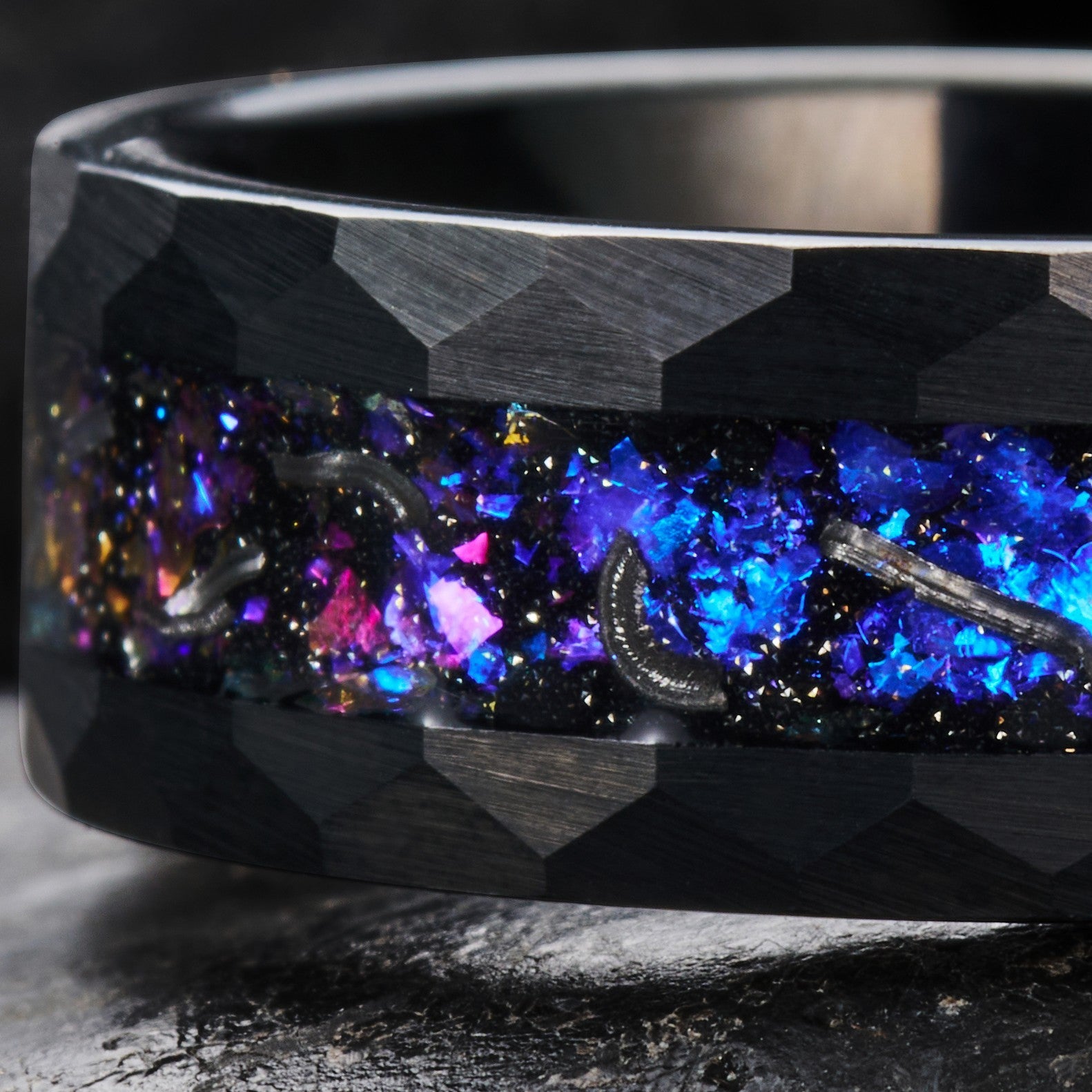
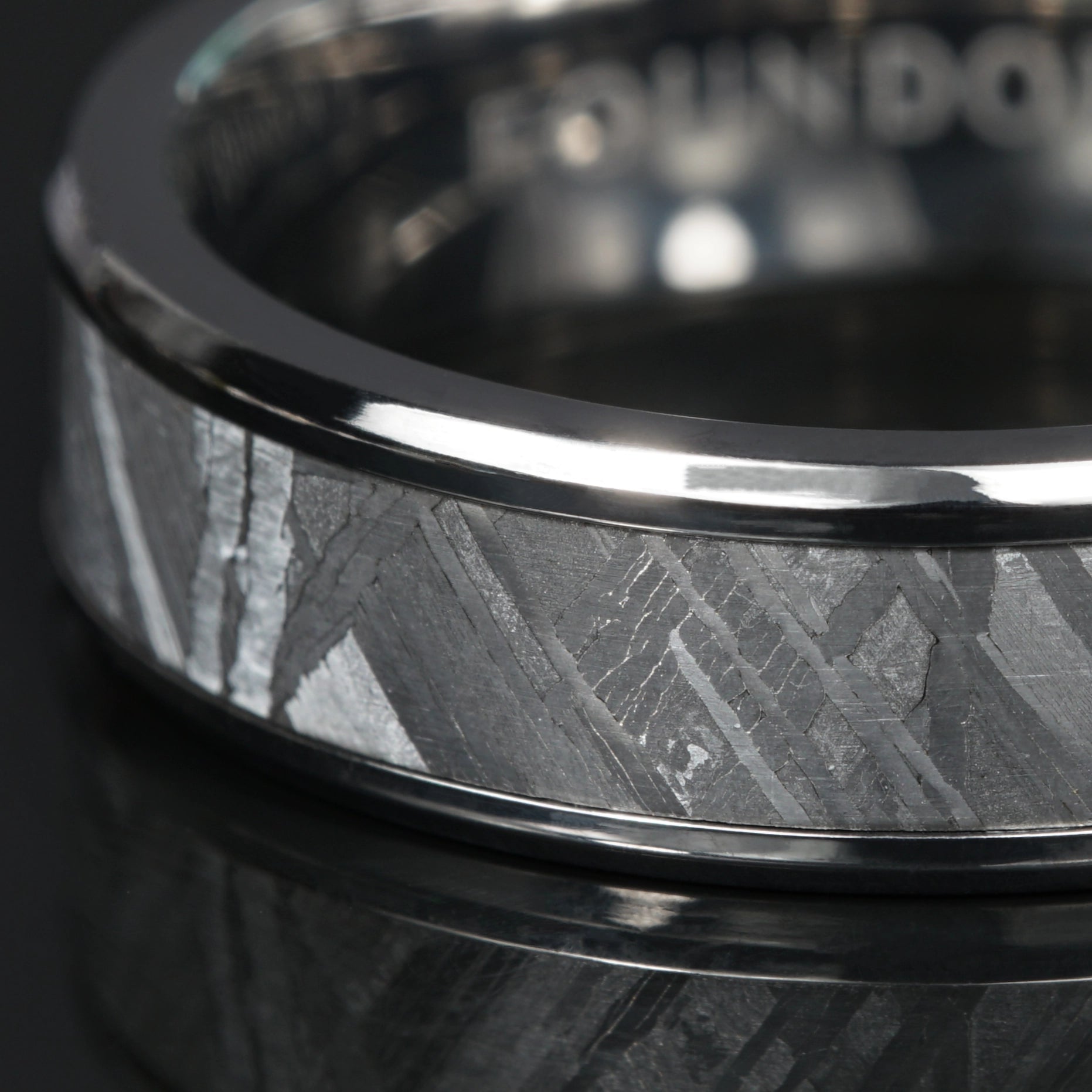
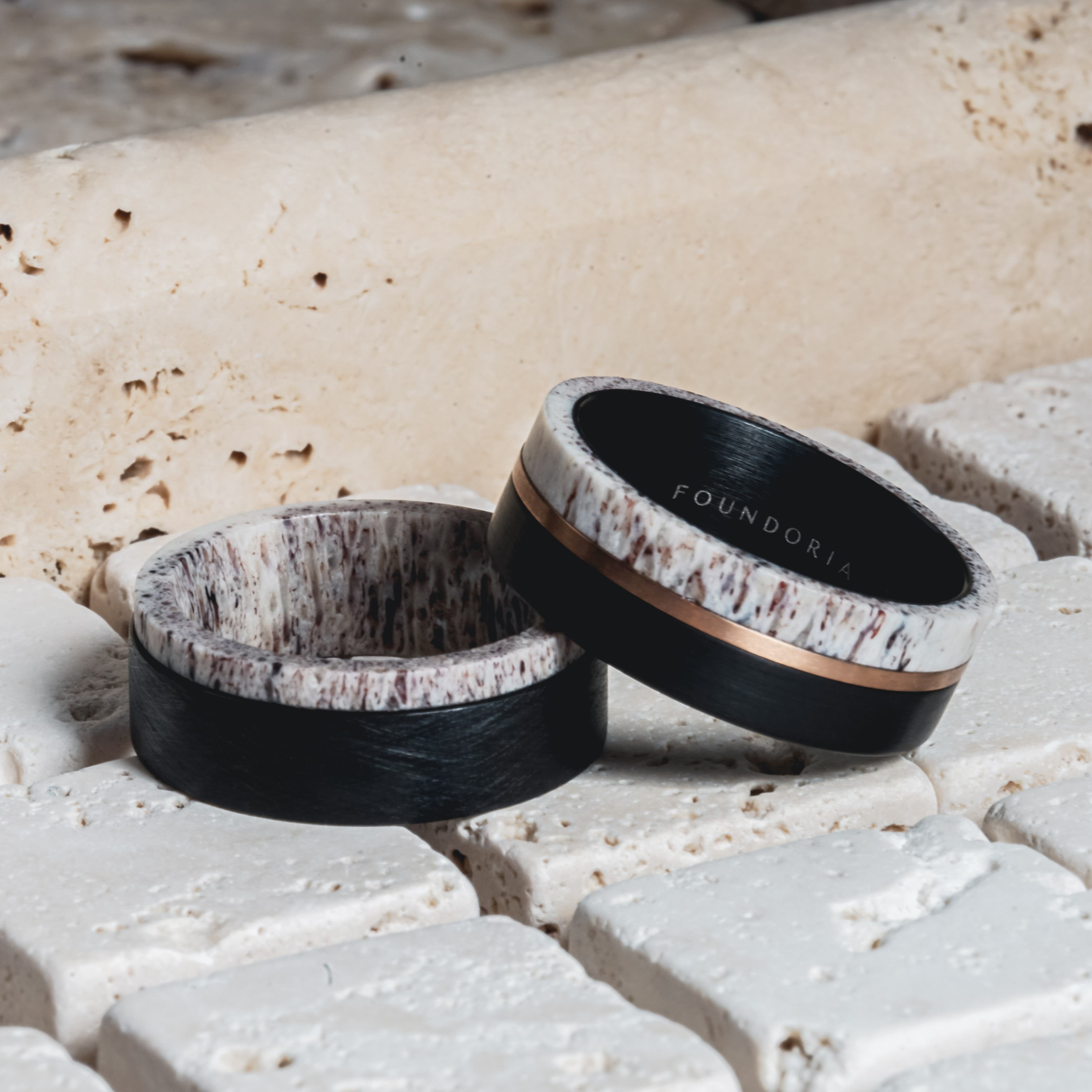

Titanium wasn't always on the radar for men's rings. For decades, the conversation started and ended with gold, silver, and platinum. Precious metals with centuries of tradition behind them and, if we're being honest, centuries of the same scratches, dents, and maintenance issues.
Then titanium turned up. A metal originally developed for jet engines and surgical implants, engineered to be stronger than steel at nearly half the weight. And somewhere along the way, ring designers realised it made for an exceptional piece of jewellery.
Here's why it's become one of the most popular choices for men who want something that actually performs on their hand.
The Numbers Behind Titanium
Before anything else, it helps to understand what makes titanium unusual as a material. Most metals force you to choose between strength and weight. The stronger they are, the heavier they tend to be. Titanium doesn't follow that rule.
That combination (strong, light, and hard enough to outperform precious metals) is what makes titanium work so well as a ring material. It's not trying to be the hardest metal available (tungsten carbide holds that title comfortably). What it does is balance every practical quality you'd want in something you're wearing for the rest of your life.
Stronger Than Every Precious Metal, By a Comfortable Margin
This is the part that surprises most people. Titanium isn't just a bit harder than gold and silver. The gap is significant.
What that means in practice: a gold ring will pick up scratches from your car keys, your desk, even the zip on your jacket. Platinum fares better but still shows wear relatively quickly for its price tag. Titanium resists all of that more effectively. Not perfectly (it will develop fine surface marks over years of daily wear), but enough that the difference is obvious next to any precious metal.
There's also a distinction worth making between hardness and toughness. Hardness measures resistance to surface scratching. Toughness measures resistance to structural failure: cracking, bending, breaking. Titanium scores well on both. It has the highest strength-to-weight ratio of any metal, meaning it absorbs impacts without cracking and resists deformation without being brittle. That's a rare combination, and it's the reason titanium is the material of choice in aircraft frames, surgical bone replacements, and high-performance engine components.
The Weight Question (And Why It Matters More Than You'd Think)
Titanium's weight, or rather its lack of weight, is the single most common reaction people have when they first try one on. It's genuinely startling. Your brain expects metal to feel heavy, and titanium simply doesn't.
Our titanium rings typically weigh between 5 and 8 grams, meteorite inlay and all. A comparable gold ring weighs several times that. Even platinum, which most people consider the premium option, is significantly heavier.
What does that actually feel like?
Genuinely close to nothing. Most men who've never worn a ring before say they forget titanium is on their finger within a day. If you've ever avoided rings because you find them distracting or uncomfortable, titanium removes that barrier entirely.
For men who want to feel their ring, who like that constant presence on their hand, titanium probably isn't the right fit. That substantial, grounding weight is where tungsten carbide excels, and it's a perfectly valid preference. But if comfort and forgettability are what you're after, nothing else comes close to titanium.
The lightweight nature of titanium has a design benefit too. Because the base metal adds so little weight, wider inlay sections (meteorite, wood, antler) remain comfortable to wear all day. A wide meteorite band in a heavier metal can start to feel cumbersome. In titanium, it sits effortlessly. It's the reason our widest meteorite setting, a full 5mm channel, is built on titanium rather than anything denser.
Biocompatible, Not Just Hypoallergenic
Most alternative ring metals are marketed as hypoallergenic, and that's technically accurate for titanium. But titanium goes further than that. It's biocompatible — meaning the human body doesn't recognise it as a foreign material.
This is why titanium is the standard material for surgical implants: hip replacements, dental posts, bone plates, and pacemaker housings. The body accepts titanium without rejection, inflammation, or allergic response. No other ring metal can make that claim with the same level of medical evidence behind it.
For men with sensitive skin or a history of reactions to jewellery, titanium is about as safe as it gets. It won't discolour your skin, it won't cause rashes, and it won't degrade from contact with sweat, saltwater, or chemicals. Samples across our range are tested by SGS against REACH standards, and we've grouped every suitable design into our rings for sensitive skin collection.
Corrosion Resistance That Actually Holds Up
Gold doesn't tarnish. Silver does, notoriously so. Platinum holds up reasonably well. But titanium's corrosion resistance operates on a different level entirely.
Titanium forms a natural oxide layer on its surface, a microscopically thin barrier that self-repairs when damaged. Scratch the surface, and the oxide layer reforms almost immediately. This is why titanium survives in seawater, chlorinated swimming pools, industrial chemicals, and the inside of the human body without degradation.
For a ring, that translates to something simple: it won't tarnish, discolour, react with your skin, or degrade from any substance you're likely to encounter in daily life. It's one of the few metals where "lifetime durability" isn't marketing language. It's materials science.
The Look: Platinum's Colour Without Platinum's Price
Titanium's natural colour is a cool grey-silver, sitting somewhere between the bright white of rhodium-plated white gold and the slightly warmer tone of polished platinum. When jewellery industry sources describe titanium's appearance, the comparison that comes up most consistently is platinum. The two metals share that understated, silvery-white quality that works with practically anything.
The difference worth knowing is what happens over time. White gold achieves its bright white finish through rhodium plating, a surface coating that gradually wears away, revealing the slightly yellowish alloy underneath. Maintaining that "like new" white gold look means periodic replating, which adds cost and inconvenience across the life of the ring. Platinum holds its colour naturally but develops a dulled patina that needs professional polishing to restore.
Titanium's colour is the metal itself. There's no plating to wear through, no underlying alloy waiting to show. The grey-silver tone you see on day one is the same grey-silver tone it carries for life. It won't yellow, won't reveal a different colour underneath, and won't need replating at any point.
For men who like the look of platinum or white gold but don't want the maintenance cycle (or the price tag), titanium delivers that aesthetic naturally and permanently. It's worth noting that titanium sits in a slightly darker, more contemporary register than the bright white of freshly plated white gold, which for most men looking at alternative rings is exactly the tonal range they're drawn to.
How Titanium Ages (And Why Some Men Prefer It)
Titanium won't stay looking factory-new forever. Over months and years of daily wear, it develops fine surface marks, a gradual patina that changes the finish without compromising the structure.
Whether that's a positive or a negative depends entirely on your perspective. Some men want their ring to look identical in year twenty as it did on day one. If that's you, tungsten carbide is the better choice. Its hardness means scratches simply don't happen.
But there's a growing number of men who actively prefer the idea of a ring that records their life. Every mark is a moment. A day at work, a weekend project, a holiday, an adventure. The ring becomes personal in a way that a permanently polished surface can't replicate.
If the patina ever bothers you, titanium can be professionally re-polished to restore its original finish. And choosing a brushed or matte finish from the start hides everyday wear far more effectively than a mirror polish would.
Who Titanium Suits Best
First-Time Ring Wearers
If you've never worn a ring before, titanium is the easiest transition. Its weight is so minimal that most men stop noticing it within a day. No adjustment period, no distraction.
Active Lifestyles
Gym, climbing, cycling, manual work. Titanium's strength-to-weight ratio means it handles impact and pressure without adding bulk. It won't crack under stress the way harder, more brittle metals can.
Sensitive Skin
Titanium's biocompatibility is backed by decades of medical research. If other metals have caused reactions, titanium is among the safest options available, and it won't discolour skin.
Statement Inlay Designs
Titanium's lightweight base allows wider, bolder inlay sections (meteorite, bourbon oak, antler) to remain comfortable all day. Designs that would feel heavy in other metals sit effortlessly in titanium.
Titanium Rings from Foundoria
Five titanium designs, from an everyday antler band to the widest meteorite setting we make. Every one is comfort-fit and REACH and GPSR certified.


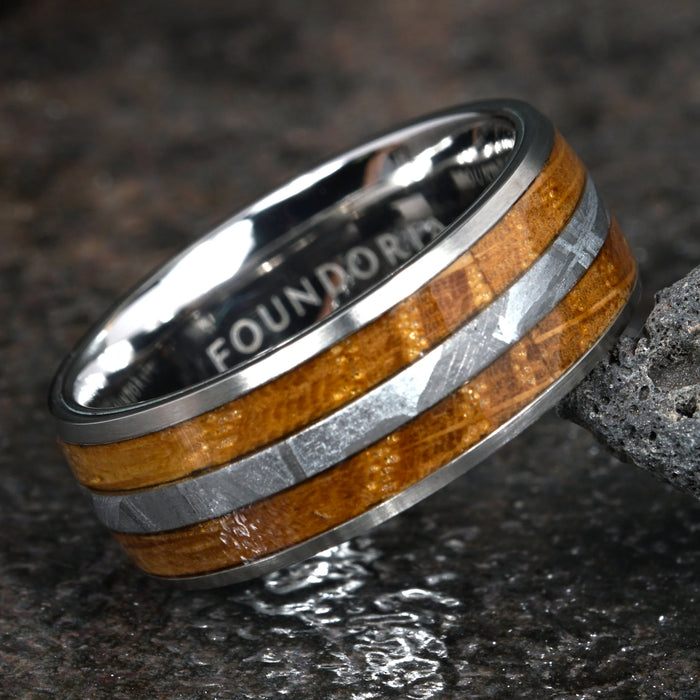


The three CELESTIUM designs are available in every size from UK L½ to Z+2, whether or not that size is in stock on the day. Sizes we don't hold are made to order and typically dispatched in 8 to 10 weeks, with the arrival window shown on the product page before you buy. Crest is stocked in nine sizes from P½ upwards, and Brow in sizes UK L½ to Z+3.
When Another Metal Might Be the Better Fit
It wouldn't be honest to talk about titanium without acknowledging where other materials have the advantage.
Tungsten carbide, for a permanent polish
Tungsten is significantly harder (8.5 to 9.5 on the Mohs scale) and its scratch resistance is unmatched outside of diamond. If keeping that pristine, just-out-of-the-box finish for decades is a priority, tungsten delivers that in a way titanium can't. It also offers a heavier, more substantial feel. For men who want to be constantly aware of their ring, who find that weight grounding, it's a better match than titanium's near-weightlessness. We've written a full comparison of tungsten vs titanium if you want the two side by side.
Black zirconium, if you want black
Titanium can be finished black, but the colour is a coating over grey metal, and coatings wear thinnest at the contact points. Black zirconium is different: its black is the metal's own surface, chemically converted to a ceramic during manufacture, so there's no layer to wear through. It's harder than titanium and heavier, though still well short of tungsten. If black is the point rather than a preference, that's the material to read about. Our guide to black zirconium rings covers it properly.
All three metals are hypoallergenic, corrosion-resistant, and tougher than any precious metal. The choice comes down to what you value on your hand: permanent polish and presence, permanent colour, or lightweight comfort and character.
Emergency Removal
Titanium can be removed in any hospital A&E department using standard ring cutters with a diamond blade. It's a straightforward procedure that any emergency team is equipped for. This shouldn't be a concern when choosing your ring. It's a solved problem.
Frequently Asked Questions
Is titanium stronger than gold?
Considerably. Titanium rates 6.0 on the Mohs hardness scale compared to gold's 2.5–3.5. It's also structurally tougher. Titanium has the highest strength-to-weight ratio of any metal, meaning it resists bending, deformation, and impact far more effectively than gold, silver, or platinum.
Will a titanium ring scratch?
Over time, yes — titanium will develop fine surface marks from daily wear. It's significantly more scratch-resistant than gold, silver, and platinum, but it won't stay pristine the way tungsten carbide does. Many men see this as character. A brushed finish hides everyday wear well, and titanium can be re-polished if you want to reset it.
How light is a titanium ring?
Our titanium rings typically weigh between 5 and 8 grams, meteorite inlay included. Most men say they forget it's on their finger within a day. If you've never worn a ring before and want the easiest transition, titanium's weight, or lack of it, is its biggest advantage.
Can titanium rings be resized?
No. Titanium can't be resized due to the properties of the metal. Accurate sizing before ordering is essential. Use our free ring sizer to get it right first time.
Is titanium safe for sensitive skin?
Titanium is biocompatible, meaning the human body doesn't recognise it as a foreign material, which is why it's used in surgical implants. It won't cause reactions or discolour your skin, and samples across our range are tested by SGS against REACH standards. It's one of the safest ring metals available for sensitive skin.
Is titanium better than tungsten?
Neither is objectively better; they excel at different things. Titanium is lighter, structurally tougher, and more comfortable if you prefer not to feel your ring. Tungsten is harder, more scratch-resistant, and offers a substantial weight on the finger. The right choice depends on what matters most to you. Our tungsten vs titanium comparison covers the full breakdown.
Titanium or black zirconium?
If you want a grey-silver ring at the lowest possible weight, titanium. If you want a black ring whose colour will not wear away at the knuckle, black zirconium, because its black is grown into the metal rather than coated on. Black zirconium is harder and heavier than titanium, and sits at a higher price point.
Does titanium tarnish?
No. Titanium forms a self-repairing oxide layer that prevents tarnishing, corrosion, and discolouration. It's resistant to sweat, saltwater, chlorine, and virtually every substance you'll encounter in daily life.