

Tungsten vs Titanium Rings: Which One Actually Suits You?
Tungsten and titanium come up in almost every conversation about alternative wedding rings. Both sit in similar price brackets, both look the part, and both outperform gold and silver in durability by a comfortable margin.
But wearing them? Completely different. One sits heavy on the hand — a constant presence you're always aware of. The other practically vanishes. One shrugs off scratches like nothing happened. The other earns its marks over time, developing a finish that's entirely yours.
Neither of those descriptions makes one better than the other. It depends on what you actually want from a ring — and this guide is here to help you figure that out.
At a Glance: Tungsten vs Titanium
| Factor | Tungsten Carbide | Titanium | Edge |
|---|---|---|---|
| Hardness | 8.5–9.5 (Mohs) | 6 (Mohs) | TUNGSTEN |
| Scratch Resistance | Exceptional — near diamond | Good — outperforms gold and silver | TUNGSTEN |
| Weight | Heavy, substantial | Featherlight | Preference |
| Structural Strength | Rigid — can fracture on extreme impact | Flexible — absorbs impact without breaking | TITANIUM |
| Strength-to-Weight | Very strong but dense | Highest ratio of any metal | TITANIUM |
| Can Be Resized? | No | Limited (plain bands only) | TITANIUM |
| Hypoallergenic | Yes | Yes | TIE |
| Tarnish / Corrosion | Never | Never | TIE |
| Polish Retention | Permanent mirror finish | Develops character over time | TUNGSTEN |
| Price Range | £80–£250 | £50–£550 | TIE |
| Design Versatility | Excellent — inlays, finishes, colours | Growing — premium inlays in titanium | TUNGSTEN |
Scratch Resistance: Where Tungsten Pulls Away
If you want the honest answer on scratch resistance, it's not close. Tungsten carbide rates between 8.5 and 9.5 on the Mohs scale — only diamond sits above it. That means your keys, tools, door handles, gym equipment… none of it will leave a mark.
Titanium sits at 6 on the same scale. To put that in context, it's harder than gold (2.5–3), silver (2.5–3), and platinum (4–4.5) by a significant margin. You'd scratch a gold ring opening a can of Coke. Titanium holds up far better than that. But it will pick up fine surface marks over time — particularly from harder metals and abrasive surfaces.
- 8.5–9.5 Mohs hardness
- Only diamond can scratch it
- Mirror polish stays permanently
- Immune to keys, tools, daily contact
- No polishing or maintenance needed
- 6 Mohs hardness
- Harder than gold, silver, and platinum
- Fine marks develop with daily wear
- Brushed finishes mask wear well
- Can be re-polished if needed
Some wearers see those surface marks as a downside. Others see a ring that's gradually becoming theirs — a finish shaped by their life rather than frozen in time on day one. There's no wrong answer here, but if a permanently pristine surface matters to you, tungsten is the only metal that delivers it outside of diamond.
Weight: This One's Entirely Personal
This is where personal preference takes over from technical specs. There's no better or worse here — just what feels right on your hand.
Some wearers want that presence. Others want to forget it's there. Both are valid.
What the Weight Actually Feels Like
Tungsten has a noticeable heft. Many wearers describe it as reassuring — a constant reminder on your finger that feels premium and deliberate. If you've tried on a gold ring and liked the weight, tungsten takes that sensation and amplifies it.
Titanium is genuinely startling the first time you try it on. It's so light that your brain questions whether it's actually metal. For those who've never worn rings, or who find jewellery distracting, that near-weightlessness is titanium's biggest selling point. It's also the reason aerospace engineers and surgeons rely on it — maximum strength at minimum weight.
If you're unsure which camp you fall into, try this: wear a heavier watch for a day. If the weight feels grounding and you like it, lean tungsten. If it annoys you by lunchtime, titanium is your answer.
Structural Strength: Hard vs Tough
This is the section most comparison guides get wrong, because they treat "durable" as a single concept. It isn't. Hardness and toughness are different properties, and tungsten and titanium sit on opposite ends of that spectrum.
- Resists scratches and surface abrasion
- Won't bend, warp, or dent
- Maintains its exact shape permanently
- Can fracture under extreme blunt impact
- Shatters cleanly rather than deforming
- Highest strength-to-weight ratio of any metal
- Flexes microscopically under pressure
- Absorbs impact without cracking or breaking
- Used in aircraft frames and surgical implants
- Virtually impossible to structurally damage
Tungsten is hard — it resists surface damage better than almost anything on the planet. But hardness comes with brittleness. Under enough blunt force (dropping it onto concrete from a height, hitting it square with a hammer), tungsten can crack. It's worth noting that "enough force" is genuinely unusual — the vast majority of tungsten ring owners will never come close to experiencing it in daily life.
Titanium is tough — it resists structural failure. It has the highest strength-to-weight ratio of any metal, which is exactly why it turns up in jet engines and bone replacements. A titanium ring will absorb impacts that would crack tungsten, and it won't deform the way gold or silver would. You could throw it at a wall and pick it up with nothing more than a surface scuff.
For everyday wear, both are far more durable than anything in a traditional jeweller's window. The practical difference only matters if your hands regularly meet heavy impacts — construction, mechanics, climbing. In those situations, titanium's structural resilience gives it a genuine edge.
Titanium Rings from Foundoria
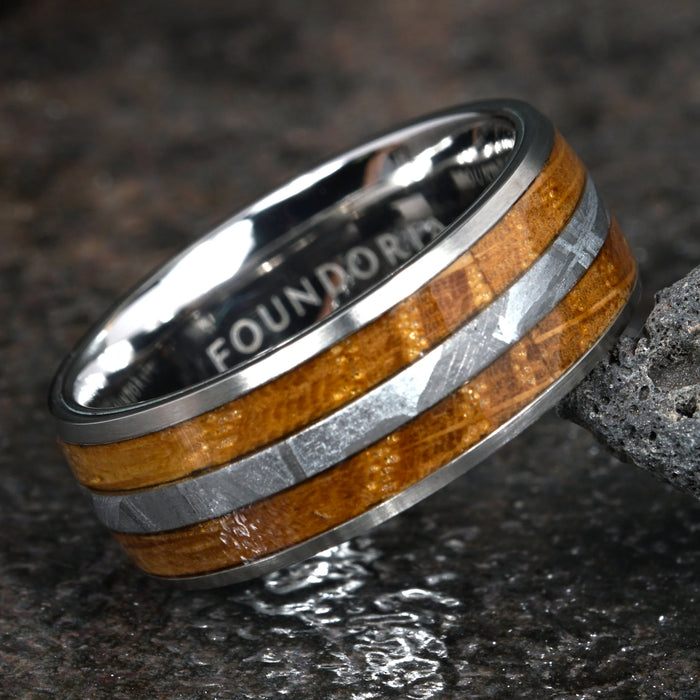
Both featured pieces below are drawn from our CELESTIUM collection — titanium rings paired with genuine Muonionalusta meteorite.

Design Options: More Range Than You'd Expect
Tungsten has historically offered more variety, and that's still true. Its density and hardness make it an excellent base for inlays — materials like deer antler, whisky barrel wood, meteorite, and carbon fibre bond securely to tungsten and stay protected by the surrounding metal. You'll find tungsten rings in black, silver, rose gold, and gunmetal finishes, often combining multiple textures in a single band.
Titanium was traditionally more limited — solid metal with a brushed or polished finish and not much else. That's changed. Titanium now serves as the base metal for some of the most striking inlay work available, particularly with meteorite. Its lighter weight means wider inlay sections are comfortable to wear all day, which opens up design possibilities that heavier metals can't match. A wide meteorite inlay in tungsten would feel like an anchor. In titanium, it sits effortlessly.
Both metals support a range of finishes — brushed, polished, matte, hammered — and both accept colour treatments well. The real question isn't which metal offers more options overall, but which specific ring catches your eye.
Emergency Removal — A Solved Problem
This comes up a lot, so let's deal with it quickly. Both tungsten and titanium can be removed in any A&E department. Tungsten is cracked off using vice-grip pliers (it fractures cleanly and safely). Titanium is cut using standard ring cutters with a diamond blade. Neither presents an issue for medical professionals, and neither should factor into your decision.
Which One Suits Your Life?
💎 Tungsten Is Your Metal If:
- You want a ring that never scratches — full stop
- You like the feel of weight on your finger
- Permanent polish with zero maintenance appeals to you
- You want your ring to look identical in year 20 as day one
- You prefer modern aesthetics with natural material inlays
- You work with your hands and want it to stay pristine
⚡ Titanium Is Your Metal If:
- You want a ring you genuinely can't feel on your finger
- You've never worn jewellery and don't want to notice it
- You prefer a ring that develops its own character over time
- Maximum structural toughness matters for your lifestyle
- You're drawn to wider inlay designs that need a lighter base
- The idea of aerospace-grade metal on your hand appeals to you
The Foundoria Verdict
Honestly? There's No Wrong Choice Here.
If scratch resistance and permanent polish are your priorities, tungsten carbide is unmatched. Nothing short of diamond will mark it, and it'll look factory-new decades from now. The weight feels deliberate, premium — a constant reminder that it's there.
If lightweight comfort and structural toughness matter more, titanium earns its place. It outperforms every precious metal in strength, disappears on your finger, and opens up design possibilities that heavier metals can't support. There's a reason it's trusted in aircraft and surgical implants — and that same engineering sits on your hand.
Both are tougher than gold, silver, and platinum. Both are hypoallergenic. Both will last. The real question is whether you want to feel your ring or forget it's there — and only you know the answer to that.
Tungsten Rings from Foundoria


Frequently Asked Questions
Is tungsten heavier than titanium?
Roughly three times heavier, yes. An 8mm tungsten ring weighs around 12–15g compared to about 3–5g in titanium. Some wearers love the substantial feel; others want something they can't notice. Neither preference is wrong — it's genuinely personal.
Will a titanium ring scratch easily?
Not easily, no — titanium is significantly harder than gold, silver, and platinum. But it will develop fine surface marks from daily wear over time. Many owners see this as character rather than damage. A brushed finish hides wear well, and titanium can be re-polished if you want to reset it.
Can tungsten rings really crack?
Under extreme blunt impact, yes — like dropping it squarely onto concrete from height or striking it with a hammer. In normal daily wear, it's extremely rare. Most tungsten ring owners never come close to experiencing it. The concern is valid but overstated.
Can either ring be resized?
Tungsten carbide can't be resized — the hardness and brittleness of the material rules it out entirely. Plain titanium can be resized by specialist jewellers, typically within about half a size either direction, though the work is expensive enough that replacement is often more practical. Titanium rings with inlays — meteorite, antler, wood — can't be resized without disturbing the inlay itself. Accurate sizing before ordering matters for both materials. Use our free ring sizer to get it right first time.
Which is better for sensitive skin?
Both are hypoallergenic. Titanium is biocompatible — the same grade used in surgical implants — and safe for the vast majority of wearers, including those with severe nickel allergies. Foundoria's tungsten carbide is manufactured with a low-nickel binder and independently tested to EN 1811:2023 by an IAS-accredited laboratory, with nickel release measured below the detection limit of 0.05 μg/cm²/week — ten times lower than the REACH threshold. Our tungsten is safe for the vast majority of wearers, including those with mild nickel sensitivity. For severe or medically-diagnosed nickel allergies, titanium is the safer choice of the two. Full detail and test documentation: our hypoallergenic rings guide.
Is titanium stronger than gold and silver?
Considerably. Titanium has the highest strength-to-weight ratio of any metal. It's roughly twice as strong as gold and significantly harder than silver and platinum, while being lighter than all of them. It's the reason it's used in aerospace and medical implant engineering.