
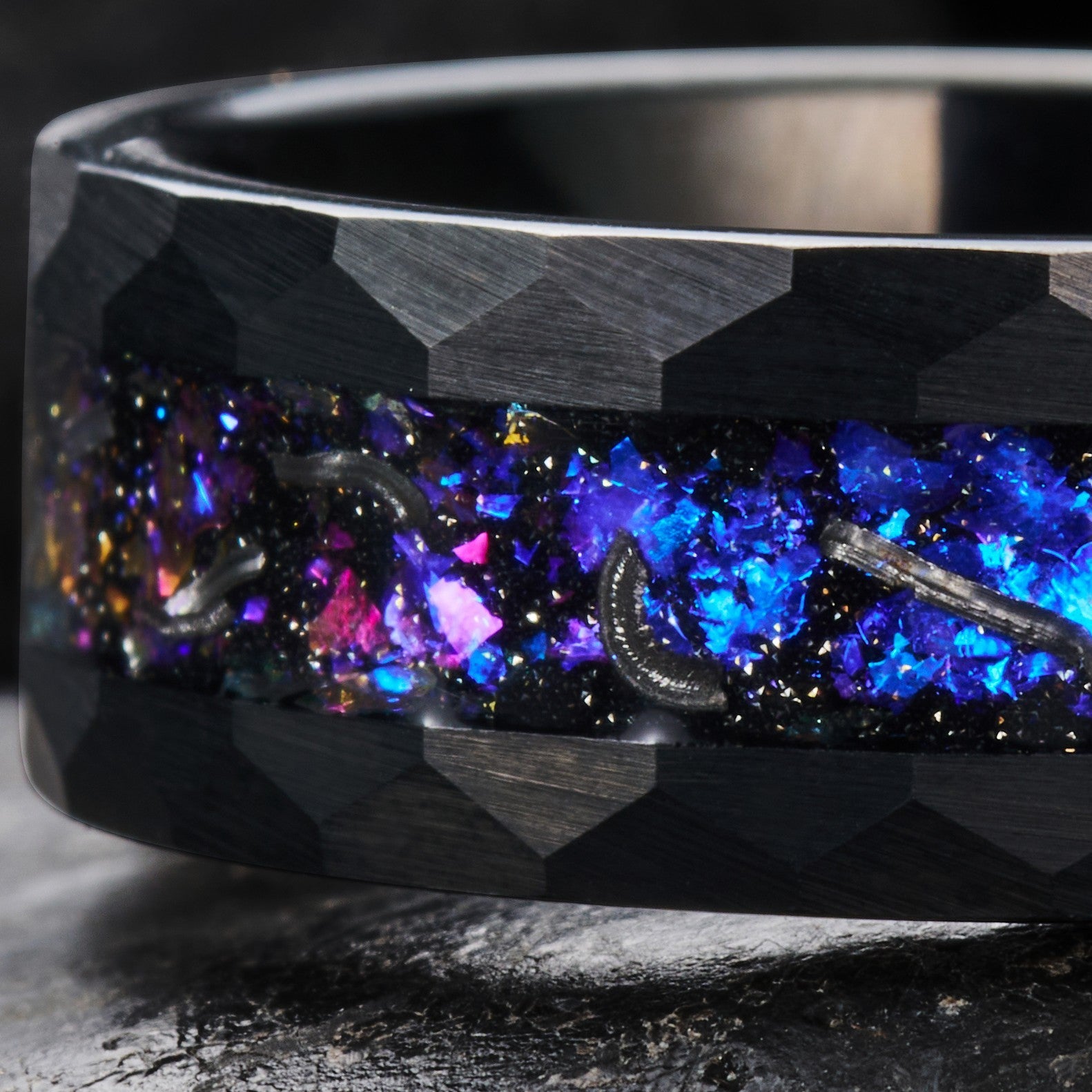
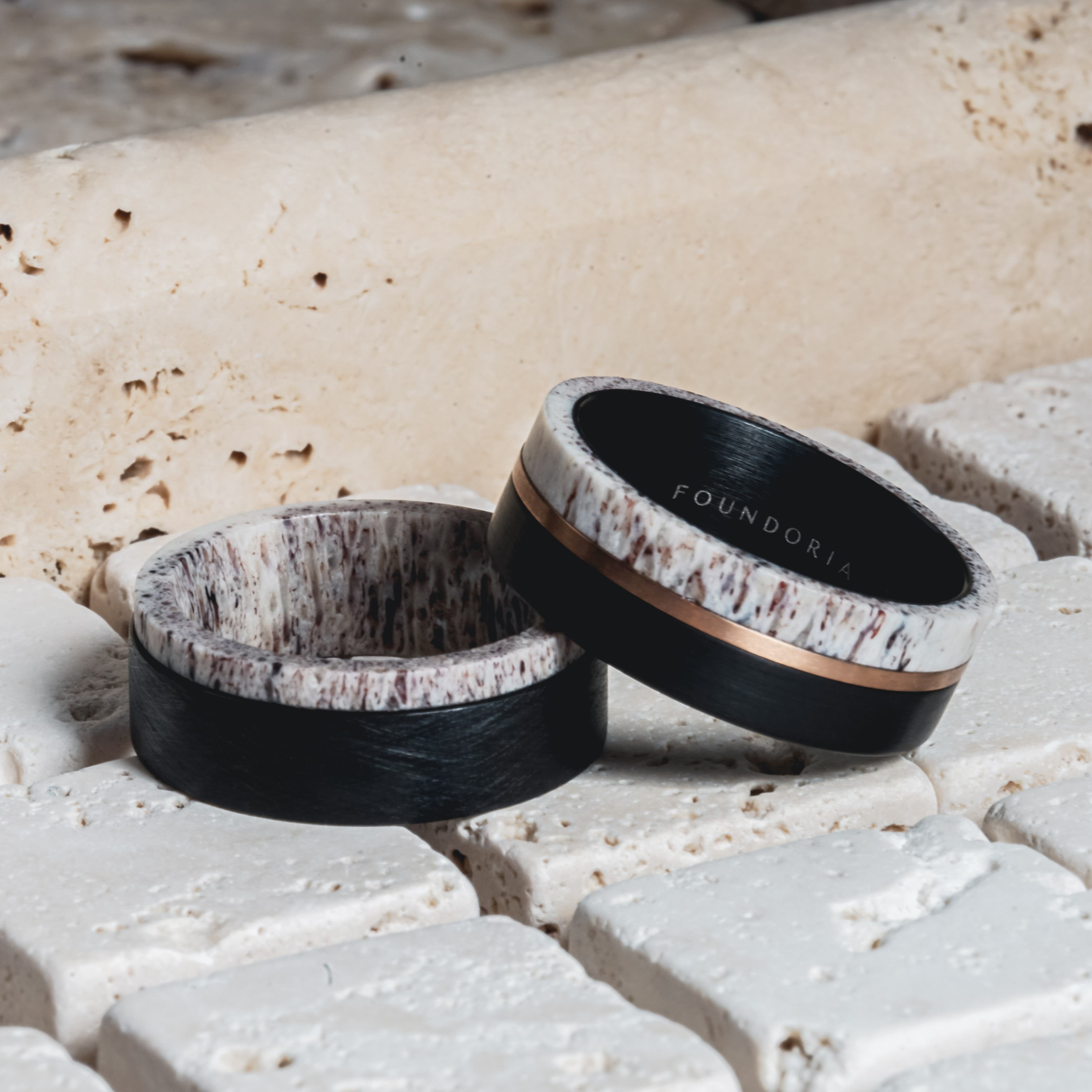

Gibeon and Muonionalusta are iron-nickel meteorites used in jewellery for their distinctive Widmanstätten pattern, a crystalline structure that forms only over millions of years in space and cannot be replicated on Earth. Both are genuine, both are roughly 4 billion years old as material, and both are used in Foundoria's CELESTIUM collection. Gibeon pairs with tungsten. Muonionalusta pairs with titanium. The pattern is your proof.
- Gibeon meteorite is roughly 4 billion years old, older than the Earth itself.
- It fell to Earth in prehistoric times in what is now Namibia, southern Africa.
- The Widmanstätten pattern can only form over millions of years of cooling in space. It cannot be faked or replicated.
- Dark spots, rust tones, and surface variation are natural properties of genuine meteorite, not defects.
- Gibeon is classified as a fine octahedrite, one of the most visually striking meteorite types for jewellery.
- Every Foundoria meteorite ring is finished with an electrophoretic coating on the inlay. This is a protective barrier against oxidation in everyday wear.
Updated for 2026.
Somewhere between 4 and 4.5 billion years ago, before the Earth had fully formed, before the oceans existed, before any living thing had drawn breath, a body of molten iron was cooling slowly in the void between planets. Over millions of years, as the temperature dropped by a fraction of a degree per million years, crystalline structures began to form inside the metal. Geometric, interlocking, utterly unlike anything that forms on Earth.
That cooling process eventually stopped when the parent body was shattered by a collision. The fragments drifted through space. Eventually, one group of them found Earth. They fell in prehistoric times over what is now Namibia. They lay in the ground for thousands of years. And now one of them is on your finger.
Every meteorite ring in the CELESTIUM collection is finished with an electrophoresis coating (e-coat) applied directly to the meteorite inlay during manufacture. This industrial electrochemical process bonds a uniform protective layer to the meteorite surface, preventing oxidation under normal wearing conditions. It does not alter the appearance of the Widmanstätten pattern. In everyday use, the e-coat does its job without you needing to think about it.
For longer-term care, we recommend applying a thin layer of Renaissance Wax to the inlay every 6 to 12 months. This museum-grade microcrystalline wax fills micro-scratches in the e-coat surface and adds a supplementary hydrophobic barrier, extending the coating's effective life. Full guidance, including what to do if the ring is exposed to chlorine or harsh chemicals, is in our ring care guide.
The Gibeon meteorite is named after the town of Gibeon in Namibia, near where the first fragments were found by European explorers in the early 19th century. The local Nama people had known about them long before. They used the iron to forge tools, the material recognised as something extraordinary long before anyone had the science to explain why.
The strewn field, the area across which the meteorite fragments are scattered, covers thousands of square kilometres of the Namibian desert. In 1911, the entire field was declared a national monument, and today Namibian law prohibits the unlicensed export of meteorite material found within its borders.
The Gibeon used in jewellery today comes from material that was legally recovered and exported prior to these restrictions, or from pieces that have been in collections and the trade for decades. It is a finite resource. There is no new Gibeon meteorite being produced, which is part of what makes it genuinely rare rather than artificially so.
Cut a slice of Gibeon meteorite, polish it, and treat it with a mild acid. What appears is one of the most striking structures in nature: a geometric lattice of interlocking crystals, forming long bands that cross and intersect at precise angles. This is the Widmanstätten pattern, named after Count Alois von Beckh Widmanstätten, who first documented it in the early 19th century.
The pattern forms from two iron-nickel alloys, kamacite and taenite, that crystallise at different rates as the parent body cools. For the Widmanstätten pattern to develop, the cooling process has to take place over an enormous timescale. Estimates suggest around 1°C per million years. At any faster rate, the crystals don't have time to organise themselves into the characteristic bands.
This is why the Widmanstätten pattern is an absolute authenticator of genuine meteorite. It is physically impossible to replicate in a laboratory or factory. The timescales involved are simply beyond any human process. If you can see the pattern, you are looking at something that formed in space over millions of years. There is no other explanation.

This is one of the most important things to understand before buying a meteorite ring, and something that isn't explained well enough in most places that sell them.
Genuine Gibeon meteorite is not a uniform material. It spent four billion years in space, survived atmospheric entry, and lay in a desert for thousands of years before anyone found it. Every piece carries the marks of that history. The following are all entirely normal properties of authentic meteorite inlays. They are not manufacturing defects, not signs of poor quality, and not cause for concern.
Dark spots and inclusions. These appear as small dark patches or flecks within the meteorite surface. They are typically troilite, a naturally occurring iron sulphide mineral that forms within the meteorite as it cools. Troilite inclusions are found in virtually all genuine iron meteorites. A surface with no dark inclusions whatsoever is actually more unusual than one that has them.
Rust-coloured tones. Gibeon meteorite contains iron, and some pieces carry warm orange, brown, or reddish tones within the inlay. These are traces of oxidation present in the material long before it became a ring, part of its geological history. The electrophoresis coating (e-coat) applied during manufacture protects against new oxidation in everyday wear, so these tones are stable characteristics of that specific piece of meteorite, not signs of ongoing deterioration.
Variation in pattern density and clarity. The Widmanstätten pattern does not look identical across every piece, or even across different sections of the same piece. In some areas the bands will be wide and clear. In others they may be finer or less distinct. This reflects the local crystalline structure of that particular section of the original parent body.
Micro-pitting and surface texture. At close range, genuine meteorite has a slightly uneven surface texture. This comes from the acid etching process that reveals the pattern, and from the natural structure of the material itself. It will not feel or look like polished stainless steel. That texture is part of the material's authenticity.
Colour variation between rings. No two Gibeon meteorite inlays are identical. The overall tone can range from cool silver-grey to warmer, more golden hues depending on the specific alloy composition and degree of oxidation in that piece. If your ring looks slightly different from the product photography, this is expected and correct.
If you ever have a question about a feature of your ring that you're unsure about, we're always happy to look at it. But in our experience, the things customers initially query as possible defects are nearly always the most interesting parts of the material.
Gibeon is the most widely used meteorite in jewellery, but it isn't the only one. Muonionalusta, named for a region of northern Sweden where it was discovered in 1906, is an iron-nickel meteorite of a different character entirely, and in many ways a more visually dramatic one.
Where Gibeon's Widmanstätten pattern tends towards broader, bolder bands, Muonionalusta's crystalline structure is exceptionally fine. Tighter, more intricate, with a density that catches light differently. After acid etching, many pieces develop a distinctive blue-silver sheen that sets it apart from the warmer grey tones of Gibeon. The effect is striking: a ring that looks unmistakably cosmic, but with more visual complexity than a plain Gibeon piece.
Muonionalusta is also ancient. The material itself formed roughly 4.5 billion years ago in the early solar system, like all iron meteorites. What makes it unusual is when it landed: the Muonionalusta meteorite fell to Scandinavia approximately one million years ago, making it one of the oldest known meteorite finds on Earth. Like Gibeon, its Widmanstätten pattern is a physical impossibility to replicate. Proof of origin written into the structure of the metal itself.
At Foundoria, Gibeon and Muonionalusta are chosen for different settings. Gibeon's character suits the weight and presence of tungsten carbide. Muonionalusta, with its finer pattern and cooler visual tone, pairs naturally with titanium, where its blue-silver sheen is given full expression in a lighter, more refined band. The two meteorites tell different stories. Which one is right for you depends on what you want the ring to say.
Meteorite rings are bought for all kinds of occasions. Weddings are the most common search term, but a significant number of buyers are purchasing for anniversaries, milestone birthdays, or for themselves. The considerations below apply regardless of the occasion.
Genuine meteorite rings are more available now than they used to be. So are rings that use synthetic or meteorite-look materials: laser-etched stainless steel, iron pyrite, things that photograph similarly but have no real connection to space.
The Widmanstätten pattern is the first thing to check. It cannot be faked. If a seller cannot name the meteorite type they use (Gibeon, Muonionalusta, Campo del Cielo), ask. Most legitimate sellers will tell you without hesitation. For a detailed walkthrough of every authentication marker — including the magnet test, density check, and common signs of imitation rings flooding the lower end of the market — see our guide on how to tell if a meteorite ring is genuine.
Price is a rough signal. Entry-level rings with a thin genuine meteorite inlay (enough to show the pattern, not the centrepiece) are available from around £100. Rings where the meteorite dominates, with a wide inlay where the Widmanstätten pattern is clearly visible at any angle, typically sell for £800 to £1,200 from most UK and international jewellers. Foundoria's Astraeus is priced at £549, which sits below the market rate for a comparable wide-inlay Muonionalusta ring. Rings priced below £50 with a "meteorite" description are worth treating with scepticism.
The bigger variable than price is how much meteorite is actually in the ring. Some rings have a thin sliver, enough to show the pattern but barely present in cross section. Others use a wider, thicker band where the pattern is visible at any angle. Genuine Gibeon and Muonionalusta are finite materials. There is no cheap way to put 5mm of real meteorite into a ring.
The CELESTIUM collection covers that range. Entry pieces like Cosmos and Stellar carry genuine Gibeon at prices that reflect narrower inlays. Astraeus sits at the other end: a wide band of Muonionalusta in polished titanium where the meteorite, not the metal, is what you're wearing.
Most rings in the CELESTIUM collection use meteorite as an inlay: a band of material set into tungsten, with metal on either side. The meteorite is real, the pattern is there, but the ring is still primarily tungsten with meteorite in it.
Astraeus is built differently. The inlay is wide enough that when you look at the ring straight on, you are mostly looking at meteorite. Polished titanium frames either edge, but the centre is Muonionalusta, an iron-nickel meteorite from Scandinavia with the finest Widmanstätten pattern of any meteorite used in jewellery.
After etching, Muonionalusta develops a distinctive blue-silver sheen. At ring scale, in decent light, it looks like nothing on Earth. Which is accurate, because the material isn't from here.
Astraeus is made in small batches. Muonionalusta is a finite material and new pieces take time to source and manufacture. If your size is showing as unavailable, reach out to us at support@foundoria.co.uk and we'll let you know when to expect the next batch.

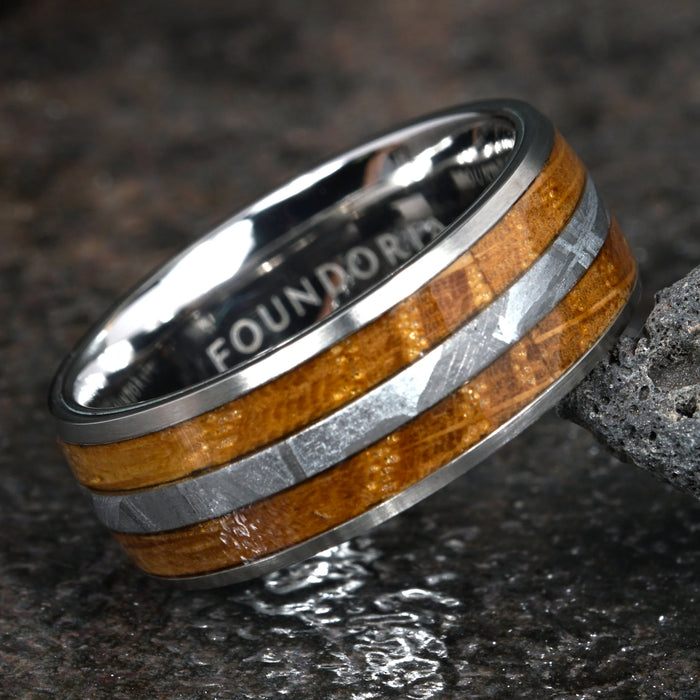


If you want a ring that carries genuine, verifiable, irreplaceable age, something no precious metal can claim, meteorite is in a category of its own. Gold is old. Silver is old. But Gibeon meteorite pre-dates the solar system. That is not a marketing claim. It is geology.
It does ask a little of you in return. The electrophoresis coating (e-coat) on the meteorite inlay does the heavy lifting, preventing oxidation against moisture in everyday conditions. Avoid prolonged exposure to chlorine or harsh chemicals, remove before swimming, and dry the ring if it gets wet. For longer-term maintenance, a thin application of Renaissance Wax on the inlay every 6 to 12 months supplements the e-coat and extends its effective life. The tungsten or titanium band itself needs no care to speak of. Full guidance is in our ring care guide.
The reward is something that is genuinely, provably unique. A Widmanstätten pattern that formed in the specific conditions of a specific parent body, four billion years ago, and has never been replicated anywhere in the universe since. If that sounds worth wearing, our full CELESTIUM collection is a good place to start, or browse the full men's tungsten rings collection if you'd like to compare materials.
Both are genuine iron-nickel meteorites with the Widmanstätten pattern, but they have distinct visual characters. Gibeon, from Namibia, tends to display broader, bolder crystalline bands with warm grey tones. Muonionalusta, from Sweden, has a finer, more intricate pattern and often develops a distinctive blue-silver sheen after etching, making it visually more complex.
Gibeon meteorite is an iron-nickel meteorite that fell to Earth in prehistoric times in what is now Namibia, southern Africa. It is estimated to be roughly 4 billion years old, older than the Earth itself, and is classified as a fine octahedrite, meaning it displays the characteristic Widmanstätten crystalline pattern that makes it one of the most visually striking meteorites used in jewellery.
Yes. Dark spots in meteorite inlays are entirely normal and expected. They are typically troilite, a naturally occurring iron sulphide mineral that forms within iron meteorites as they cool. Their presence is a marker of authentic meteorite. Rust-toned areas, variation in pattern density, and subtle surface texture are also all natural properties of genuine Gibeon meteorite, not manufacturing defects.
No. The Widmanstätten pattern requires a cooling rate of approximately 1°C per million years to form, a timescale that is physically impossible to replicate in any laboratory or manufacturing process. If the pattern is genuinely present, the material is genuinely meteoritic in origin. That pattern is your assurance. For a full walkthrough of the visual and physical markers that distinguish real meteorite from imitations, see our meteorite ring authenticity guide.
Yes. Gibeon meteorite is an iron-nickel alloy and is safe for everyday wear. All Foundoria meteorite rings are independently tested to REACH compliance standards and finished with an electrophoresis coating (e-coat) on the meteorite inlay, which prevents oxidation under normal wearing conditions. Avoid prolonged exposure to chlorine or harsh chemicals, and remove before swimming. With routine care, a thin application of Renaissance Wax every 6 to 12 months, the ring is built for daily life.
Because no two pieces of meteorite are identical. The Widmanstätten pattern varies in density and clarity between pieces, the overall colour can range from cool silver-grey to warmer tones depending on the specific alloy composition and oxidation history, and inclusions vary in size and distribution. Product photography shows a representative piece. Your ring will display the same properties but in its own unique configuration. This is not a defect; it's the nature of the material.
The Gibeon meteorite used in Foundoria rings is roughly 4 billion years old, formed during the early solar system, before the Earth had fully coalesced. For context, the Earth itself is estimated to be around 4.5 billion years old. The meteorite you're wearing predates almost everything on this planet.
Very little, with proper care. The electrophoresis coating (e-coat) applied to the meteorite inlay during manufacture is designed to prevent patina under normal wearing conditions for many years. In everyday use the coating performs reliably without any active effort on your part. The scenarios where it can degrade faster are sustained chlorine exposure, harsh cleaning chemicals, or prolonged immersion. All straightforward to avoid. To maintain the e-coat's effectiveness over time, we recommend a thin application of Renaissance Wax on the inlay every 6 to 12 months. This museum-grade microcrystalline wax fills micro-scratches in the coating surface and extends its protective life considerably. After many years of heavy wear, or if the ring has been exposed to conditions beyond normal use, some patina may eventually appear. If it does, the Widmanstätten pattern remains clear, and professional resealing is an option. Contact us at support@foundoria.co.uk if you ever have concerns about your ring's condition.
Genuine meteorite rings range considerably depending on how much meteorite is in the ring. Entry-level pieces with a narrower meteorite debris inlay, genuine meteorite but not the primary material, start from around £100. Rings where the meteorite is the centrepiece, with a solid, wide, prominent inlay, typically sell for £800 to £1,200 from established UK and international jewellers. Foundoria's Astraeus sits at £549 for a wide-inlay Muonionalusta ring in polished titanium. The lower price reflects a direct-to-customer model with no retail showroom, no intermediary margin, and no London premises to subsidise. The saving passes to you rather than covering overheads.
A small number of UK-based jewellers sell genuine meteorite rings. Foundoria's CELESTIUM collection is one. It covers entry-level tungsten rings with Gibeon inlays from £139 through to Astraeus at £549, which uses Muonionalusta in polished titanium. Other options include specialist jewellers and some Amazon sellers, though Amazon requires more care. "Meteorite" is used loosely in some listings and not all descriptions are accurate. The safest check, wherever you buy, is to ask for the specific meteorite type by name. If the seller cannot tell you, that is useful information.