

- American bourbon law requires aging in new, charred white oak barrels — no exceptions.
- Once a barrel has aged bourbon, it can never be used for American whiskey again.
- The spirit soaks into the wood grain for up to 12 years, staining it amber from the inside out.
- No two staves are identical — meaning no two bourbon barrel wood rings are either.
- Properly stabilised and sealed wood set in tungsten carbide is built for daily wear.
- The char layer on the inside of every barrel leaves a permanent mark in the wood's grain.
Updated for 2026.
At Foundoria, we have an unusual relationship with wood and craft. Our founder's mother, Elaine, made the transition from interior design to handcrafting silver jewellery from her garage — designing and making each piece by hand in limited quantities, a practice built entirely on material selection and the patience of working with something real. When we chose bourbon barrel wood as the foundation of our WELDWOOD collection, it came from a similar place: the belief that the material itself should have a story worth telling.
There's a warehouse in Kentucky — probably more than one — where thousands of charred oak barrels sit in darkness, doing nothing in particular. No machines. No electricity. Just wood, spirit, and time. This is where your ring begins.
To understand bourbon barrel wood, you first need to understand why the barrel matters so much to the whiskey inside it.
American bourbon law requires that the spirit be aged in new, charred white oak barrels. Not used barrels. Not uncharred barrels. New, charred white oak — every time, no exceptions. The char layer on the inside of each barrel acts as a filter, pulling harsh compounds from the spirit while the oak itself imparts the flavour compounds that define what bourbon tastes and smells like. Vanilla, caramel, toasted spice — these don't come from the grain. They come from the wood.
Once a barrel has done its job — typically four to twelve years depending on the distillery — it can never be used for bourbon again. The wood has given what it has to give to American whiskey. This is where the barrel's second life begins.
Most of the world's used bourbon barrels travel to Scotland and Ireland, where they're filled with Scotch and Irish whiskey and aged for another decade or more. Others go to craft breweries, hot sauce producers, and vinegar makers. A small number end up somewhere more unusual — cut apart, their staves selected for grain and character, and transformed into something you wear.
Bourbon barrel wood for rings comes from these retired staves: the long, curved planks that form the sides of a barrel. Each stave carries a record of its life. The inner face — the side that touched the whiskey — is darker, stained deep amber and brown by years of spirit contact. The outer face is lighter, more natural in tone. The grain runs in patterns shaped by the particular tree, the particular growing conditions, the particular decade in which it grew.
No two staves are identical. Which means no two rings made from them are identical either.
One of the most distinctive features of bourbon barrel wood isn't visible to the naked eye, but it's there in the grain: the remnants of the char.
Before a barrel is filled for the first time, the inside is set alight for a controlled number of seconds — anywhere from a light toast to a heavy char, depending on the distillery's preference. This creates a thin layer of carbon on the inner surface that filters sulphur compounds from the raw spirit and begins the chemical transformation that turns new make whiskey into bourbon.
Over years of use, the spirit penetrates through and beyond this char layer, carrying its colour deep into the wood. When a stave is eventually cut and shaped into a ring inlay, that history is preserved in cross-section — a subtle record of heat, time, and whiskey locked into the material on your finger.

One of the reasons people find Foundoria is that they're looking for a ring that means more than its metal. Our WELDWOOD collection was built around reclaimed American bourbon barrel oak — selected for grain quality, stabilised for durability, and set into tungsten carbide bands built to outlast the wood itself with proper care.
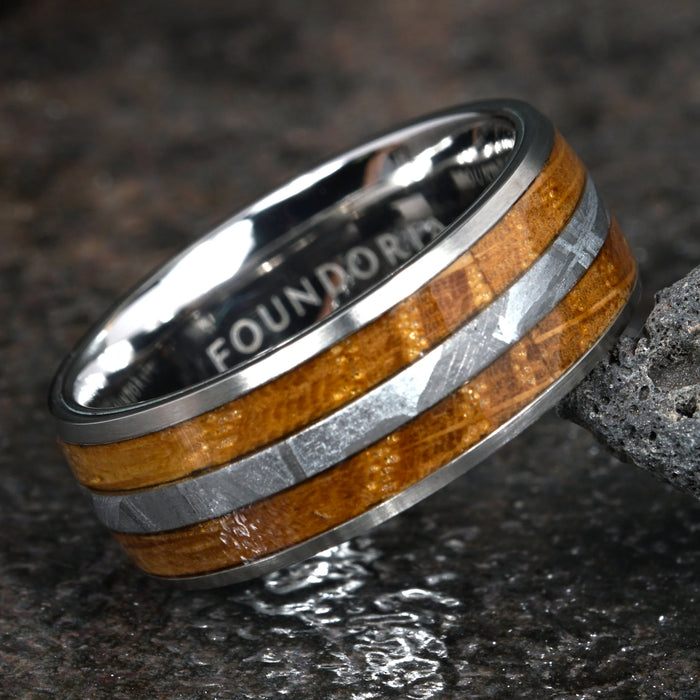
Some designs keep it clean and simple — bourbon oak in plain or two-tone tungsten. Others pair it with a second natural material: red opal in Caskara, or gold foil in the limited-edition Echelon. And then there's the Equinox — technically part of our CELESTIUM meteorite collection, but included here because bourbon barrel oak is one of its two inlays. It sits at a higher price point than the rest of the WELDWOOD range, reflecting the genuine Gibeon meteorite it carries alongside the whiskey oak. Below is a selection from the collection.


Material choice — and Elaine would say this from her years in interior design — is rarely just functional. It reflects how you want something to feel in everyday life, and what kind of relationship you want with an object you carry permanently.
Plain metals are neutral. They ask nothing of you and tell nothing about themselves. Bourbon barrel wood is the opposite — it arrives already having lived somewhere. The amber staining in the grain isn't a finish applied by a manufacturer. It's the result of years of whiskey pressing into oak, season after season, in a specific barrel in a specific warehouse. The char on the inner face is the record of a deliberate act of fire, made to transform one thing into something worth drinking.
When you wear a bourbon barrel wood ring, you're wearing the history of a particular white oak tree, the whiskey it held, the cooperer who made the barrel, and the distiller who decided how long to let it age. That story doesn't appear on the surface of the ring. It is the surface of the ring.
If your priority is a ring with visible character, warmth, and genuine material heritage, bourbon barrel wood is difficult to match. No two inlays are identical, the grain carries its history visibly, and the feel of natural wood against the skin is distinctly different to any metal. It suits people who find plain tungsten or gold a little too anonymous, and who want something that means something before they put it on.
If you work with your hands in water regularly, or want a ring that requires genuinely zero maintenance, a plain tungsten or titanium band will serve you better — natural wood inlays need to be removed before swimming, washing up, or extended water exposure. The tungsten band itself is virtually indestructible. The wood asks a little more of you, but not much.
The wood will age. Its tone may deepen slightly over years of wear. The grain may become more pronounced as the surface develops a natural patina. This is not deterioration — it's the material continuing to live, quietly, long after the barrel was dismantled. A ring that changes with you, slowly, over time. If that sounds right, our full WELDWOOD collection is a good place to start.
Bourbon barrel wood is reclaimed oak taken from retired American bourbon barrels — the new, charred white oak casks that bourbon must be aged in by law. After years of holding whiskey, the barrel is decommissioned and its staves repurposed. Selected for grain quality and character, these staves are dried, stabilised, shaped, and bonded into ring inlays — a slice of living material history that no factory process can replicate.
Yes — with appropriate care. Properly stabilised and sealed bourbon barrel wood, set in tungsten carbide, handles daily wear well. The tungsten band itself is virtually indestructible. The wood inlay requires a little more mindfulness: remove the ring before swimming, showering, or washing up, and clean gently with a soft dry cloth. Treated this way, the wood ages gracefully rather than deteriorating.
Subtly, yes. Bourbon barrel wood may deepen in tone with wear and develop a natural patina over time. This is part of its character — the material continues to age in a way that synthetic inlays cannot replicate. The grain often becomes more pronounced with patina, not less. Most wearers find this adds to rather than detracts from the ring's appeal.
Not in any persistent way. The wood is fully dried, stabilised, and sealed before it becomes a ring. The spirit itself is long gone. What remains is the material it left behind: the staining, the grain, the char. Some wearers notice a faint warmth to the scent of new wood inlays, but this fades quickly. The ring carries the story of the whiskey, not its smell.
Correct — and this isn't marketing language. Every stave has a unique grain pattern shaped by the specific tree, its growing conditions, and the particular whiskey it held. Even two rings cut from the same barrel will differ. The inlay you receive is genuinely one of a kind.
Yes. Several WELDWOOD designs pair bourbon barrel oak with a second natural material. Caskara combines it with red opal. Echelon pairs it with gold foil in a hand-assembled limited-edition design. And the Equinox — our most ambitious bourbon barrel wood piece — brings genuine meteorite and bourbon barrel oak together in an 8mm titanium band: 4 billion years of cosmic history alongside decades of American distillery heritage, in a single ring.