

- Tungsten carbide is nearly four times harder than titanium and virtually scratch-proof.
- Neither tungsten nor titanium can be resized — getting the fit right at purchase matters.
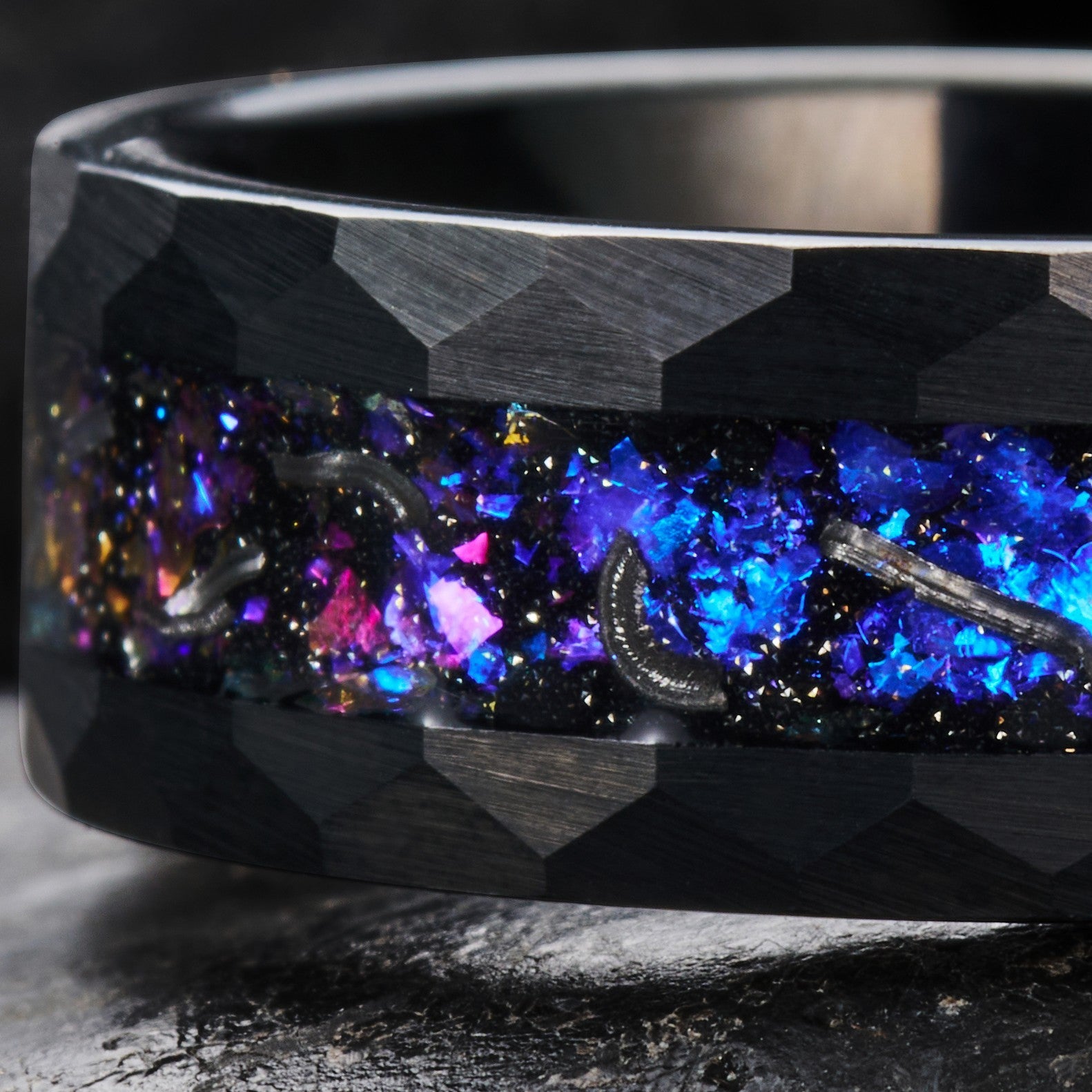
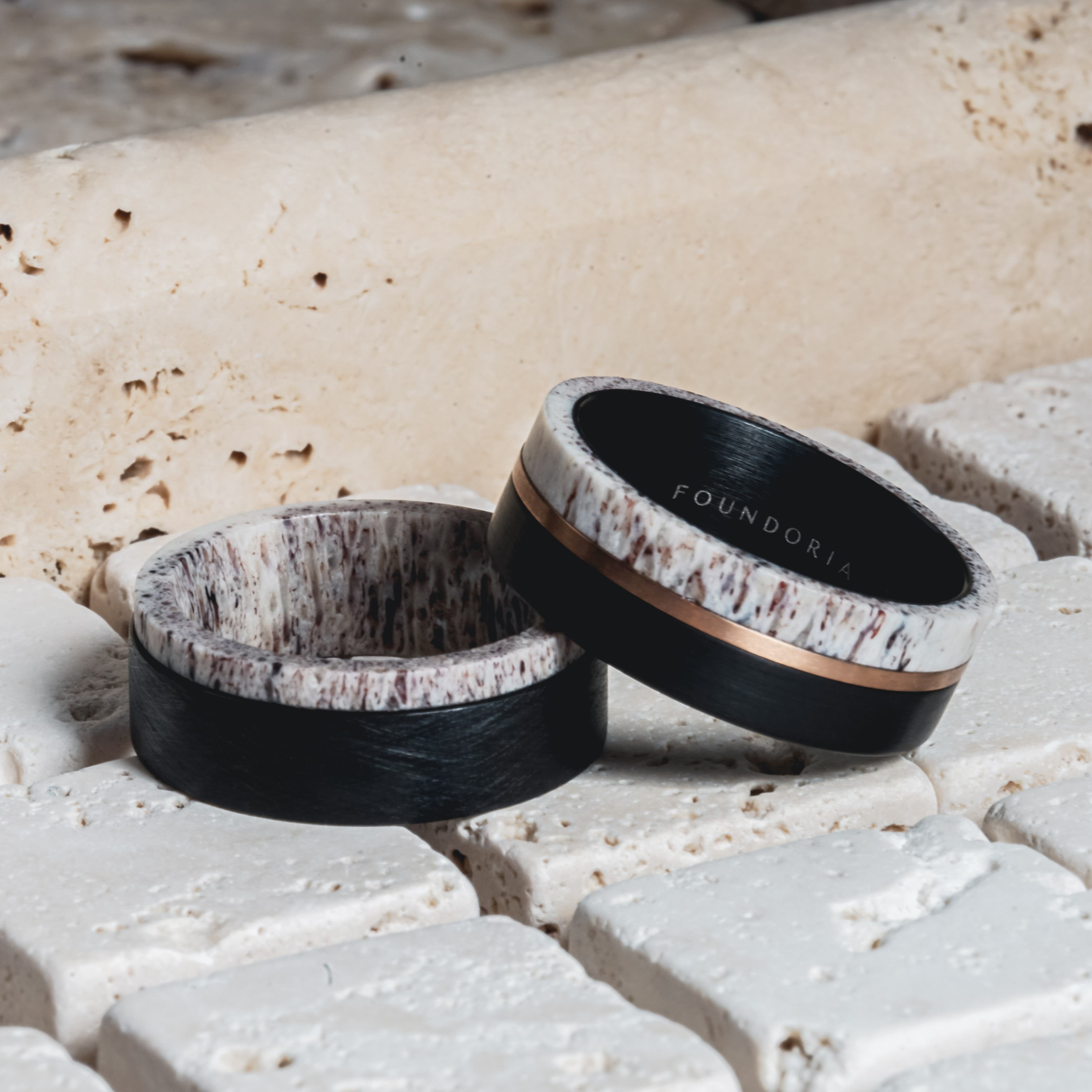
- Natural inlays — meteorite, deer antler, bourbon barrel wood — each carry their own material story.
- Gibeon meteorite is approximately 4 billion years old — older than the Earth.
- Scottish deer antler is naturally shed — no animal is harmed in sourcing.
- All Foundoria rings include free UK delivery and a lifetime warranty. Free ring sizers are available on request before you order.
Updated for 2026.
A wedding ring will be on your finger every day for the rest of your life. It will go to work with you, to the gym, into the garden, through every season and every year you live from the day you put it on. The choice deserves proper consideration — material, fit, durability, and what the ring actually means to you.
This guide covers everything you need to make an informed decision about men's wedding rings in the UK in 2026 — from material comparisons to sizing, from natural inlays to care. It links out to more detailed guides on specific topics where the subject warrants it. Read it in full, or jump to the section that's most relevant to where you are in the decision.
Material is the most important decision in buying a wedding ring. The material you choose determines how the ring looks, how it wears, what it costs, and how much attention it requires over the years. Get this right and everything else follows.
There are two distinct questions here. First: what metal should form the band? Second: do you want a plain band or one with a natural inlay? These decisions are related but separate, and we've covered both below.
| Feature | Tungsten | Titanium | Gold | Silver |
|---|---|---|---|---|
| Scratch resistance | Exceptional (8.5–9 Mohs) | Good (6 Mohs) — will scratch over time | Low (2.5–3 Mohs) | Low (2.5 Mohs) |
| Weight | Heavy, substantial | Light | Medium | Light |
| Resizable | No | No | Yes | Yes |
| Maintenance | Minimal | Minimal | Regular polishing | Regular polishing |
| Price range | £60–£200 (typical) | £60–£200 (typical) | £300–£2,000+ | £50–£300 |
| Price factors | Metal quality, inlays, plating | Metal quality, inlays, plating | Carat, weight, design complexity | Weight, design complexity |
Typical price ranges reflect standard designs in each material. Tungsten and titanium rings featuring premium inlays — such as Gibeon meteorite, Muonionalusta, or other rare natural materials — can exceed these ranges significantly.
If you want to go deeper on specific comparisons, we've written detailed guides on each:
- Tungsten vs Gold — durability, maintenance, price, and what each material says about your priorities
- Tungsten vs Silver — the scratch resistance gap, the resizing question, and which suits a working lifestyle
- Tungsten vs Titanium — weight, hardness, feel on the hand, and when each is the better choice
The short version: for day-to-day scratch resistance and low maintenance, tungsten leads — it's significantly harder than titanium and will hold its finish almost indefinitely. Titanium scratches more readily, but can be polished and refinished by a jeweller if needed — something tungsten cannot offer. For those who find tungsten's weight unfamiliar, titanium is the lighter, repairable alternative. For tradition, cultural recognition, and the ability to resize, gold or platinum remain the standard — at a significantly higher price point and with more maintenance required.
Not every ring needs to tell a material story — and for many, a precision-engineered tungsten band in the right finish is exactly the right choice. If that's the direction you're heading, the TUNGRA collection guide covers everything: finishes, specification, ion plating, and what's included. But if you want a ring that carries more than its metal — one with a material story that no precious metal can match — a natural inlay is worth serious consideration.
Gibeon Meteorite. Formed approximately 4 billion years ago in the void between planets, and fallen to Earth in what is now Namibia. Each piece carries the Widmanstätten pattern — a crystalline structure that takes millions of years to form and cannot be replicated. A finite material: there is no new Gibeon meteorite being produced. Read the full meteorite guide →
Scottish Deer Antler. Naturally shed by red deer in the Scottish Highlands every spring — no animal is harmed. Scotland has approximately 400,000 wild red deer, the largest population in Europe. Each piece of antler has a unique grain and colour shaped by the individual animal, its age, and the landscape it ranged. Read the full antler guide →
Bourbon Barrel Wood. Reclaimed from retired American bourbon barrels — the new, charred white oak casks that bourbon must be aged in by law. The spirit has long since left, but its history is visible in the grain: amber staining, char marks, and the specific pattern of a particular tree that grew somewhere in the American Midwest. Read the full bourbon wood guide →
All natural inlays require a small amount of additional care — primarily removing the ring before swimming or washing up to protect the material from prolonged moisture. The tungsten or titanium band itself is virtually indestructible; the inlay asks for a little mindfulness in return for being genuinely one of a kind.
Tungsten and titanium cannot be resized after manufacture. This makes getting the size right at purchase more important than it would be with a gold or silver ring — but it's not as difficult as it sounds if you approach it correctly.
Use a reliable sizing method. String-based ring sizing is an option, but it does require significant care — it's easy to measure too loosely and end up with a ring that's too large. For a more accurate result, use a proper ring sizer or visit a local jeweller. Foundoria offers a free ring sizer on request — order one before you buy if you're unsure. For existing rings, the inside diameter in millimetres gives you a direct size reference.
If you're between sizes, go half a size down. Because all Foundoria rings have a comfort-fit profile — with a slightly domed inner band — they wear slightly larger than a flat-fit ring of the same nominal size. If you're sitting between two sizes, the smaller one is usually the right choice.
Measure at the end of the day. Fingers are at their largest in the evening, after a full day's activity. A ring sized in the morning may feel tight by evening. This matters most for the ring finger, where even a half-size difference is noticeable.
Consider the width. A wider band sits less far down the finger than a narrow one, which can affect the perceived fit. If you're ordering a ring wider than 8mm, you may need to go half a size up from your usual ring size.
Free size exchanges. If the first size isn't quite right, Foundoria offers free ring size exchanges. Read the full ring sizing guide →
Most Foundoria rings are available in 6mm and 8mm widths. A few notes on choosing between them.
6mm is the more traditional width for a men's wedding band — visible and present on the hand, but not dominant. It suits narrower fingers well, and works better alongside other rings without overwhelming them.
8mm is broader and makes a stronger statement. It gives natural inlays — meteorite, antler, wood — more surface area to display their character. It suits larger hands and those who want the ring to be visible and deliberate rather than subtle.
All Foundoria rings feature a comfort-fit profile — the inside of the band is slightly domed rather than flat, which reduces the contact area against the skin and makes the ring easier to put on and take off. This matters most for wider rings, which can otherwise feel constrictive.
One of the main practical arguments for tungsten and titanium is how little they require of you. For plain metal bands, maintenance is minimal — mild soap and warm water, a soft cloth, and that's about it. No polishing. No trips to a jeweller.
For natural inlay rings, one additional principle applies across all materials: remove before swimming, showering, or prolonged washing up. Natural inlays — meteorite, antler, wood — are sealed and protected, but sustained moisture exposure over time will degrade the inlay. This is a small thing to build into a daily routine, and the rings handle everything else without thought.
Meteorite inlays specifically benefit from being kept dry — the iron-nickel alloy can develop surface oxidation with sustained moisture. A quick dry after water contact is sufficient. Read more in the meteorite ring guide →
All Foundoria rings carry a lifetime warranty. If something is wrong with the ring, we'll address it — and if your size changes significantly, the free exchange policy covers the first resize.
An increasing number of men in the UK now wear an engagement ring — whether given at the proposal, chosen together, or simply worn as a personal marker of where they are in their life. There is no convention that prevents it. The tradition of only women wearing engagement rings is exactly that: a tradition, not a rule.
The same considerations that apply to wedding rings apply here — durability, material, fit. The complete guide to men's engagement rings covers the question in full: Men's Engagement Rings UK — The Complete Guide →
Foundoria rings are organised by material. Each collection has its own story — below is a summary of what each one is, with links to the full range and the detailed material guides.


There is no single best metal — it depends on your priorities. Tungsten carbide offers the best scratch resistance and lowest maintenance of any commonly used ring metal. Titanium is lighter but will scratch more readily than tungsten — it sits at around 6 on the Mohs scale versus tungsten's 8.5–9. Gold and platinum are traditional, resizable, and culturally recognised, but scratch more easily and cost significantly more. For men who work with their hands or want a ring that handles daily life without thought, tungsten is hard to beat on practical grounds.
No — tungsten carbide cannot be resized due to its extreme hardness. This makes accurate sizing at purchase important. Foundoria offers a free ring sizer on request — order one before you buy if you're unsure of your size. Free size exchanges are available if the first size isn't quite right. Getting the size right is straightforward with the right tools; the key is to measure properly rather than guessing.
Most men's wedding rings fall between 6mm and 8mm wide. 6mm is traditional and suits narrower fingers well; 8mm makes a stronger statement and gives natural inlays more surface area to display their character. If ordering a ring wider than 8mm, consider going half a size up from your usual ring size, as wider bands sit higher on the finger and can feel tighter than narrow ones at the same nominal size.
Yes. Tungsten rings can be safely removed in medical emergencies using standard ring-cracker tools available to paramedics and A&E departments. All Foundoria tungsten rings are independently tested to REACH and GPSR standards, with nickel content within the limits considered safe for the vast majority of people. If you have a known severe nickel allergy, seek specific guidance before purchasing any metal jewellery.
Tungsten is denser, heavier, and significantly harder than titanium — rated 8.5–9 on the Mohs scale versus titanium's 6. In practical terms, tungsten will resist scratching almost completely in daily wear, while titanium will develop surface marks over time. However, titanium has one meaningful advantage: it can be polished and refinished by a jeweller to remove scratches, restoring it close to its original finish. Tungsten cannot be refinished — if it chips or degrades, it typically needs replacing rather than repairing. Titanium is also the better choice if you need a lighter feel or a hypoallergenic option. Both sit well above gold and silver on durability and are far more practical for everyday wear than precious metals.