
Foundoria sources its deer antler from naturally shed antlers found across the Scottish Highlands. No deer is hunted, harmed, or disturbed. Stags cast their antlers naturally each spring, and the shed antlers are collected from the ground. Every piece is different because every stag is different.
- Red deer shed their antlers naturally every year. No animal is harmed in sourcing.
- Scotland is home to roughly 400,000 wild red deer, the largest population in Europe.
- A stag grows and sheds a full set of antlers every year, across his whole adult life.
- The interior of deer antler has a honeycomb-like structure unique to each animal.
- Colour and texture vary considerably between pieces. No two antler rings are identical.
- Antler is living tissue when growing. It's one of the fastest-regenerating materials in nature.
Updated for 2026.
Every spring, something remarkable happens across the Scottish Highlands. Red deer stags, the largest land mammals in Britain, begin shedding their antlers. Not because something has gone wrong. Not because they're injured or dying. Simply because that's what they do, every year, as reliably as the seasons themselves.
Within hours of casting, the stag begins growing a new set. Within months, he'll be carrying a full rack again. The shed antlers lie where they fall, in glens, on hillsides, beneath the pines, until someone finds them. And that is where your ring begins.
Scotland is home to roughly 400,000 wild red deer. It's the largest population in Europe, shaped by centuries of Highland land management. The open moorlands and glens provide ideal habitat: wide grazing, shelter in the valleys, and enough elevation to keep populations naturally dispersed.
Red deer antler is prized for ring-making because of its density and its visual character. The outer cortex, which is the hard outer shell, has a smooth, almost polished surface when worked. The inner cancellous tissue has a distinctive honeycomb-like structure. When cut for a ring inlay, both layers may be visible in cross-section. The result is a material that looks unlike anything synthetic.
The specific origin matters too. Scottish Highland deer live and range on open land. Their antlers reflect that, shaped by weather, terrain, and the particular diet of the uplands. Antler from different regions, different estates, different animals will look and feel subtly different. That specificity is part of what makes the material interesting.
It's a question worth asking directly: does an animal suffer for this material?
The answer is no. Deer cast their antlers naturally, annually, as part of their biological cycle. The shedding process is not painful. In fact, the moment of casting is thought to bring relief, because the antlers become heavy and the velvet covering them in the growth phase becomes sensitive. Antler collection involves finding shed antlers on the ground, a practice known in the UK as antler picking (or shed hunting in some other regions). It has been carried out for centuries across the Highlands.
No animal is approached, disturbed, or harmed in sourcing shed antler. The stag that grew the antler on your ring has long since grown a new set. This makes deer antler one of the most genuinely sustainable natural materials available for jewellery. It's a renewable resource that replenishes itself every year, on its own schedule, without human intervention.
There is a distinction worth making here. Shed antler is different from antler sourced as a by-product of deer culling. Both are used in the industry. Foundoria uses shed antler, collected after natural casting, from Highland estates where land managers and stalkers know the ground and the deer on it.

Like meteorite, deer antler is not a uniform material. Understanding its natural variation matters if you want to wear it confidently.
Colour variation. Antler ranges from pale cream to rich tan, warm brown, and occasionally darker tones. The colour depends on the individual animal, its age, its diet, and how long the shed antler lay on the ground before collection. An antler that has lain through autumn and winter will look different to one collected shortly after casting. Neither is better. They are simply different animals, different seasons, different ground.
The honeycomb interior. When cut to reveal the cross-section used in a ring inlay, you may see variation between the denser outer cortex and the more open inner tissue. In some pieces this contrast is subtle. In others it's pronounced. This is the internal architecture of the antler. Completely normal, and in our view one of the most visually interesting things about the material.
Small pits or surface variation. The outer surface of deer antler is not perfectly smooth. It has a natural texture shaped by the velvet covering it during growth, and by weathering after casting. Small pits, grain variation, or subtle surface irregularities are all normal and expected in worked antler.
Tonal shift over time. Antler may lighten or subtly shift in tone over years of wear, as UV exposure and the natural oils of the skin interact with the material. This is not deterioration. It's the material continuing to age in a way that reflects how it has been worn.
No two antler ring inlays are identical. The piece on your finger came from a specific stag, on a specific estate, in a specific season. That provenance isn't recorded on a certificate, but it's present in the material itself, visible in the grain, the colour, the structure.
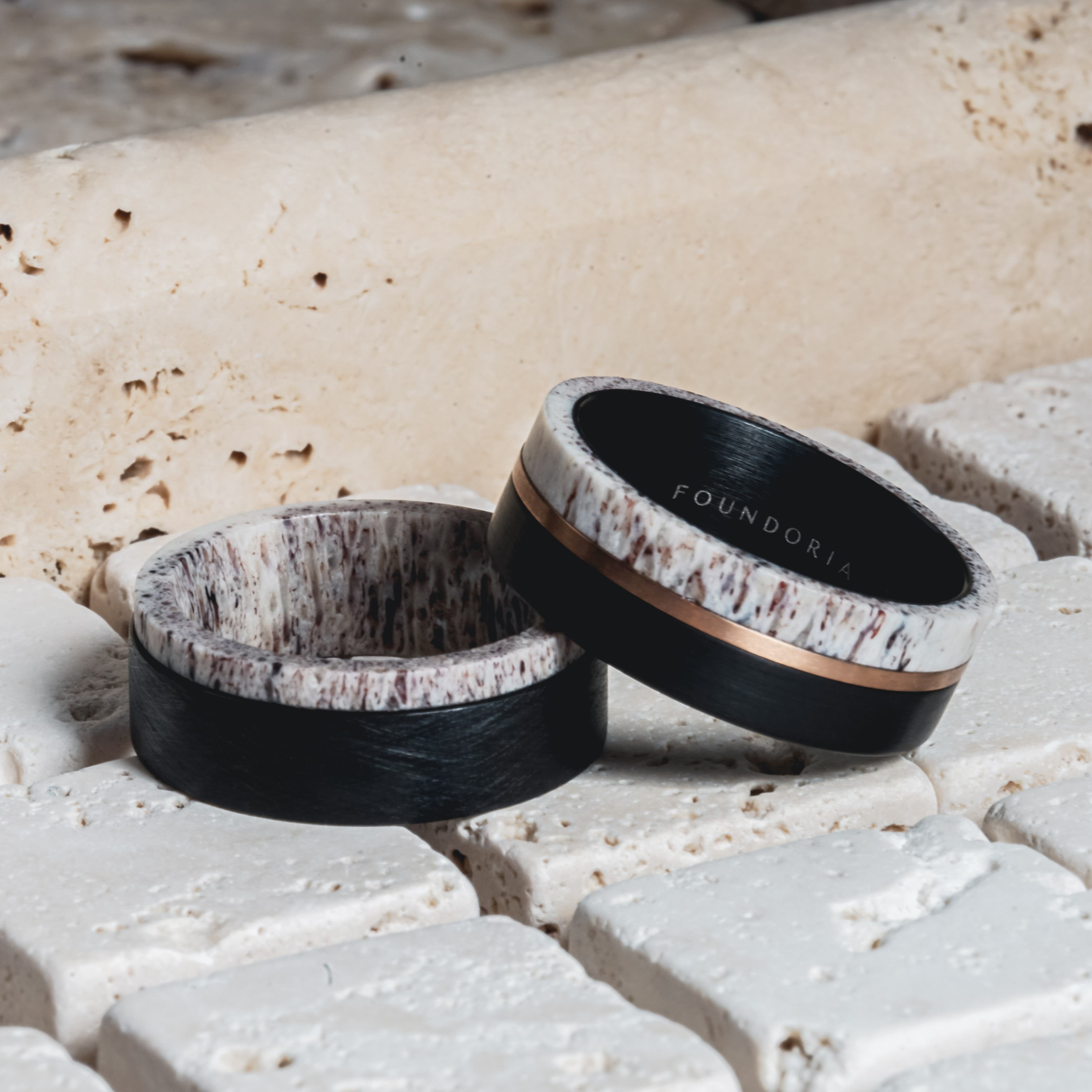
Our CERVUS collection, named for the Latin name of the red deer, Cervus elaphus, was built around this material. Each ring uses naturally shed Scottish Highland red deer antler, selected for quality and character, set into tungsten or titanium bands built to protect the inlay for life.
The collection suits those who feel a connection to the land. Hill walkers, stalkers, fly fishers, farmers. Or simply those who want a ring that carries something real rather than something manufactured. Below is a small selection from the collection, including Alba (named for the Gaelic word for Scotland) and Crest, which uses textured titanium in place of tungsten.


If you want a ring that is genuinely, provably natural, ethical in sourcing, warm in appearance, and rooted in a specific landscape, deer antler is a compelling choice. No animal is harmed. The material is renewable. And the connection to the Scottish Highlands is real, not a brand story layered over something manufactured.
The same care principles apply as with any natural inlay. Remove before swimming or washing up. Clean with a soft dry cloth. Antler is reasonably resilient but will respond to sustained moisture over time. A small amount of attention keeps it at its best.
If you're comparing natural materials, our WELDWOOD bourbon barrel wood collection and CELESTIUM meteorite collection offer a different kind of story in the same format. Or browse the full men's tungsten ring collection to see everything side by side.
Yes. Deer shed their antlers naturally every year as part of their biological cycle. No animal is harmed, approached, or disturbed in sourcing shed antler. It's collected from the ground after natural casting, a practice known in the UK as antler picking (or shed hunting in some other regions). Foundoria uses naturally shed Scottish Highland red deer antler, not antler sourced from culling. The material is renewable, replenishing every year on the deer's own schedule.
Because no two pieces of deer antler are identical. Colour ranges from pale cream to rich tan and warm brown depending on the individual animal, its age, diet, and how long the shed lay before collection. The internal honeycomb structure varies in density and contrast between pieces. Your ring shows the natural character of that particular piece of antler. This is not a defect. It's what makes it genuinely unique.
Yes, with appropriate care. Deer antler is a naturally dense material and holds up well in everyday wear when sealed and set in tungsten carbide or titanium. Remove before swimming, showering, or washing up. Natural antler is porous and sustained moisture exposure will cause it to swell and potentially crack over time. Clean with a soft dry cloth. Treated this way, the antler ages gracefully.
Foundoria uses naturally shed red deer antler from the Scottish Highlands, home to roughly 400,000 wild red deer and the largest population in Europe. The antler is collected from Highland estates after natural casting. Scottish Highland red deer are free-ranging animals living in open moorland and glen habitats, and the antler reflects the character of that landscape.
Subtly, yes. Deer antler may lighten slightly over years of wear as UV exposure and the natural oils of the skin interact with the material. This is natural ageing, not deterioration. In most cases the character of the inlay becomes more pronounced rather than less. Keeping the ring away from harsh chemicals and direct sustained sunlight will slow this process if desired.