

- Wood has been used in ceremonial jewellery and adornment for thousands of years — long before precious metals became the default.
- Different char levels in bourbon barrels — from a light toast to a heavy char — produce dramatically different colours and grain effects in the wood.
- Stabilisation involves impregnating the wood with resin under vacuum pressure — a process originally developed for gunstock and knife handle making.
- A retired bourbon barrel weighs around 200kg when full and holds roughly 53 US gallons of whiskey — the staves from a single barrel can yield dozens of ring inlays.
- Hawaiian Koa is so tightly regulated that export of raw timber is restricted — finished and worked Koa products are how most of the world encounters the material.
- Oak has been a symbol of strength and endurance across Celtic, Norse, and Roman cultures — the Druids considered it the most sacred of all trees.
Updated for 2026.
Wood is one of the oldest materials humans have worked with. Before we knew how to smelt metal, we were carving, shaping, and wearing it. The earliest known wooden artefacts used for adornment date back tens of thousands of years — which puts the recent resurgence of wood in contemporary ring design in a rather different light. It isn't a trend. It's a return.
What has changed is how we work with it. Modern stabilisation techniques, precision cutting, and the structural protection of tungsten carbide mean that natural wood can now be worn daily in a way that simply wasn't practical before. This guide covers the range of woods used in ring-making, how they're processed, what they mean symbolically, why upcycled wood in particular has a compelling case to it — and how to take care of a ring that contains it.
Not all wood works well as a ring inlay. The material needs to be dense enough to hold its form, stable enough to resist the movement that moisture causes, and visually interesting enough to justify the craftsmanship involved in setting it. Here are the woods most commonly found in quality ring-making, and what distinguishes each one.
Bourbon barrel oak (American white oak). The most narratively rich wood used in ring-making. American white oak used in bourbon production is charred on the inside before first use, then spends years absorbing spirit — the amber and brown tones in the grain are the direct result of that contact. The char layer, the grain structure, and the colour gradient from inner to outer face vary between barrels and between staves, making every piece genuinely distinct. If provenance matters to you, this is hard to beat. The full story is in our bourbon barrel wood ring guide.
Hawaiian Koa. Native exclusively to the forests of Hawaii, Koa is one of the rarest tonewoods in the world. It grows at elevations between 1,000 and 6,000 feet on the volcanic slopes of the Hawaiian islands, and its export as raw timber is restricted — meaning most Koa encountered outside Hawaii has been worked into finished products first. The figure — a shifting, interlocking grain pattern that changes in different light — is the material's defining characteristic, alongside warm tones that range from pale gold through amber to deep reddish-brown. In Hawaiian culture, Koa (meaning "warrior" or "brave") has been used for canoes, weapons, and musical instruments for centuries. It carries that cultural weight into every ring made from it.
Olive wood. Dense, hard, and extraordinarily fine-grained, olive wood from Mediterranean trees has been prized for carving and woodworking for millennia. The grain is tight and irregular, with warm golden-brown tones and darker streaks that create a natural contrast without any processing. Olive trees can live for thousands of years — which means olive wood ring material occasionally comes from trees that were already ancient when they were pruned or felled. The material carries deep cultural symbolism across Greek, Roman, and Biblical traditions: peace, wisdom, and longevity.
Walnut. Rich, dark, and immediately recognisable, walnut is one of the most popular choices for wood ring inlays because its deep chocolate-brown tones contrast dramatically against both light and dark metal finishes. American black walnut in particular has a straight, open grain that shows well in cross-section. It's dense enough for ring-making without stabilisation in many cases, and its colour range — from pale tan through warm brown to near-black — varies naturally between pieces.
Ebony. The densest commonly used ring wood — so dense it sinks in water. True ebony is jet black with almost no visible grain, creating an inlay that reads as a band of pure darkness against metal. Its rarity and controlled availability mean genuine ebony in ring-making commands significant attention; it is often substituted with dyed alternatives in lower-quality rings. Genuine ebony needs minimal stabilisation due to its natural density and oil content.
Other notable woods. Cherry, rosewood, and maple burl all appear in quality ring-making. Cherry has a warm reddish tone that deepens with age and UV exposure. Rosewood — where sourced legally and sustainably — has rich purple-brown tones and a fine, even grain. Maple burl is particularly dramatic: the irregular, swirling figure of burl wood creates a grain pattern unlike any straight-grained timber, making each piece of burl inlay genuinely one of a kind.
The choice of wood carries meaning that goes beyond visual preference — and for a ring worn daily, that matters more than it might for any other object. Wood symbolism has roots across virtually every human culture, and the associations are remarkably consistent even between traditions that had no contact with each other.
Oak has meant strength and endurance across Celtic, Norse, and Roman traditions. The Druids considered it the most sacred of all trees — the word "druid" may itself derive from the Proto-Celtic word for oak. The Norse world tree Yggdrasil, the cosmic axis around which existence turns, is often depicted as an ash or oak. For a wedding ring, oak symbolism connects the object to ideas of permanence and deep rootedness — qualities you want associated with a marriage.
Koa translates directly from Hawaiian as "warrior" or "brave." Historically, Koa was reserved for the ali'i — the Hawaiian nobility and warrior class — and was used to make the canoes that navigated thousands of miles of open ocean. Wearing Koa carries associations of courage and heritage that are specific to Hawaiian culture but translate clearly across traditions.
Olive is one of the most symbolically loaded materials in Western culture: peace (the olive branch), wisdom (sacred to Athena), victory (olive wreaths at the ancient Olympics), and divine favour across Biblical tradition. An olive wood ring is drawing on several thousand years of accumulated meaning.
Walnut has associations with intellect and clarity in many folk traditions — the walnut's resemblance to a human brain led to its use in "doctrine of signatures" herbalism as a symbol of mental strength. Less rigorous than the oak or olive symbolism, but present in the cultural background nonetheless.
For wood from a bourbon barrel specifically, the symbolism operates differently — and more personally. The material has a documented history. It aged something. It was part of a process that people care about deeply. For whiskey enthusiasts in particular, a bourbon barrel wood ring connects the wearer to something they already have a relationship with: the craft of distilling, the patience of ageing, the specific character that oak gives to spirit.

One of the less-discussed aspects of bourbon barrel wood ring-making is the role that the barrel's original charring plays in the material's final appearance — and how deliberate fire can be used more broadly to create effects in wood that ageing alone cannot produce.
Before a bourbon barrel is filled for the first time, the interior is set alight for a controlled duration. The American Distilling Institute categorises this into levels: from a light toast (#1, applied for around 15 seconds) to a heavy char (#4, sometimes called "alligator char" because of the cracked, scaled surface it produces). Each level creates a different depth of carbon layer, which in turn affects how deeply and how quickly the spirit penetrates the wood — and therefore how much of that process is visible in the grain when the stave is eventually used for a ring.
A lightly toasted stave will have subtler amber tones — more of the natural oak character shows through. A heavily charred stave will have deeper, more dramatic colouring with greater contrast between the inner and outer faces. Both are authentic; neither is more "correct." The difference is a direct record of a decision made by a distiller years before the ring was made.
Beyond barrel charring, some ring-makers apply controlled charring or scorching techniques to other wood types to achieve specific aesthetic effects — darkening grain, enhancing contrast, or creating a surface texture that differs from natural or sanded wood. The Japanese technique of shou sugi ban (charring timber to preserve it) has influenced some approaches to wood ring finishing. These are deliberate design choices rather than material history, but the visual results can be striking — and the protective properties of a char layer are real regardless of whether the fire was applied in a Kentucky distillery or a ring-maker's workshop.
A retired bourbon barrel has already had two lives before it becomes a ring. In its first life, it was a new charred white oak barrel — coopered by hand in Kentucky, filled with new make spirit, and set aside to age in a rickhouse for anywhere from four to twelve years. In its second life, it was typically exported — most retired bourbon barrels travel to Scotland or Ireland to age Scotch or Irish whiskey for another decade or more, a process that only deepens the spirit contact in the grain.
After that second life, the barrel's value to the spirits industry is largely exhausted. Without a third use, retired staves are often repurposed as furniture or garden planters, sold as decorative items, or in some cases simply discarded. A ring inlay is something different: a precise, considered use of a small section of material that carries more history per cubic centimetre than almost any other natural substance used in jewellery.
This matters beyond the environmental argument — though the environmental argument is real. Using reclaimed barrel wood means no new tree is felled for the purpose. The material already exists; it's a question of what becomes of it. But the more compelling case is the one about meaning. An upcycled material carries its history into its next form. The ring you wear isn't made from something that was grown for ring-making. It's made from something that lived a full life first — and is now living another one on your finger.
The whiskey enthusiast angle is worth naming directly. If you drink bourbon or Scotch — if you have opinions about different distilleries, different mash bills, different ageing conditions — a bourbon barrel wood ring is a different kind of object for you than it is for someone who simply finds it visually appealing. The barrel that held your favourite dram and the stave on your finger came from the same material tradition. That's a connection most jewellery simply cannot offer.
Raw wood, however beautiful, is not naturally suited to being worn on a finger. It absorbs moisture, expands and contracts with temperature changes, and can crack or warp if not treated. The process that makes it viable for ring-making is called stabilisation — and understanding it is worth doing, because it's what separates a wood ring that will last from one that won't.
Stabilisation involves impregnating the wood with a resin — typically an acrylic resin — under vacuum pressure. The process works by first drawing air out of the wood's cellular structure in a vacuum chamber, then introducing the resin under pressure, forcing it deep into the grain. Once fully impregnated, the resin is cured, typically with heat, hardening within the wood's structure and dramatically reducing its porosity and movement.
The technique was originally developed for gunstock and knife handle making — applications where natural wood needs to perform reliably under demanding conditions. It crossed into ring-making as the craft developed, and is now standard practice in quality wood ring production. A properly stabilised wood inlay will resist normal daily moisture, hold its shape through temperature changes, and maintain its appearance over years of wear.
After stabilisation, the inlay is cut to shape, fitted into the ring channel, bonded, and then sealed again on the finished surface — typically with a UV-resistant lacquer or resin coating. This surface seal is what protects the wood from the oils and moisture of daily skin contact. It can be reapplied by a jeweller if it shows wear over many years of use, though with proper care this is rarely necessary.
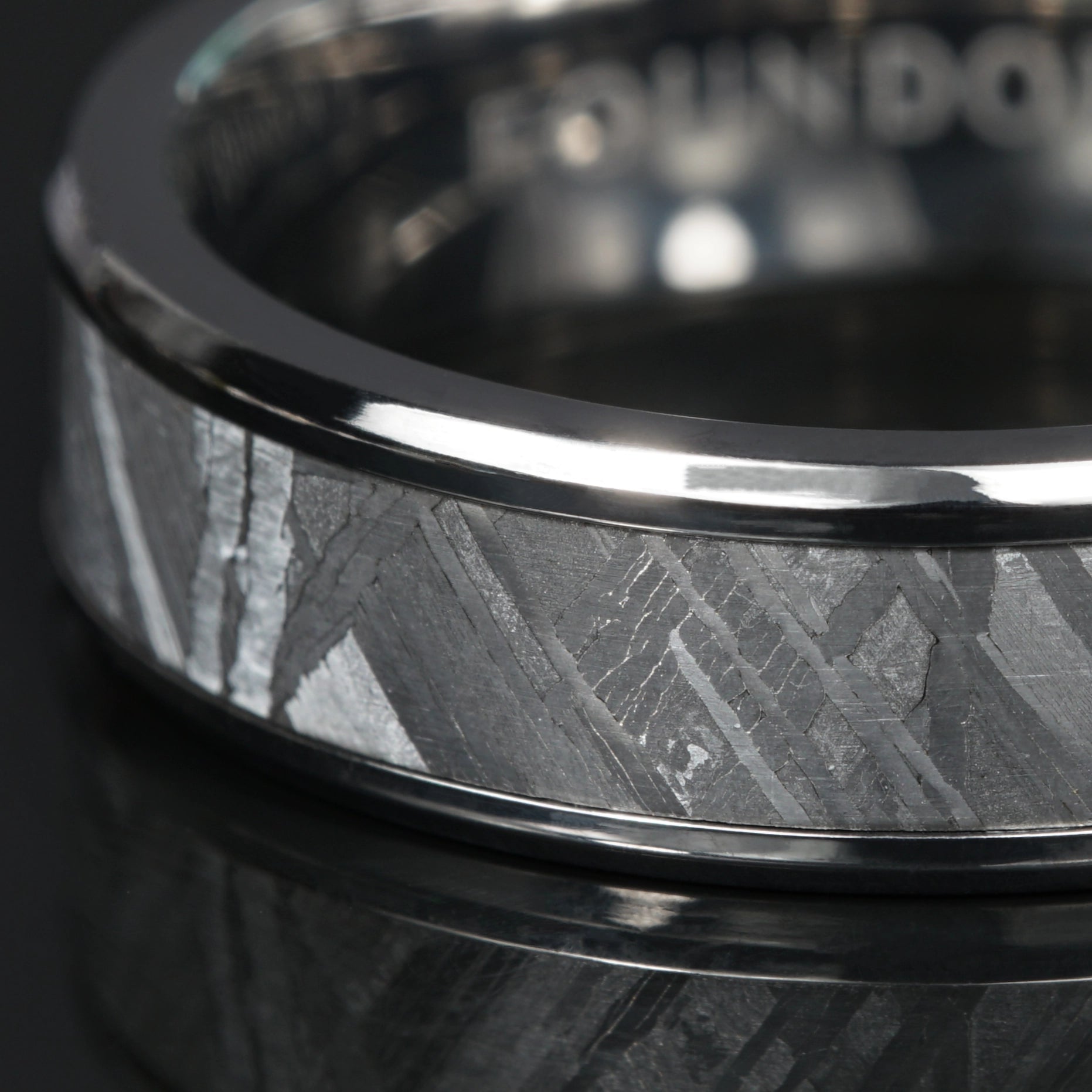
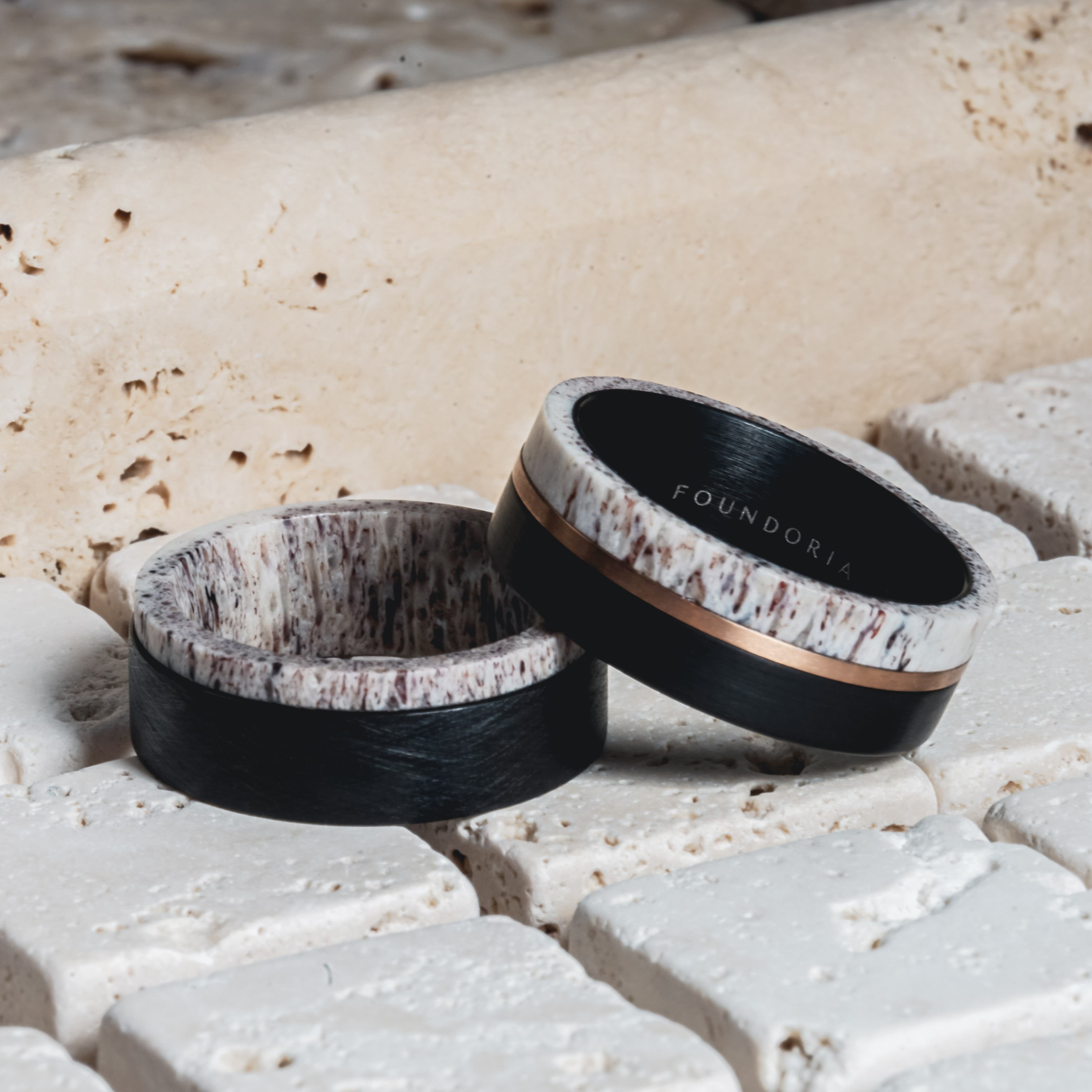
Our WELDWOOD collection uses both bourbon barrel oak and Hawaiian Koa — the specific wood in each ring is stated in the product description. Most designs keep the focus on the wood itself; a few pair it with a second material. The Equinox in the CELESTIUM collection pairs genuine Gibeon meteorite with bourbon barrel oak — if you want something that combines the oldest material in our range with reclaimed distillery wood, that's where to look. And if deer antler alongside bourbon wood interests you, the CERVUS collection's Glen and Ridge rings do exactly that.


Water. Brief contact — hand washing, light rain — is fine; dry promptly. Remove before swimming, showering, washing up, or any prolonged water exposure. The stabilisation process dramatically reduces the wood's porosity, but sustained water contact over time will eventually affect any natural material. This is the most important care rule.
Chemicals. Remove before using cleaning products, solvents, or hand sanitisers. Harsh chemicals can break down the surface seal on the inlay and affect the wood's colour and texture.
Cleaning. A soft dry cloth is all you need for routine cleaning. If the ring has picked up residue, a very slightly damp cloth followed immediately by drying is fine. Avoid abrasives, ultrasonic cleaners, and steam cleaning — these are appropriate for plain metal rings but not for wood inlays.
Physical work. The tungsten band is virtually scratch-proof and will handle most physical activity without issue. It's the wood that warrants care during heavy manual work or activities where the inlay could be struck repeatedly against hard surfaces. The complimentary ENDURA silicone companion band included with every order is designed for exactly these situations — wear it to the gym, on site, or anywhere you'd rather not risk the ring.
Ageing. Natural wood will develop a gentle patina over years of wear. For bourbon barrel oak this typically means the grain becomes more pronounced and the amber tones deepen slightly. For Hawaiian Koa the figure becomes richer. This is not deterioration — it is the material continuing to age, which is precisely what it was doing before it became a ring. Treat it well and it improves with time.
The best wood depends on what you want the ring to carry. For provenance and a documented history, bourbon barrel oak is hard to match — every piece of amber and brown in the grain is a direct record of years of spirit contact. For rarity and dramatic visual character, Hawaiian Koa is exceptional — its shifting figure is unlike any other wood used in ring-making. Both are stabilised for daily wear. The choice between them is ultimately about which material story resonates more.
Stabilisation is the process of impregnating wood with acrylic resin under vacuum pressure, then curing it with heat. The resin fills the wood's cellular structure, dramatically reducing its ability to absorb moisture and limiting the expansion and contraction that can cause untreated wood to crack or warp. A stabilised wood ring inlay is structurally far more robust than raw wood — it's what makes the material viable for daily wear over years and decades.
Yes. The bourbon barrel oak used in Foundoria's WELDWOOD collection is genuine reclaimed American white oak sourced from retired Kentucky distillery barrels — the same barrels that aged bourbon under American law before being decommissioned. The amber staining in the grain is from years of spirit contact, not a dye or finish. It is in the material, not applied to it.
No. The stabilisation and sealing process removes any residual spirit from the wood, and the surface seal means there's no direct contact between the wood and your skin. The amber tones in the grain are the visible legacy of the whiskey; the scent does not transfer to the finished ring.
Tungsten carbide cannot be resized after manufacture. A free ring sizer is available on request before ordering. If you are between sizes, size down by half — our comfort-fit interior wears slightly larger than a flat-fit ring of the same nominal size. Free size exchanges are available if the first size isn't right.
Every WELDWOOD ring ships with a complimentary ENDURA silicone companion band, luxury presentation packaging, free UK delivery, and a lifetime warranty. A free ring sizer is available on request before you order.