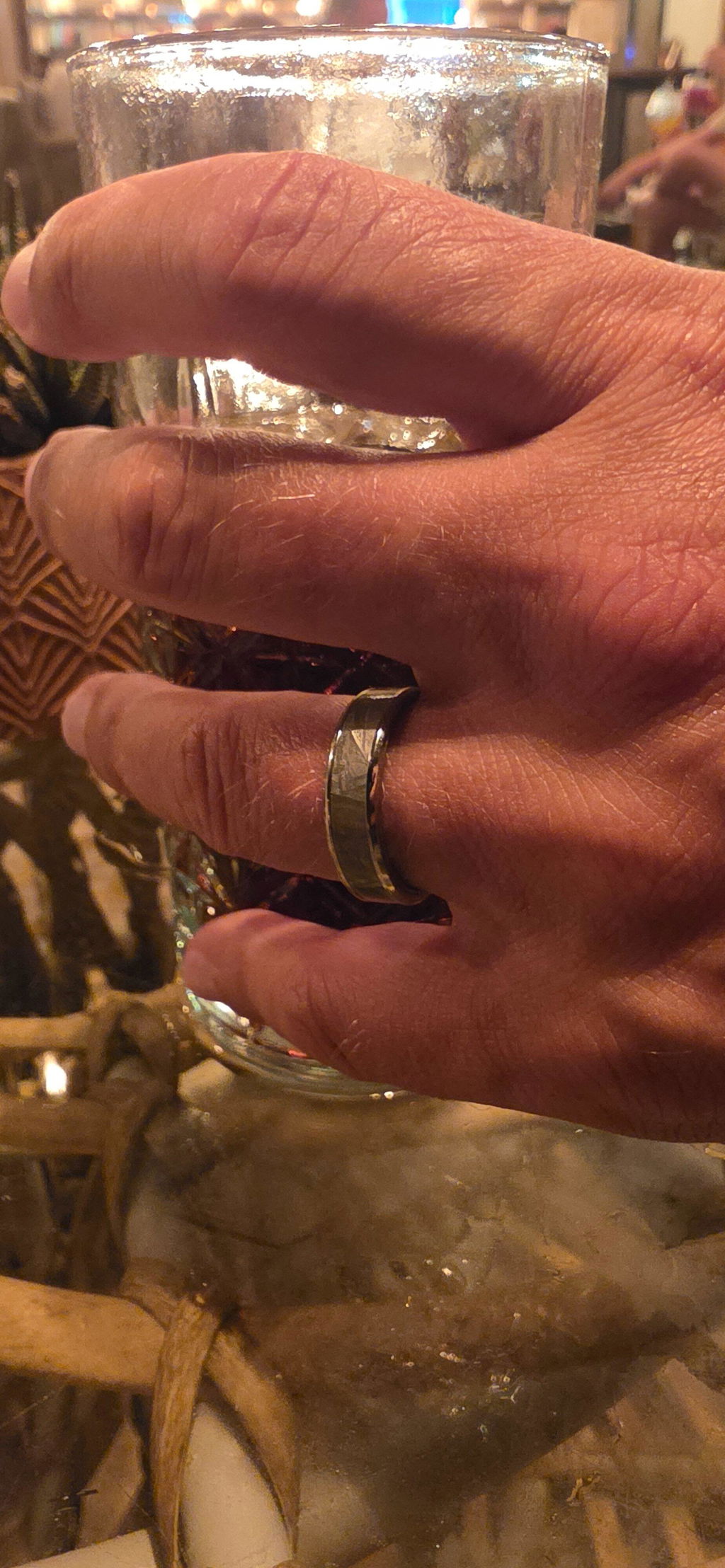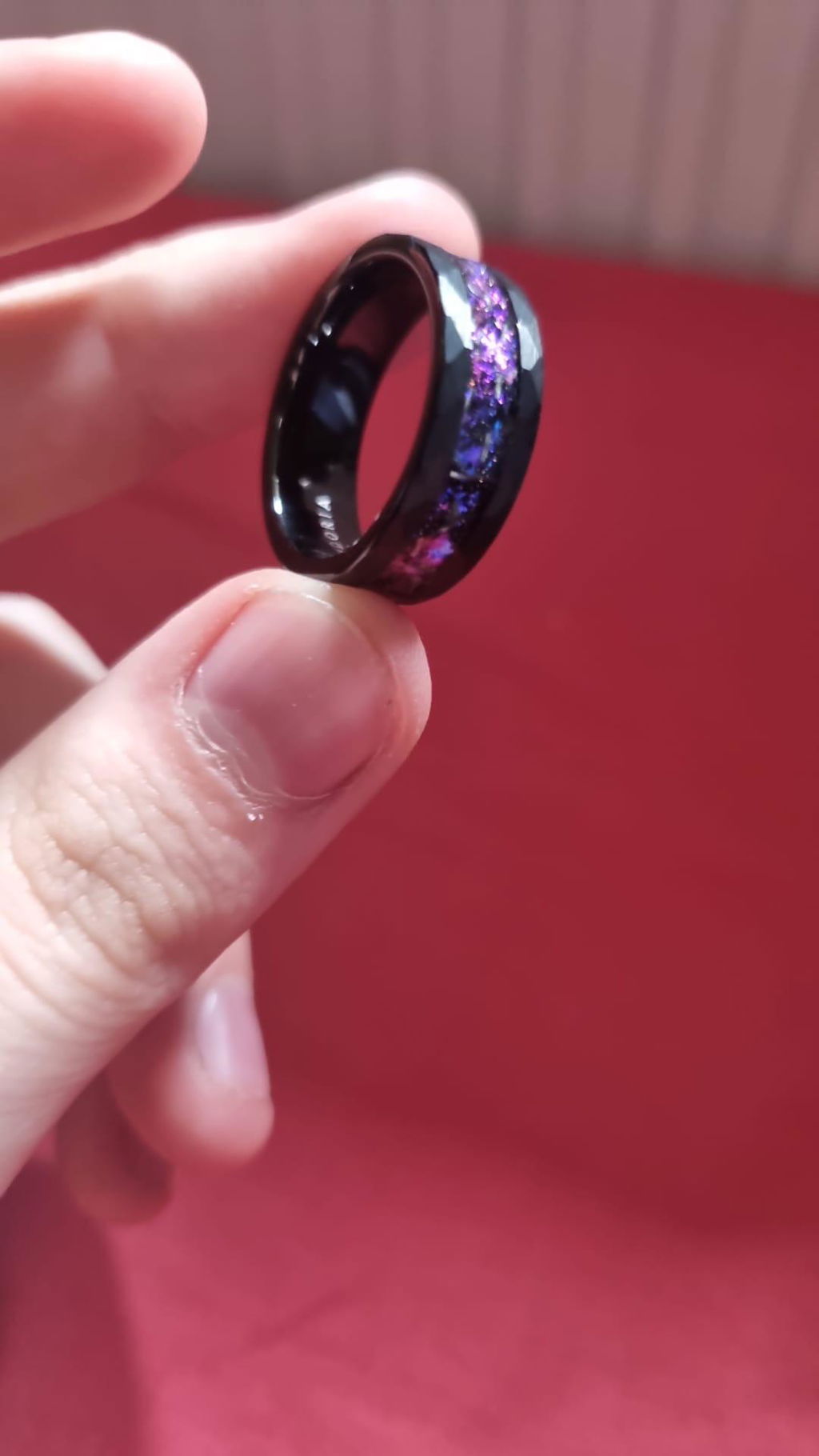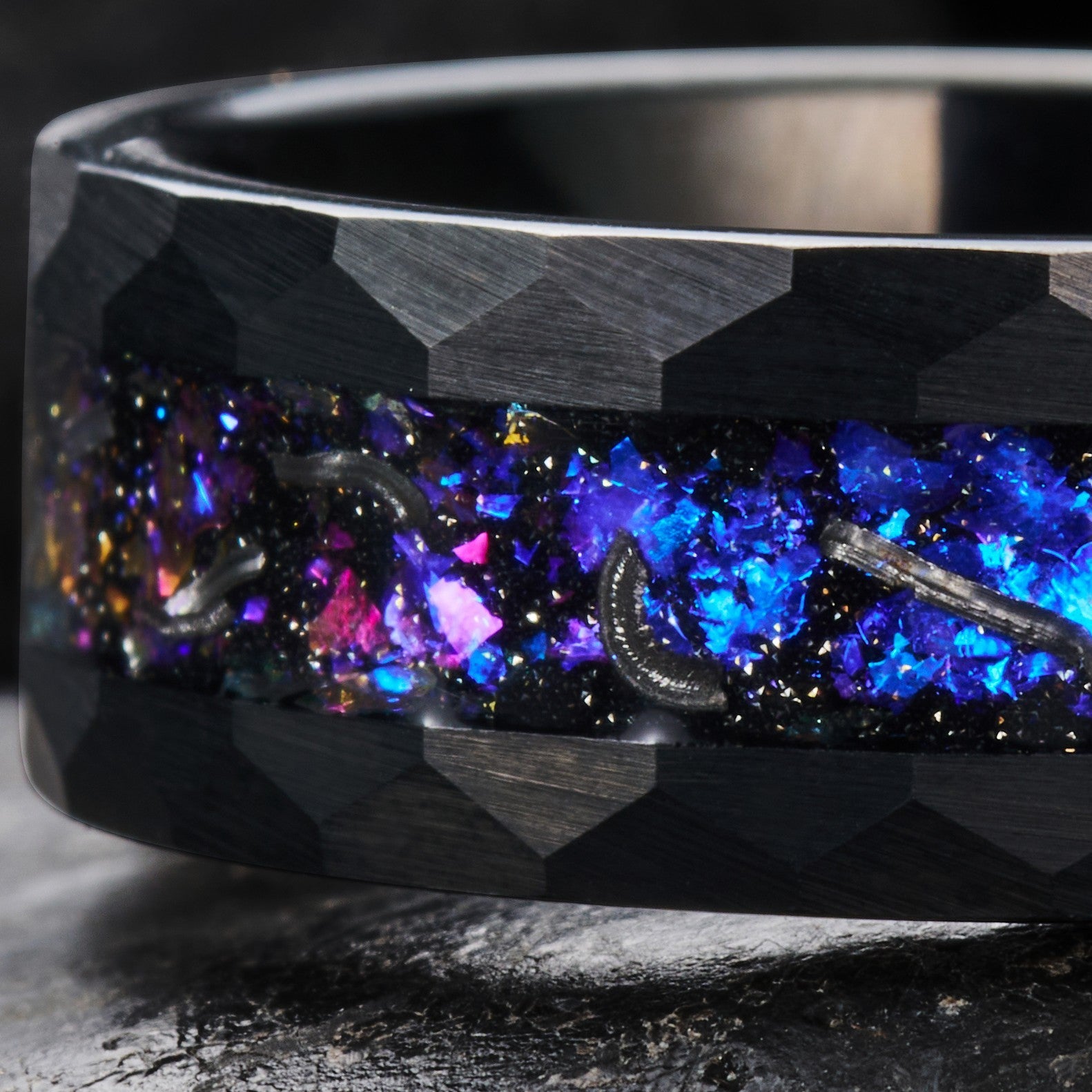
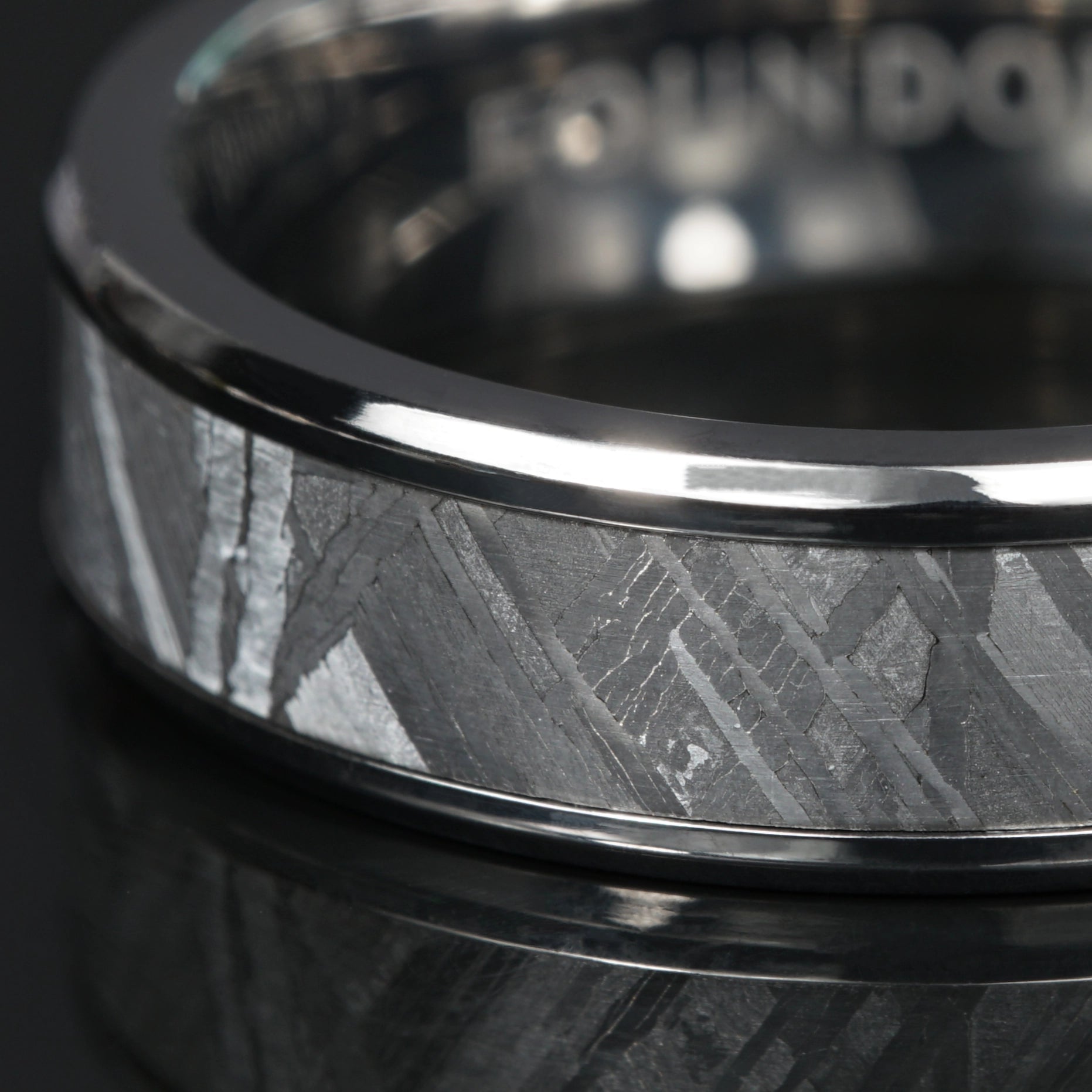
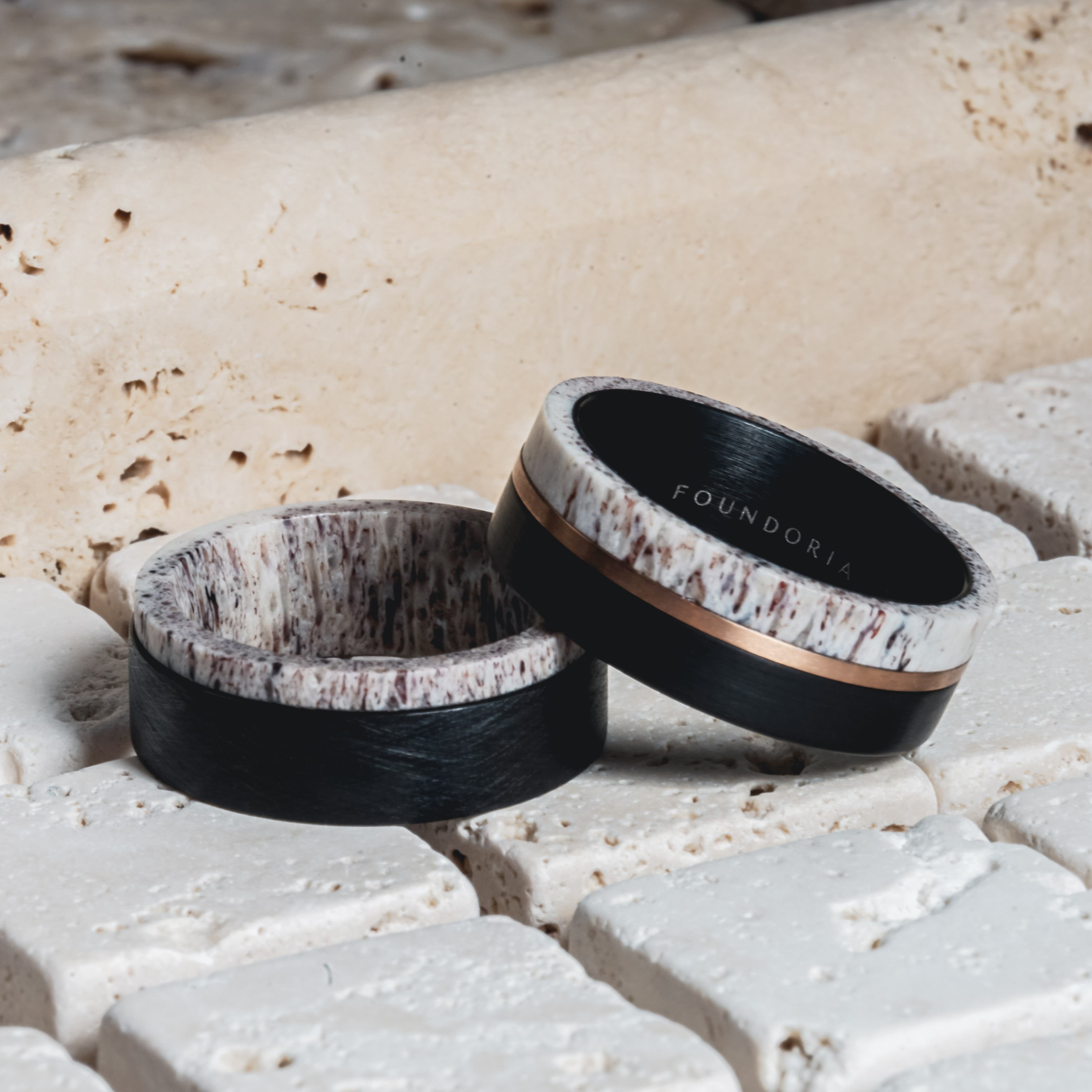
Every inlay we set is the material itself. Not a print, not a resin imitation, not a photograph under a clear coat. That distinction matters, because the market for alternative rings is full of pieces that only look the part, and at a glance the difference is genuinely hard to see.
This page explains what each of our materials actually is, what an imitation of it usually looks like, and what you can reasonably ask any seller before you buy. Use it on us as much as on anyone else.
Meteorite: Gibeon and Muonionalusta
Both are iron meteorites, and both carry a crystal structure called a Widmanstätten pattern that forms over millions of years of extremely slow cooling in space. It cannot be manufactured on Earth, which is what makes it the single most reliable authenticity marker there is. We etch the surface to bring that pattern out.
Gibeon has a bolder, wider lattice. Muonionalusta is finer, with a cooler blue-silver tone. Neither repeats, so no two rings are the same.
What an imitation looks like. A repeating or suspiciously regular pattern, identical across every ring in a listing, or a pattern that sits under a glassy layer rather than in the metal. Read the full breakdown in How to Tell if a Meteorite Ring is Genuine.
Reclaimed wood: barrel oak and Hawaiian Koa
Our oak is reclaimed from spent Scottish whisky casks and American bourbon barrels. Years of spirit pressing into the staves leaves the grain stained and the charred inner surface darkened, and that colouring runs through the wood rather than sitting on it. Koa is a Hawaiian hardwood, prized for a deep figured grain that shifts as the light moves across it.
Wood used in a ring has to be stabilised before it can survive daily wear, which is a process of drawing resin through the timber so it no longer moves with humidity. Stabilised wood is still wood. It is not a wood-effect composite.
What an imitation looks like. Grain that repeats along the band, or grain that runs off the edge of the inlay in a way real timber never would. Printed wood effect also tends to be perfectly even in tone, where reclaimed oak varies stave to stave. If a listing shows the same grain on every ring, it is a print.
Deer antler: naturally shed Highland antler
Antler has a dense outer wall and a porous, marbled core, and that contrast is what gives a CERVUS ring its character. Because it comes from an animal that grew it, the pattern is different in every single ring, and the speckling can be heavy in one and sparse in another.
What an imitation looks like. Uniform speckling, an even cream tone with no variation in density, or a listing where the product photograph is clearly the same piece of antler every time. Real antler is inconsistent by definition, and any honest seller will say so up front.
Carbon fibre: woven, not printed
Real carbon fibre is a woven cloth set in resin, so the weave has depth. Tilt it and the pattern shifts, because you are looking at layers rather than a surface. It is also very light, which is much of the appeal.
What an imitation looks like. A flat weave that does not change as the ring moves, or a checkerboard that is too regular. Hydrographic film, which is a printed wrap, is common at the low end and is the usual culprit.
What to ask any seller
- Which meteorite is it, by name? A seller who cannot tell you whether it is Gibeon or Muonionalusta is a seller who does not know. Then check the ring itself: the crystal pattern, how the surface catches the light as it moves, and whether it responds to a magnet. How to check a meteorite ring.
- Is the inlay the material, or a print of it? Ask directly. The answer is usually revealing.
- Will my ring look exactly like the photograph? With natural inlays it cannot, and a seller who claims it will is either printing the pattern or setting you up for disappointment.
- What is the band made from, and has it been tested? See How our rings are tested.