

Ring Materials by Profession: What Actually Survives Your Working Week
A wedding ring doesn't know it's jewellery. It goes to work with you, every day, for decades. It meets whatever your hands meet.
Most material guides are written as though the choice is aesthetic. It isn't, or not only. A nurse, an electrician and a software engineer have genuinely different problems, and the honest answer for one of them is a ring they take off before every shift.
This is what we've learned serving customers across a wide range of professions, including the times the right answer for someone's working week wasn't the ring they came in for.
Four Ways a Ring Gets Ruined, and They're Not the Same Problem
"Durable" is a useless word on its own. A material that shrugs off one kind of damage is often the worst choice for another. Work out which of these applies to your day and the shortlist gets very short.
Abrasion
The slow dulling from keys, desks, tools, handlebars and gym bars. This is about surface hardness, and it's the one most people mean by "scratches".
Impact
A single sharp knock against concrete or steel. Hard materials resist scratching but can be brittle, so this is a different test entirely.
Deformation
Crushing or bending out of round under load. Soft precious metals do this readily, which is why a gold band flattens over the years.
Catching
The one that matters most and gets discussed least. A ring caught on a ladder rung, a machine or a falling load can take the finger with it. No material solves this except one that breaks.
The Materials, Told Straight
Every material below is one we actually make in, so these are working notes rather than a spec sheet.
Tungsten carbide
The hardest thing on the list and the most scratch resistant material used in rings by some distance. A tungsten band looks the same in year ten as it did in week one, which is exactly why more of our customers choose it than anything else.
The trade-off is brittleness. Tungsten carbide is a ceramic composite all the way through, so under a hard enough impact it cracks rather than bends. That sounds like a flaw and is genuinely a feature in an emergency, since a cracked ring comes off in two pieces, but it does mean a dropped ring on a tiled floor is a real risk in a way that a titanium one isn't.
Titanium
Titanium is the tough one rather than the hard one, and that distinction is the whole story. It will not crack, will not shatter and will not bend out of round easily. It will pick up fine surface marks, and over a few years it develops a patina that some people love and others don't.
It's also the lightest metal we work in by a wide margin, roughly half the weight of a tungsten band of the same size. If you've worn a heavy ring and found yourself conscious of it by mid-afternoon, that's the problem titanium solves.
Black zirconium
A deep charcoal grey rather than a flat black, and the colour is part of the metal itself. Zirconium is heated in a controlled atmosphere until its own surface converts to a ceramic, so the tone is grown into the ring rather than applied to it. A hard surface over a metal core also means it takes an impact the way a metal does rather than cracking.
It's the material people choose when they want the colour to be structural rather than superficial, and it opens up two-tone work that nothing else can do: cut through the dark surface and the bright raw zirconium underneath becomes the contrast, with no second metal involved. Our full guide to black zirconium covers how it's made.
Tantalum
Rare, dense and a distinctive blue-grey that isn't quite anything else. Tantalum has a long record in surgical implants and chemical plant because it's essentially immune to corrosion, and that heritage is part of the appeal. On the hand it reads as weight and colour: it's noticeably dense, and the blue-grey tone is unlike steel, titanium or platinum. It's softer than tungsten, so it marks the way a metal does rather than chipping, and it machines beautifully, so grooves and fine lines are where it shines.
Carbon fibre
Not a metal at all, which is the point. Carbon fibre is the lightest thing we make, and for a genuine metal sensitivity it removes the question entirely. It's less hard than the metals, so treat it as a ring for lighter duty.
More on it in our guide to carbon fibre in men's rings.
Deer antler, oak and other organics
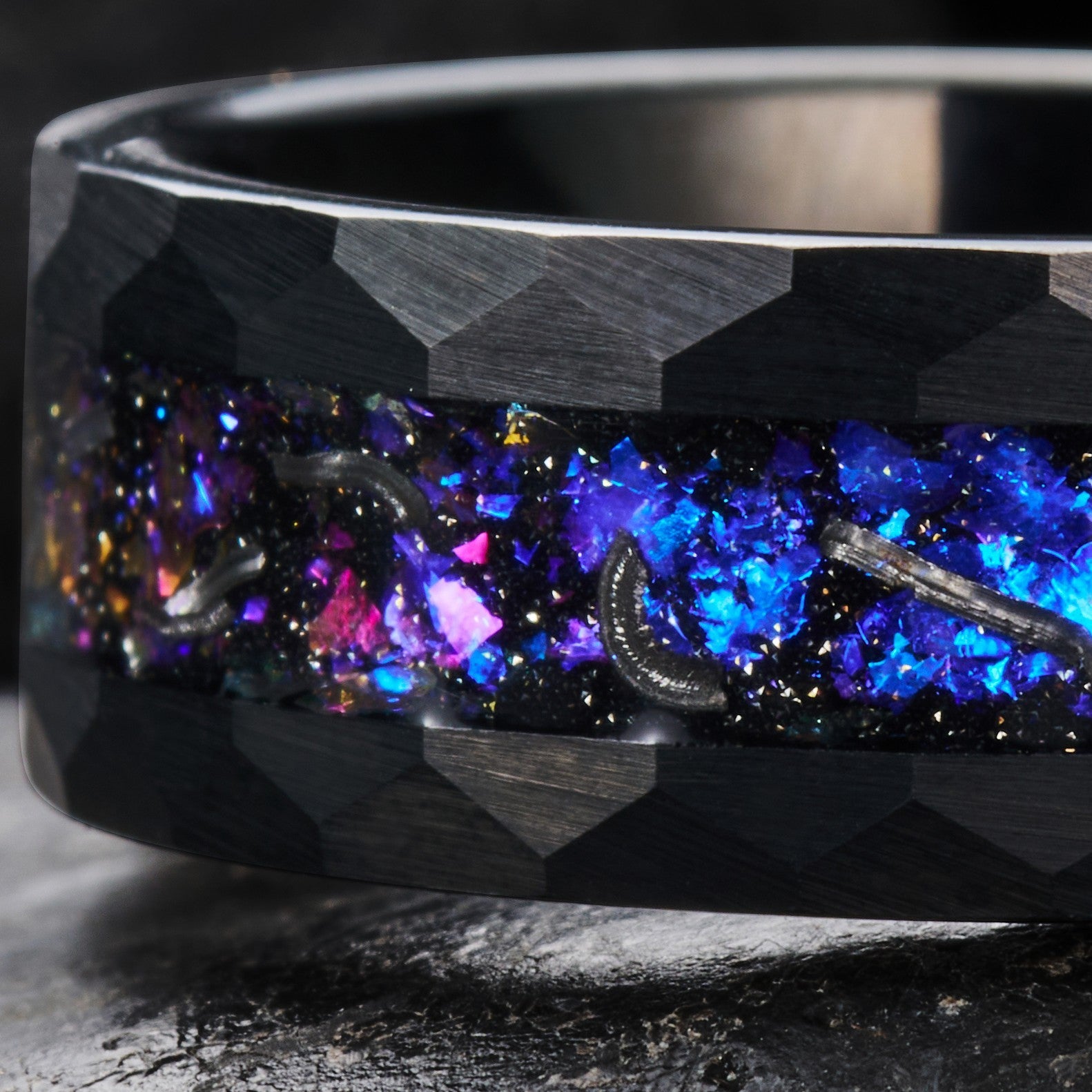
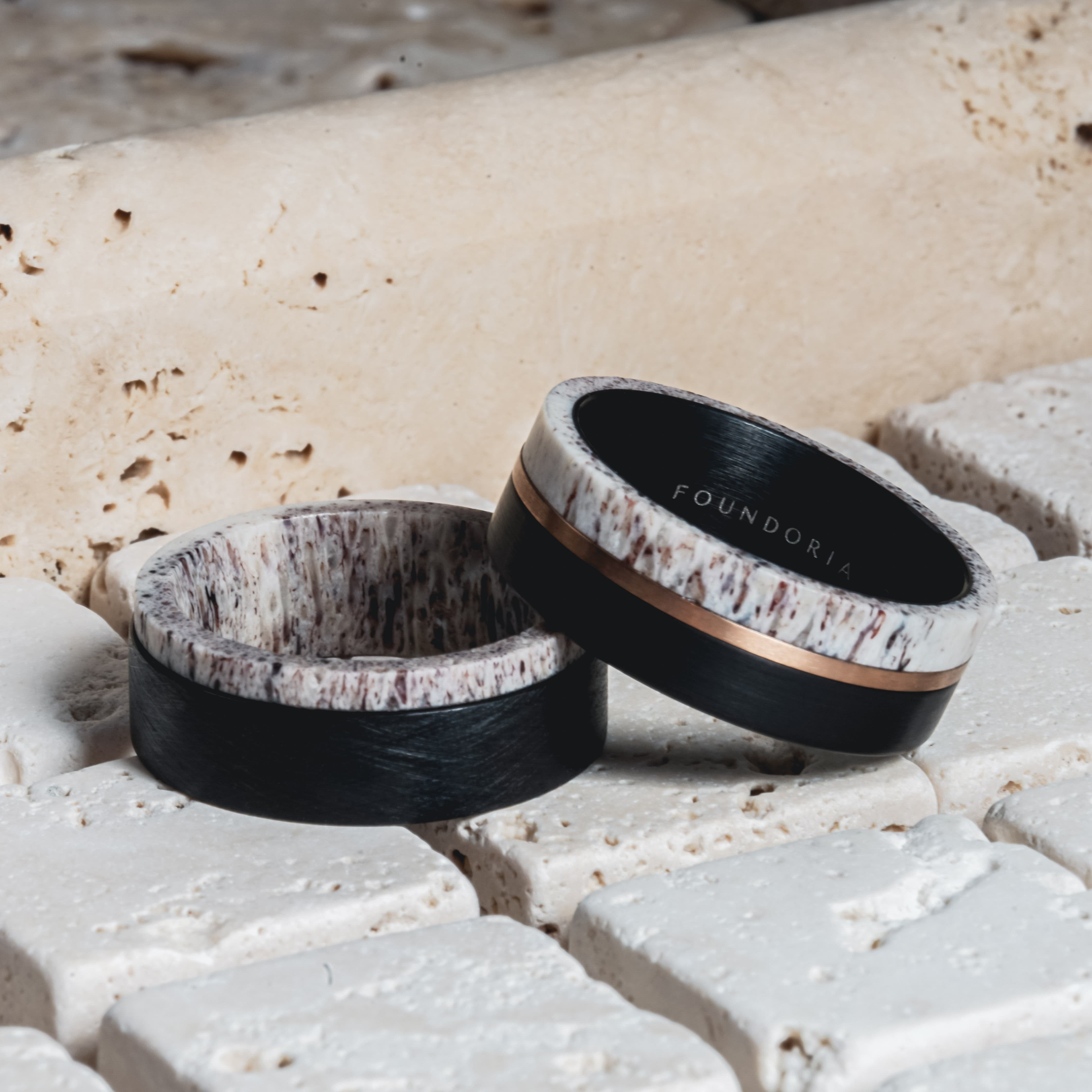
Naturally shed Scottish deer antler and reclaimed whisky barrel oak, set into tungsten or titanium. These are the rings with a story in them, and they're the ones people stop you about.
Be honest with yourself about the job, though. Organic materials are porous. They're sealed, and they hold up well to ordinary life, but repeated soaking, harsh solvents and constant alcohol gel are not ordinary life. If your hands are wet or chemically scrubbed all day, this isn't the material, and we'd rather say so now.
Silicone
The only material on this list designed to fail. A silicone band tears off the finger under load instead of taking the finger with it, and it doesn't conduct electricity. For a lot of trades that combination isn't a nice-to-have, it's the whole requirement.
It's why every Foundoria ring ships with a free ENDURA silicone band in your size, and why we wrote why every ring needs a second band.
Side by Side
| Surface hardness | Under impact | Weight | Conducts | |
|---|---|---|---|---|
| Tungsten carbide | 8.5 to 9.5 Mohs | Can crack | Heavy | Yes |
| Black zirconium | Above 8 Mohs | Metal core, resists cracking | Moderate | Yes |
| Tantalum | Around 6.5 Mohs | Dents, won't crack | Dense | Yes |
| Titanium | 6.0 Mohs | Very tough | Very light | Yes |
| Carbon fibre | Lower | Can chip | Lightest | Yes |
| Silicone | Not applicable | Tears away by design | Negligible | No |
| 9ct gold | 3.0 to 3.5 Mohs | Bends and flattens | Heavy | Yes |
| Platinum | 4.0 to 4.5 Mohs | Deforms, holds material | Very heavy | Yes |
If you want the two most common finalists compared properly, our tungsten against titanium piece goes deeper, and the UK buyer's guide to alternative ring materials lays out the whole range.
Healthcare: Can You Wear a Ring at All?
This is the question we get asked most often and the one most guides skip, so here's the detail.
What the policy actually says
UK clinical settings work to a "bare below the elbows" standard, and the reason is evidential rather than fussy. Hand and wrist jewellery harbours microorganisms and gets in the way of proper hand decontamination, so watches, bracelets and rings come off.
With one exception, and it's the one that matters here. NHS bare below the elbows guidance consistently permits a single plain band. Trust wording varies, but the pattern is the same throughout: no wrist jewellery, no stones, no settings, one plain wedding ring permitted. Some trusts word it as "no rings with stones, one plain band is permitted", which tells you precisely what the concern is.
So the answer is yes, usually, provided the ring is the right kind of ring. Check your own trust or practice policy, because they do differ, and theatre and some procedural areas are stricter than the wards.
What makes a ring clinically sensible
The hygiene issue isn't the metal, it's the geometry. Bacteria collect where hand gel and water can't reach, which means claws, settings, engraved detail, textured finishes and the gap under a stone. A plain band with a smooth continuous surface has nowhere for anything to sit.
- No stones, no settings, no raised detail. This is the part policies actually specify.
- Non-porous material. Tungsten, titanium, zirconium and tantalum are all non-porous and completely unbothered by the twenty-plus alcohol gels a shift. Antler and wood are not, so leave those for your days off.
- A polished or lightly brushed finish rather than a deep hammer or a coarse texture. Smooth is easier to clean and easier to justify if someone asks.
- Comfort fit. The domed interior means less flat surface trapped against the skin, which is where moisture and soap residue sit. All our rings are comfort fit as standard.
- A width you'll actually keep on. Narrower bands sit closer and dry faster.
The honest version
Plenty of clinical staff take the ring off for the shift and wear it the rest of the time, and there's nothing wrong with that. Skin under any ring stays damp and carries a higher bacterial load than the skin around it, which is exactly why the policy exists.
If you'd rather not have the conversation with an infection control lead at all, wear a silicone band on shift and your real ring the moment you're out. That's the arrangement most of our NHS customers land on, and it's the one we'd suggest.
Plain bands that pass a bare below the elbows check
Smooth, non-porous, nothing set into the face, and a polished contrast sleeve inside so there's still something to it.


The Rest of the Working World
Silicone on shift, no exceptions
Every metal on this list conducts, titanium and tungsten included, and so does carbon fibre, whatever you may read elsewhere. There is no clever material that solves this except one: silicone. Wear a silicone band at work and keep the ring for everything else.
The catching risk outranks everything
Around rotating machinery, ladders and lifted loads, the danger isn't damage to the ring. A band caught on something that moves will not give way, and the finger does instead. Silicone is the answer for the hours that matter.
Off site, this is tungsten's natural home: grit, tools and metal edges are exactly what it ignores. Look at the TUNGRA collection for plain precision tungsten.
Plain, smooth and non-porous, same logic as clinical
Food hygiene rules mirror healthcare closely, and a plain band is the usual permitted exception. Heat isn't an issue for any of these metals, but knives, steel counters and constant washing are, so a polished tungsten or titanium band with nothing set into the face is the sensible choice. Antler and wood are not.
The bar is harder than most metals
A knurled barbell chews through gold and silver, and it will mark titanium. Tungsten holds up best, but the honest answer is that a silicone band under the bar saves you thinking about it. It's also the one scenario where a ring pinched between a bar and a rack is genuinely worth avoiding.
Choose on how it looks and feels, not how tough it is
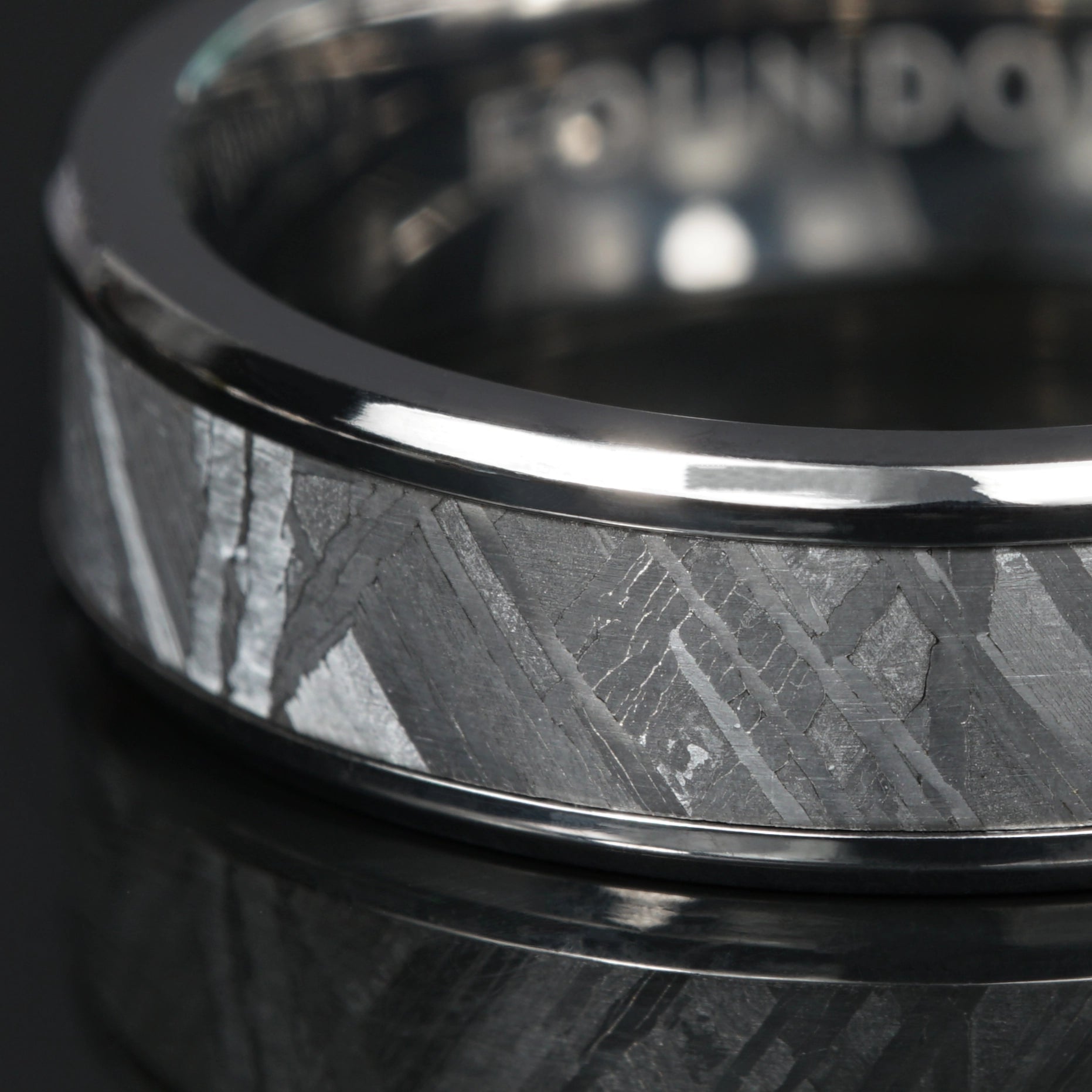
If your hands don't meet much worse than a keyboard and a car door, nothing here will let you down, so the durability question is more or less settled before you start. Pick on weight, width and what you want to look at. This is where the interesting materials earn their place: meteorite, antler, wood and stone inlays.
Cold, wet, and the ability to take a knock
Titanium's toughness is the right property here: it won't crack when a ring meets rock or a vehicle door, and its lightness matters on a long day. None of these metals corrode in salt water. If you're in and out of gloves and kit all day, keep a silicone band in the bag.
Narrow and light, or nothing at all
A wide heavy band changes how a hand moves. Guitarists in particular tend to end up at 4mm or narrower, in titanium or carbon fibre, or wearing the ring on the other hand. Nobody's ring should change how they play.
Four that suit hands with a job to do


Two Things Worth Knowing Before You Buy
None of these can be resized
Tungsten, titanium and zirconium can't be resized after manufacture. That's a property of the metals rather than a shortcoming of any workshop, and it makes getting the size right the single most important decision you'll make. If a ring doesn't fit, we exchange it rather than alter it.
Our complete ring sizing guide covers six methods and we'll send you a free ring sizer. Best of all is a jeweller: take the width, the material and the fit with you, ours are all comfort fit, and ask for the inner diameter in millimetres rather than just a letter. Inner diameter is the one measurement that converts cleanly between every sizing system.
Emergency removal is a solved problem
It's the question behind a lot of hesitation about these metals, so here's the plain answer. Titanium, zirconium and tantalum are metals and a standard A&E ring cutter with a diamond blade goes through them. Tungsten is cut differently: because it's brittle, it's cracked off with locking pliers in a few seconds, which is faster than cutting gold. Every emergency department is equipped for both. Our full explainer on whether a tungsten ring can be cut off goes into it properly.
Frequently Asked Questions
Can nurses and doctors wear a wedding ring?
Generally yes. NHS bare below the elbows guidance permits one plain band while ruling out watches, bracelets and rings with stones or settings. Policies vary between trusts and theatre is usually stricter, so check yours. The ring itself should be a plain, smooth, non-porous band with nothing set into the face.
Is a ring hygienic to wear at work?
The material matters less than the shape. Skin under any ring stays damp and carries more bacteria than the skin around it, and stones, claws and textured finishes create places that hand gel can't reach. A plain non-porous band is the version that's defensible. If your work is clinical or food-facing and you'd rather not think about it, wear silicone on shift.
Which ring material is best for manual work?
For the ring, tungsten carbide. For your hand, silicone. Those aren't the same answer, and if your work involves machinery, ladders or electricity then the second one is the one that counts during working hours.
Can I wear a titanium or tungsten ring for an MRI?
Don't plan around it. Neither is ferromagnetic in the way steel is, but imaging departments ask you to remove all jewellery as a matter of course and they aren't going to make an exception. Take it off.
Will a tungsten ring shatter if I drop it?
It can crack on a hard floor, and that's the honest trade for its scratch resistance. It's uncommon in normal use, and it's also the reason tungsten is quick to remove in an emergency. If you regularly work at height above concrete, titanium is the tougher choice.
Are these materials safe for sensitive skin?
Titanium, zirconium, tantalum and carbon fibre are all excellent choices, and samples across our range are tested by SGS against REACH standards. Our guide to hypoallergenic rings for sensitive skin has the detail, and the rings for sensitive skin collection groups the suitable designs.
Can I get a ring built around my job?
Yes. Our Ring Studio lets you set the material, width, profile and finish yourself and see the ring render in 3D as you build it. If you want something narrow, plain and in a specific metal because of your work, that's the quickest way to get exactly it.